
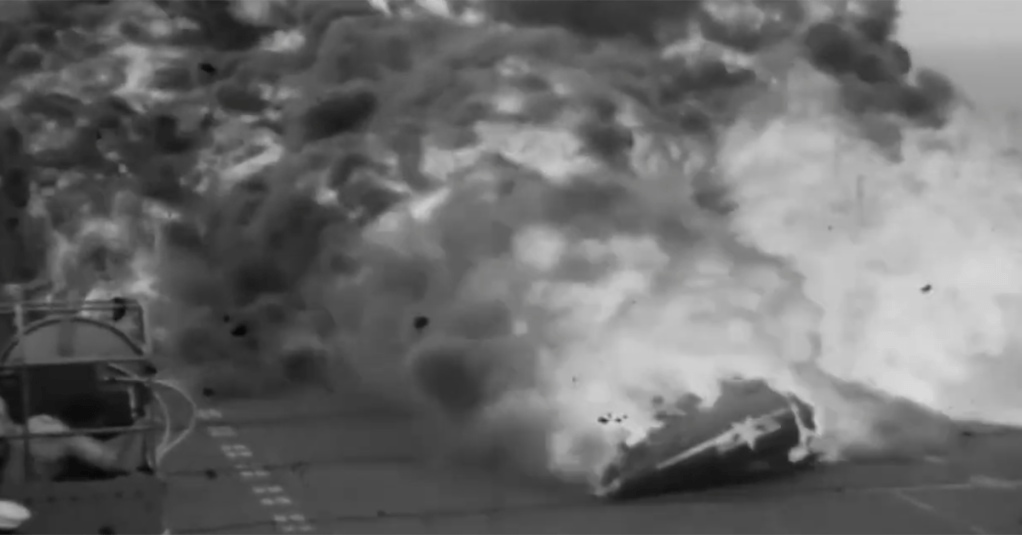
The enormous fireball covered almost the entire width of one end of the USS Midway after an airplane crashed into the aircraft carrier’s deck. One look at the flames, and it defies logic that someone could survive an accident of that magnitude.
But someone did. On June 23, 1951, USS Midway crew members got Navy Cmdr. George Duncan out of the damaged cockpit of his F9F-5 Panther fighter jet. They brought him directly to medical personnel, who treated Duncan’s injuries. They assessed him with two scorched ears and other burns, but he miraculously did not sustain any broken bones or a concussion.
Also Read: What happened on the final flight of the namesake for Edwards Air Force Base
Duncan returned to the air in six months, a remarkable accomplishment considering what happened to him. A highly decorated U.S. Navy aviator during World War II, Duncan survived combat. Now he made it through an accident that was captured on video for training purposes. As a result, millions of viewers—most probably not even alive when it occurred—have watched the terrifying incident on social media.
Duncan became a central figure in “the most replayed carrier crash in history.”
An Acclaimed World War II Aviator

Crashed but Survived – George Chamberlain Duncan on the USS Midway – #history #avaition #usnavy
A native of Washington state, Duncan was born in 1917 and received an appointment to the U.S. Naval Academy after graduating high school. He graduated with the Class of 1939 and started flight training in Pensacola, Florida, in 1941.
He earned his wings the following year and eventually was appointed executive officer of Fighter Squadron 15 aboard the USS Essex in the Pacific. It was there that Duncan is credited with taking out 13½ Japanese planes during the war.
Duncan repeatedly proved the most pressure-packed situations did not rattle him, first as an aviator during wartime and then as a test pilot after hostilities ceased. It was in that latter role that Duncan found himself during one of the most memorable days of his life.
At that time, Duncan was based out of the Naval Air Test Center in Maryland, according to TWZ—a defense website previously known as The War Zone. The USS Midway was stationed off the Virginia Capes in the Atlantic Ocean. Duncan was putting the F9F-5 Panther through training runs, and he completed his first attempt without incident.
On the second one, however, a downdraft destabilized the military aircraft as it approached the USS Midway’s deck. Duncan had very little time to react.
Issues in the Air
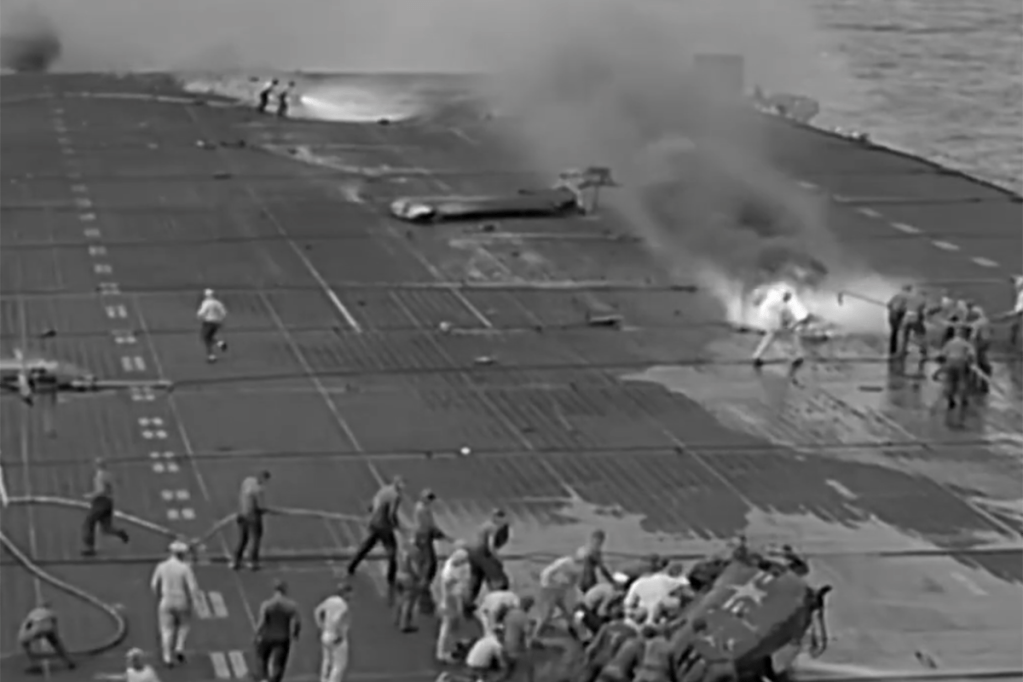
Video of the horrific impact between Duncan’s jet and the USS Midway’s deck isn’t hard to find on YouTube. In one posted on After Action Report’s channel of military history videos, the narrator explained that a sudden change in wind wasn’t the only issue that Duncan encountered in-flight.
He also determined that he was carrying too much fuel, making the degree of difficulty potentially higher while landing. Duncan acted accordingly, dumping some of his excess fuel to lighten his load. He then expended some more while remaining airborne while another plane made six landings successfully, per the account from After Action Report.
Once Duncan was ready to approach the USS Midway, the downdraft occurred. When Duncan tried to move the Panther back into proper position, his actions caused the nose of his plane to rise. The crash created huge columns of smoke and flames. It also split the aircraft in half, with the portion containing Duncan—still inside the cockpit—spinning haphazardly down the deck. The extreme forces tore off the canopy and Duncan’s helmet, exposing his head to a potentially severe injury.
Duncan remarkedly remained in his seat, clinging to it with all his strength, After Action Report detailed. After Duncan’s portion of the Panther finally stopped spinning, the USS Midway’s deck crew sprang into action. Perhaps surprised he was still alive, they got the injured and stunned aviator the help he required.
Other Aerial Accidents Involving the Midway
As any military historian can attest, accidents involving the USS Midway were not uncommon before the Navy decommissioned the carrier in 1992.
The USS Midway, whose years of service included the Cold War, Vietnam War, and Persian Gulf War, was also the site of an accident in late October 1972. That was when an attack aircraft collided with parked planes during a crash landing in the Gulf of Tonkin. Five crewmen died, and 23 other military personnel were injured.
Then in the 1980s, three other fatal incidents happened on the USS Midway. Two sailors died on July 29, 1980, after a Panamanian freighter turned into the carrier’s path and prompted a collision. Four years later, a pilot died after crashing into the USS Midway’s ramp while attempting to land.
Finally, a training flight went tragically wrong on August 17, 1985, when the plane did not line up with the arresting wires on deck. Unable to slow down, the aircraft roared off the USS Midway and crashed into the Arabian Sea. Two crew members died in the accident while rescuers plucked three others from the water alive.
After the Accident
As for Duncan, he went on to continue a distinguished service career, including captaining an aircraft carrier, the USS Ranger, before retiring in 1968. For his many accolades and achievements, nothing got people talking quite like his accident involving the USS Midway.
Over the years, footage of Duncan’s crash was included in multiple movies, including “The Hunt for Red October” in 1990. That’s understandable because the video almost has a cinematic quality to it. It wasn’t make-believe, however. It was very real and something Duncan never wanted to live through again.
Duncan became a lawyer after his military career and lived a full life, dying in 1995 at the age of 78.
Don’t Miss the Best of We Are The Mighty
• How Paul Newman survived 2 close calls in the Navy during World War II
• A critically injured Navy SEAL explains why wounded warriors don’t want your pity
• What went wrong when the Navy first attempted to fly nonstop to Hawaii

Loading comments…
Comments couldn’t be loaded. Please refresh the page.