
When the Japanese navy showed its overwhelming force during the Russo-Japanese War in the early 20th century, U.S. President Theodore Roosevelt took notice.
Well before he became assistant secretary of the Navy or America’s 26th president, Roosevelt advocated for a stronger sea component to the military. When he ascended to the White House in 1901 after the assassination of William McKinley, Roosevelt started to develop a Navy that, for so long, others in power largely ignored.
Also Read: How a trip underwater propelled Teddy Roosevelt to improve submariners’ pay
At Roosevelt’s urging, Congress increased funding significantly to construct more battleships and large cruisers. He not only allocated more financial resources toward a more formidable Navy; the service’s manpower also grew robustly during Roosevelt’s 7½ years in office.
Warships fascinated Roosevelt as he grew up in New York City. Now, he found himself in a position to make his vision for the Navy a reality. Once Roosevelt did, he wanted to show the world—Japan, most of all—the capability of America’s enhanced Navy.
Roosevelt saw Japan as a potential threat to the U.S.
“I am exceedingly anxious to impress upon the Japanese that I have nothing but the friendliest possible intentions toward them, but I am none the less anxious that they should realize that I am not afraid of them and that the United States will no more submit to bullying than it will bully,” the president wrote during that period.
What Was the Great White Fleet?
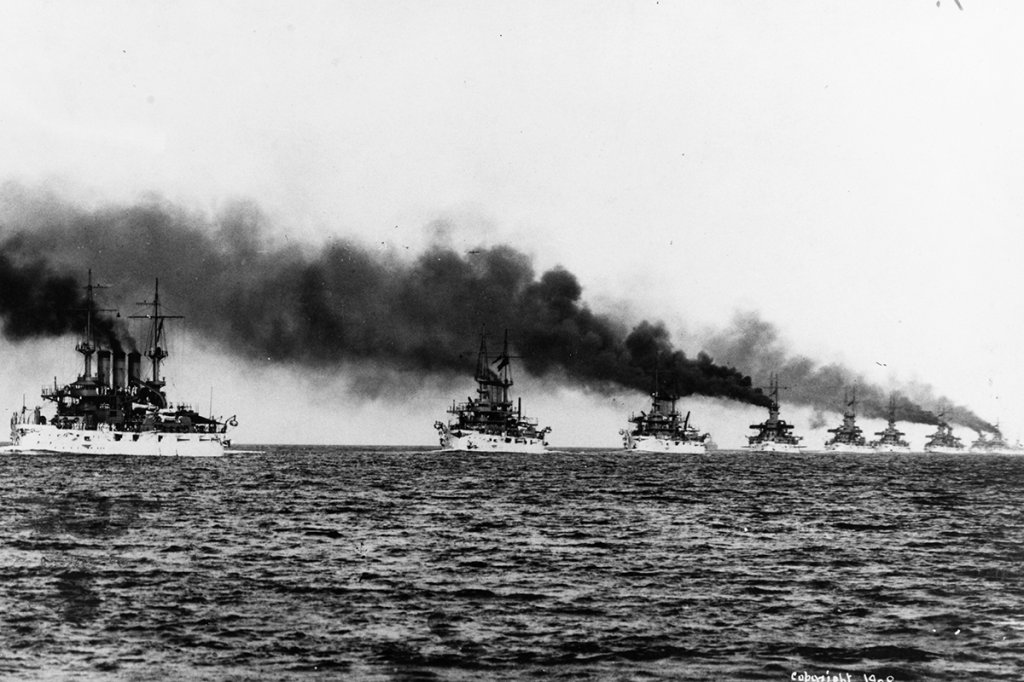
On December 16, 1907, Roosevelt watched from the presidential yacht Mayflower as 16 battleships left Hampton Roads, Virginia.
“Did you ever see such a fleet?” Roosevelt beamed. “Isn’t it magnificent? Oughtn’t we all feel proud?”
Roosevelt certainly was.
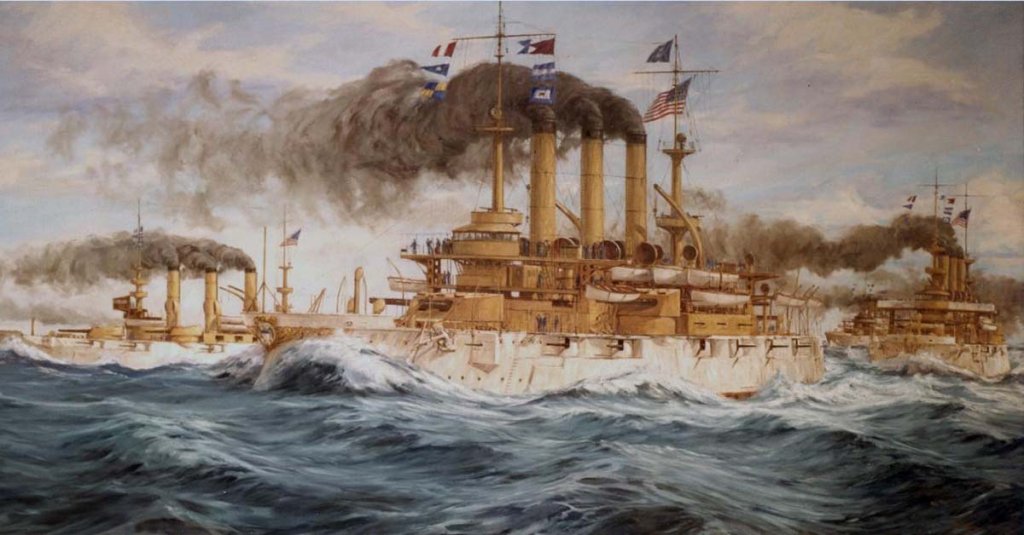
That flotilla, which became known as the Great White Fleet because of its ships’ bright white paint scheme, headed off on an unprecedented journey. When the Great White Fleet returned to Hampton Roads on February 22, 1909, it marked the successful completion of an around-the-world voyage. The battleships, most of them named after U.S. states, covered approximately 43,000 miles and stopped in 20 ports. They traveled to six continents, all except Antarctica.
The fleet consisted of two squadrons, which had two divisions of four battleships each. Six torpedo boat destroyers and six fleet auxiliaries tagged along during various points of the journey, according to the U.S. Naval History and Heritage Command. Roughly 14,000 sailors and Marines manned the impressive vessels.
With the Panama Canal under construction, the trip’s first leg took the Great White Fleet through the Straits of Magellan on its way to San Francisco. That segment saw the battleships stop in Trinidad, Brazil, Chile, Peru, and Mexico before arriving in California in early May 1908.
A Change in Commanders
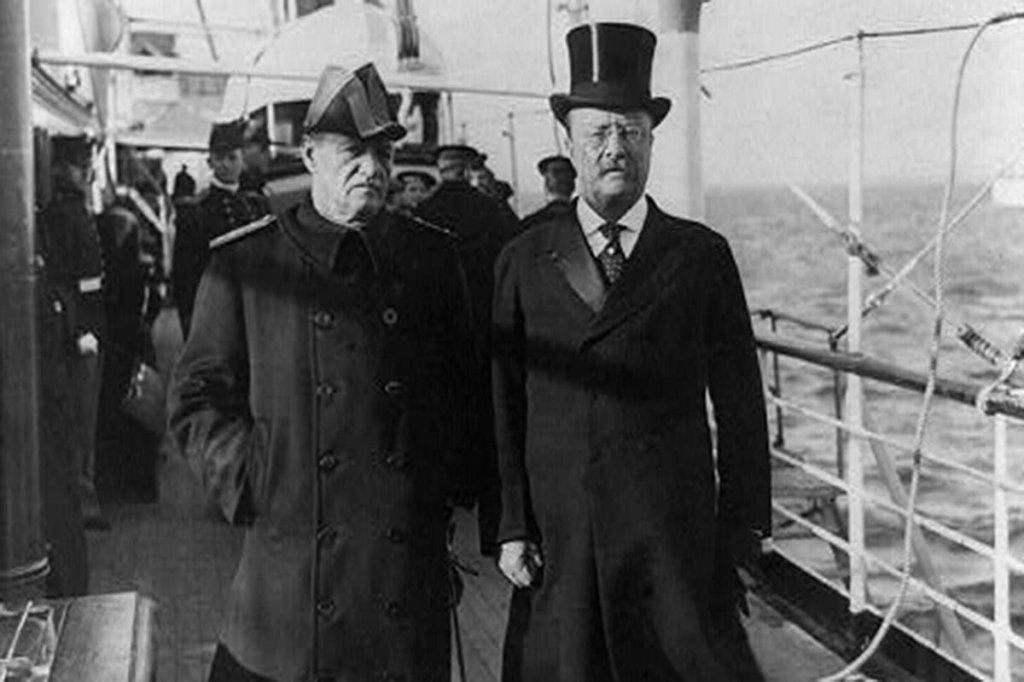
Rear Adm. Robley “Fighting Bob” Evans, the commander of the USS Maine, started as the leader of the flotilla. Once the Great White Fleet reached San Francisco, Evans couldn’t continue because of poor health. That couldn’t have pleased Evans, who was nearing the end of a 48-year naval career.
Evans’ service dated to the Civil War. During the Battle of Fort Fisher in North Carolina in 1865, Evans sustained such severe wounds to his legs that doctors considered amputating them. That is, until Evans—with a revolver in his hands—persuaded them otherwise.
“I told [the surgeon] that there were six loads in it, and that if he or anyone else entered my room with anything that looked like a case of instruments, I meant to begin shooting, and that he might rest perfectly sure that I would kill six before they cut my legs off,” Evans threatened.
Evans did not lose his legs and eventually returned to the Navy. More than four decades later, his time with the Great White Fleet, however, was over. Another longtime Navy man, Rear Adm. Charles S. Sperry, replaced Evans.
During their stop in California, the USS Maine and USS Alabama dropped out. The USS Nebraska and USS Wisconsin replaced them. Once those changes occurred, Sperry shifted to commanding the entire fleet as it pushed off across the Pacific Ocean.
Helping Out During a Natural Disaster
After two months in San Francisco, the Great White Fleet started its longest leg of the trip: 16,336 miles. The battleships were on their way to stops in Hawaii, New Zealand, Australia, the Philippines, Japan, and China, according to a Library of Congress timeline. The Japanese must have taken particular interest in how transformed and more powerful America’s Navy was.
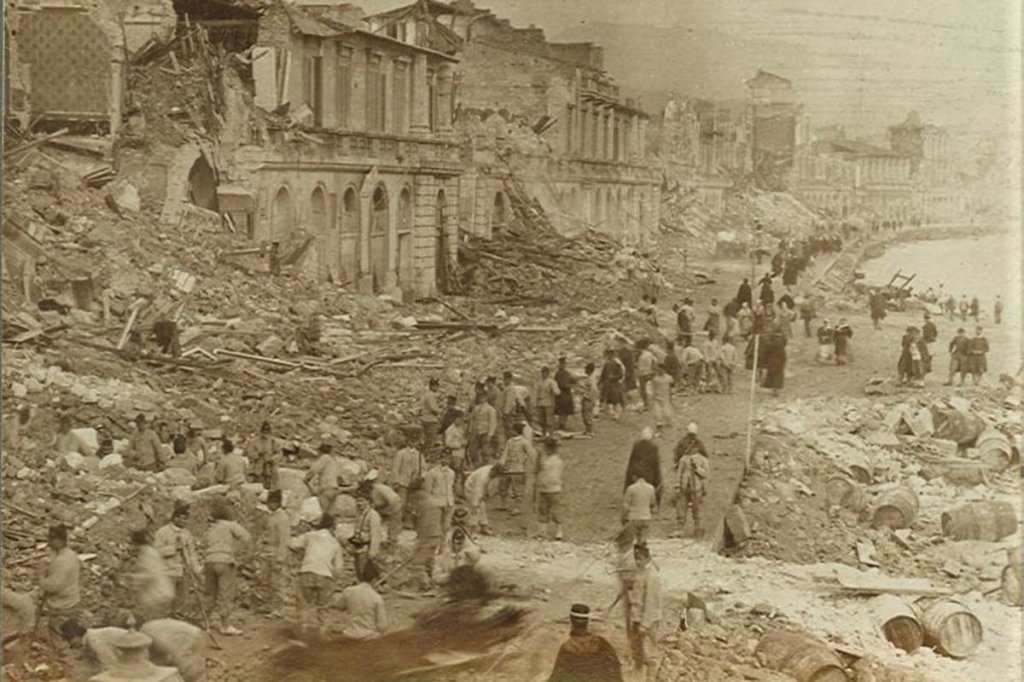
The third and final leg of the Great White Fleet’s journey began when it left the Philippines on December 1, 1908. The ships were on the way to Egypt when an extremely powerful earthquake struck southern Italy on December 28. The largest quake ever to strike Europe triggered a horrendous tsunami that battered the country’s coasts. About 200,000 people died as a result.
The USS Connecticut, USS Illinois, USS Culgoa, and USS Yankton were sent to the scene and offered assistance. Two other ships then replaced the USS Connecticut and USS Illinois so they could rejoin the Great White Fleet.
In addition to the devastating quake, the voyage from Gibraltar back to Hampton Roads proved very challenging because of heavy winds, according to journalist Franklin Matthews. The battleships Maine, Idaho, Mississippi, and New Hampshire—along with two armored cruises and three scout vessels—accompanied the fleet as it approached home. As they prepared to pass from the Atlantic Ocean to Chesapeake Bay, Roosevelt was there on the Mayflower to greet them.
“They’ll Have to Follow You”
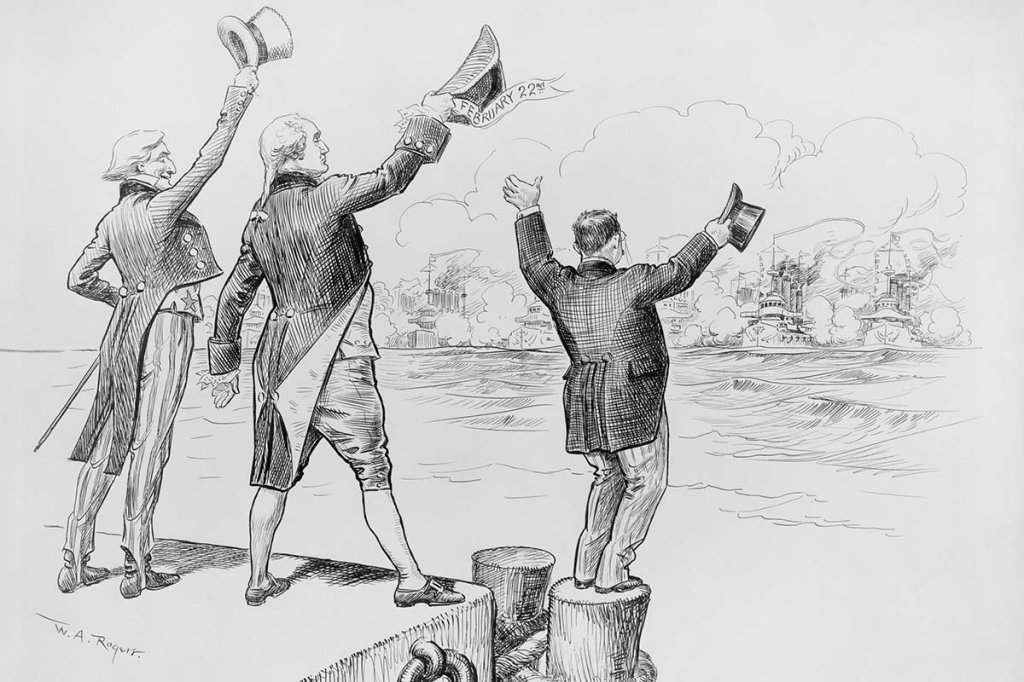
The fleet returned to Hampton Roads and dropped anchor shortly after noon on February 22, 1909. A large crowd awaited them. The president went aboard the fleet’s four flagships and gave a short speech to the officers and crew.
“You’ve done the trick,” an elated Roosevelt told them. “Other nations may do as you have done, but they’ll have to follow you.”
The Great White Fleet was a diplomatic, as well as a public relations, success. It promoted peace and resulted in improved relations with several nations in which the flotilla stopped, including Japan.
Roosevelt saw firsthand that the Navy wasn’t as formidable as possible during the Spanish-American War. He sought to change that, and the Great White Fleet placed the expectations of the sea service on another level.
“It was the most powerful fleet ever assembled under the American flag,” Matthews wrote.
Don’t Miss the Best of We Are The Mighty
• Teddy Roosevelt is the reason for military PT tests
• What went wrong when the Navy first attempted to fly nonstop to Hawaii
• Meet the 12-year-old sailor who fought at Guadalcanal
Featured
Loading comments…
Comments couldn’t be loaded. Please refresh the page.