
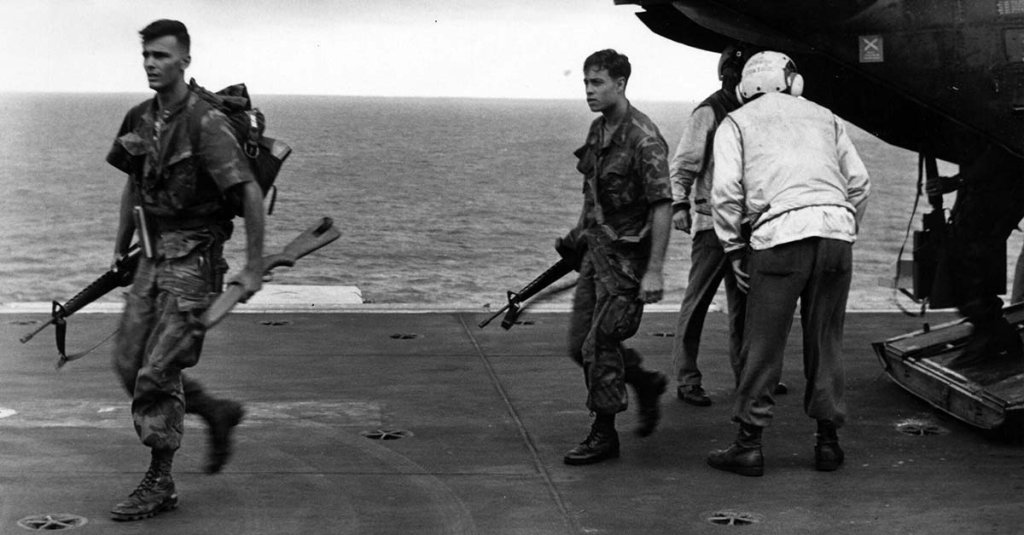
As the last Marines awaited rescue from Vietnam on April 30, 1975, they gathered on the rooftop of the U.S. Embassy in Saigon. Tired and nervous, they engaged in idle chatter. A primary topic of conversation was whether anyone was coming to get them before the city fell to the North Vietnamese.
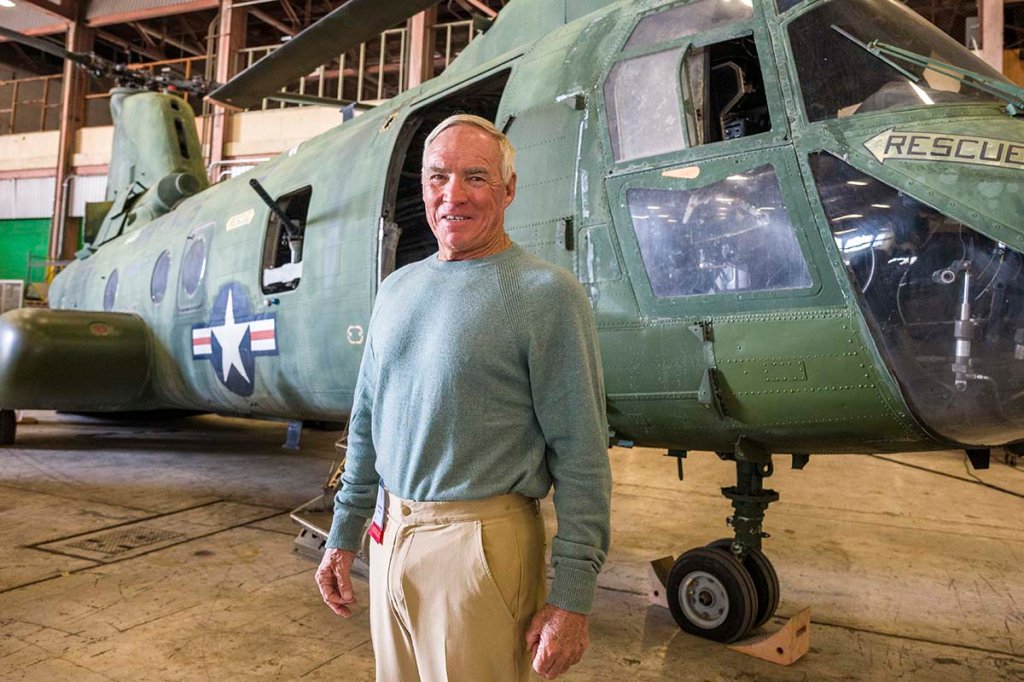
Maj. Jim Kean, their commanding officer, had his doubts until two of his Marines spotted a contrail in the sky, journalists Bob Drury and Tom Clavin chronicled in the 2011 Smithsonian magazine article, “Last Men Out.” A CH-46 Sea Knight helicopter soon appeared, along with four Marine AH-Cobra gunships to protect it.
Also Read: 6 songs that will always remind America of the Vietnam War
Once the Sea Knight landed, Kean approached the pilot, Capt. Tom Holben, with gratefulness in his voice.
“Waiting for you,” Kean shouted. “Didn’t think you were coming.”
What Was Operation Frequent Wind?
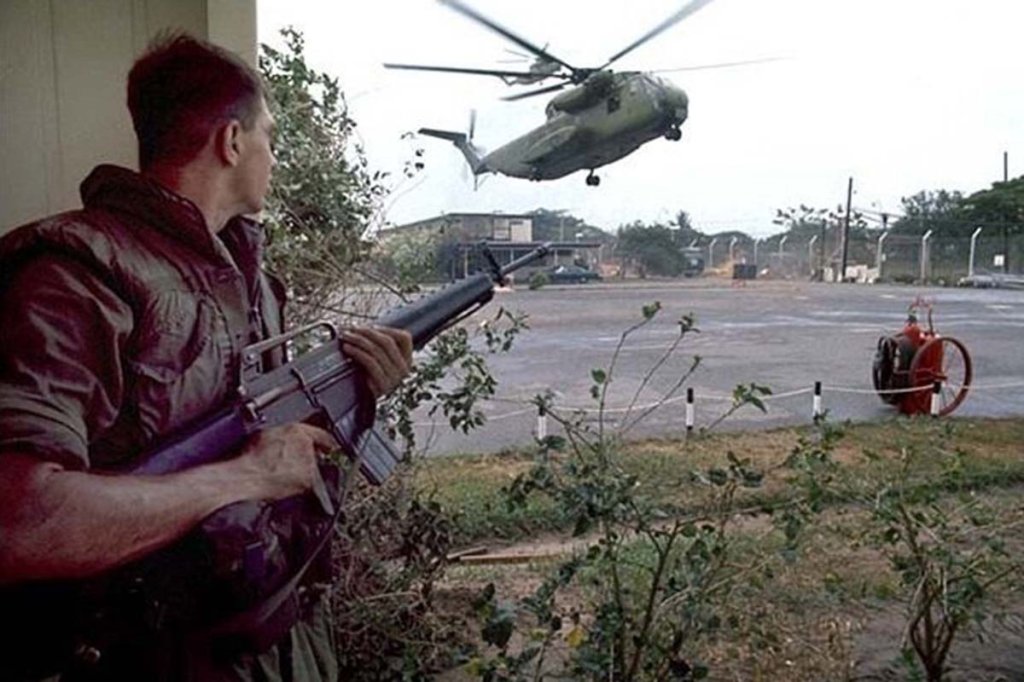
For a war that so deeply divided Americans, the pullout of the U.S. military from Vietnam was perhaps fittingly chaotic. The withdrawals involved evacuating personnel from the U.S. Embassy and the U.S. Defense Attaché’s Office at the Saigon airport.
Called Operation Frequent Wind, the mission involved considerably more evacuees than originally thought. Kean said at least a thousand South Vietnamese milled about inside the embassy alone, waiting to be picked up, Drury and Clavin detailed. That was in addition to Ambassador Graham Martin, his staff, and 46 Marines. Oh, as Kean explained, thousands more were outside the compound.
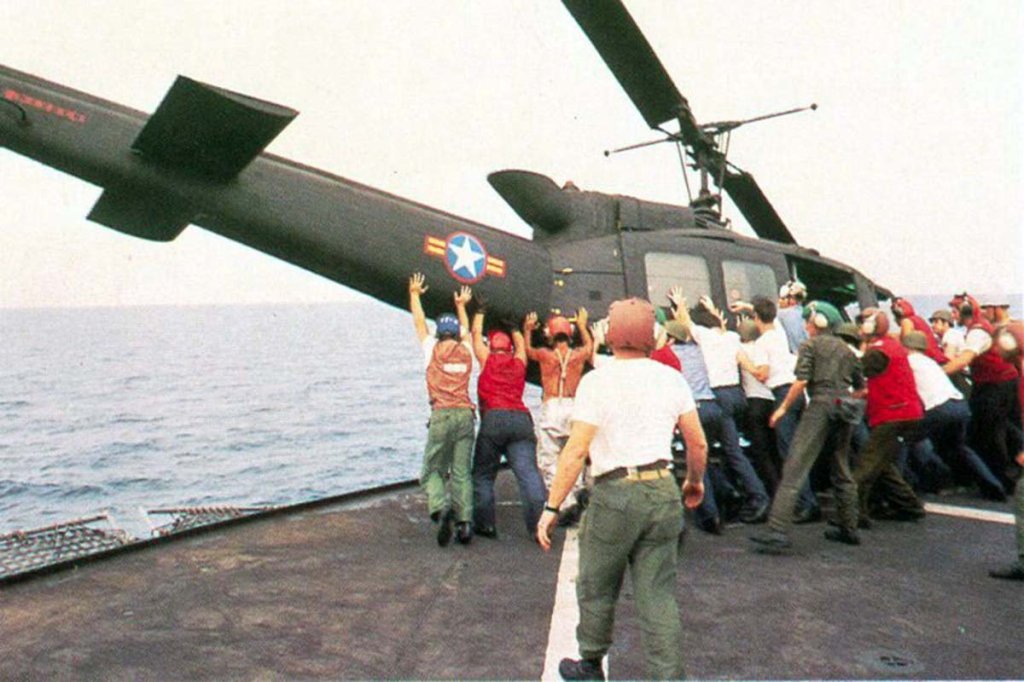
The two airlifts that Marine Brig. Gen. Richard Carey originally planned for the embassy were not nearly sufficient. He immediately ordered more helicopters. The Marine Corps, Air Force, and Navy contributed aircraft to Frequent Wind. So did Air America, a civilian airline that the CIA ran.
They started at the U.S. Defense Attaché’s Office at Tan Son Nhut Air Base, then headed toward the embassy. There, the plan called for Sea Knights to pick up evacuees on the roof while CH-53 Sea Stallions did the same in the parking lot.
At about 6 p.m. on April 29—seven hours after Operation Frequent Wind launched—Kean heard the sound of helicopters overhead. Four helicopters descended, one after the other, each taking on 25 or so refugees, according to the Smithsonian magazine article. After a pilot asked Kean how many more evacuees remained, the major said, “At least a thousand.”
That wasn’t the answer the pilot expected.
An Urgent Message from President Ford
It was also getting near sundown, and the pilot was unsure whether those in charge would allow them to fly in the dark, Drury and Clavin noted. Kean shortly learned that the Task Force 76 commander, Adm. David Whitmire, halted all night parking-lot evacuations at the embassy because of the risk.
Kean didn’t find that answer satisfactory. He ordered the Marine guard to relocate every available vehicle to the parking lot and turn on their headlights. That worked for a while until shortly after midnight, when the beams started to weaken.
Around that time, Carey—commanding operations from the USS Blue Ridge—stepped in and overruled Whitmire. Realizing the lives of service members and others were at risk if they waited for sunrise, Carey ordered helicopters back into operation.
Shortly after 2 a.m., Kean and Master Sgt. Juan Valdez noticed Sea Knights hovering over the embassy. After one landed, a pilot informed Kean that 19 more helicopters were to follow.
“That’s it,” Kean was told, according to Smithsonian magazine.
That pilot did not know that, by Kean’s estimates, at least 850 evacuees and 200 Marines still awaited rescue at the embassy.
There was still so much to be done, and then the focus of Operation Frequent Wind shifted. In an early morning message to Carey, President Gerald Ford demanded that they evacuate the ambassador immediately. Ford also did not want any more Vietnamese citizens evacuated.
“The Tiger Is Out of His Cage”
A CH-46 helicopter lifted Martin, the ambassador, out of the embassy at roughly 5 a.m. on April 30, 1975. Capt. Gerry Berry flew that Marine aircraft. When Kean sought confirmation, he got in touch with Carey. Kean learned the president ordered the removal of Martin.
Kean didn’t hold back his frustration.
“General, my Marines are on the wall, and then there’s the front door of the embassy,” Kean told Carey, according to Smithsonian magazine. “Between my Marines and that front door are some 400 refugees still awaiting evacuation. I want you to understand clearly that when I pull my Marines back to the embassy, those people will be left behind.”
Replied Carey: “And I want you, Major, to understand that the president of the United States directs…”
Kean ordered his Marines to go inside the embassy. In three groups of about 15 Marines each, they backed into the lobby and bolted the double doors behind them, leaving roughly 400 Vietnamese outside, Drury and Clavin reported. The service members made their way to the roof.
Meanwhile, Carey read a coded message from Berry that read, “The tiger is out of his cage.” Berry meant the ambassador, not all Americans, but Carey realized the confusion resulted in an order to ground helicopters.
Carey contacted Lt. Gen. Lou Wilson in Honolulu, Drury and Clavin wrote.
“General, I want you to inform the entire chain of command there of one important fact,” Wilson said, none too pleased. “I will personally court-martial anyone, regardless of service or rank, who halts any flights while Marines remain unaccounted for. Are you clear on that?”
The Last Flight Out
The Marines on the embassy roof didn’t have much time. Only a barricaded steel door separated a mob of South Vietnamese citizens from joining the Marines and greatly endangering their evacuation plans.
Two helicopters—which Berry and his wingman, Capt. Klaus Schagat, piloted—arrived to remove some Marines. Before Berry departed, Kean made sure to tell him, “Make sure you get back for us. Don’t leave us here.”
Berry’s wasn’t the last helicopter to arrive at the U.S. Embassy during Operation Frequent Wind. Holben flew that aircraft, ending a mission that—despite its myriad miscommunications and high number of moving parts—proved successful.
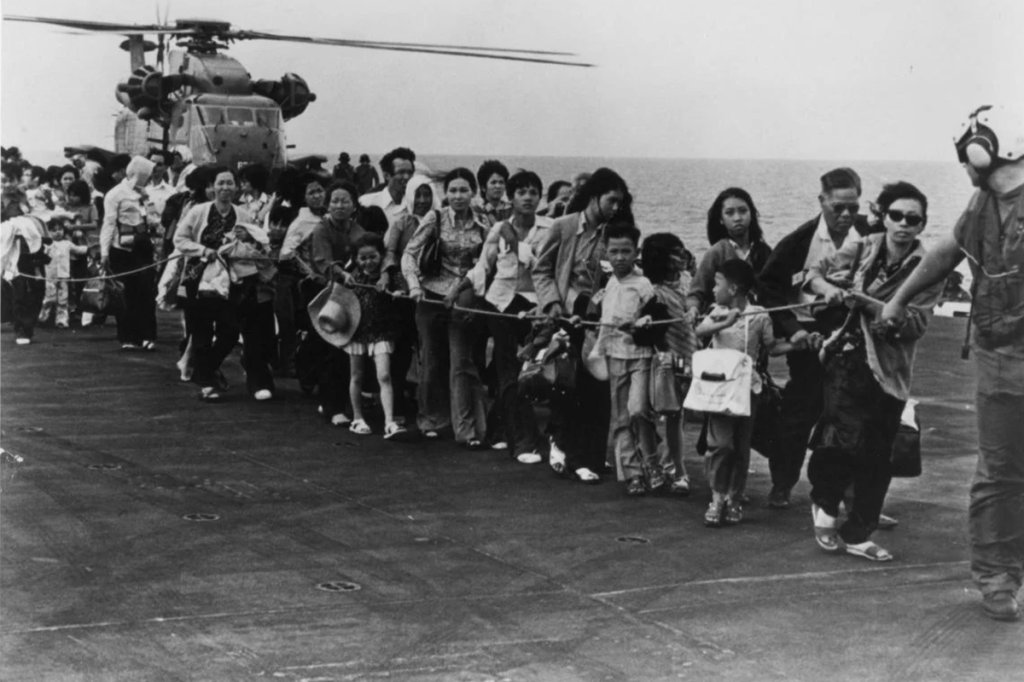
Some pilots flew for more than 18 hours continuously to evacuate as many service members and refugees as possible. Operation Frequent Wind resulted in the evacuation of more than 7,000 Americans and South Vietnamese and third-country nationals. Valdez was the last Marine on board that last flight at 7:53 a.m. on April 30.
“The ramp, you could see behind me, it was starting to go up, and that helicopter wanted to get the hell out of there,” Valdez, who died in March 2026, recalled in 2021.
Don’t Miss the Best of We Are The Mighty
• The tragedy and controversy surrounding Operation Babylift
• 8 of the most terrifying Vietnam War booby traps
• A Medal of Honor recipient explains what being an American means
Featured
Sponsored Content
‘The Fix’ is an action movie for the post-War on Terror world
Loading comments…
Comments couldn’t be loaded. Please refresh the page.