
A month after arriving on Okinawa, Robert Eugene Bush received sobering news.
His higher-ups informed the 1st Marine Division that it was expendable during the American military’s quest to seize control of the Japanese island. Those in the division, including Bush, knew a difficult and long battle loomed ahead. But with their pronouncement, they viewed their expected life expectancies differently.
“That really didn’t make for a happy camper, but it did bring to attention that we had a job to do,” Bush told the Congressional Medal of Honor Society for a “Living History” video interview.
Also Read: A World War II POW who defied Nazis to protect Jewish soldiers will receive the Medal of Honor
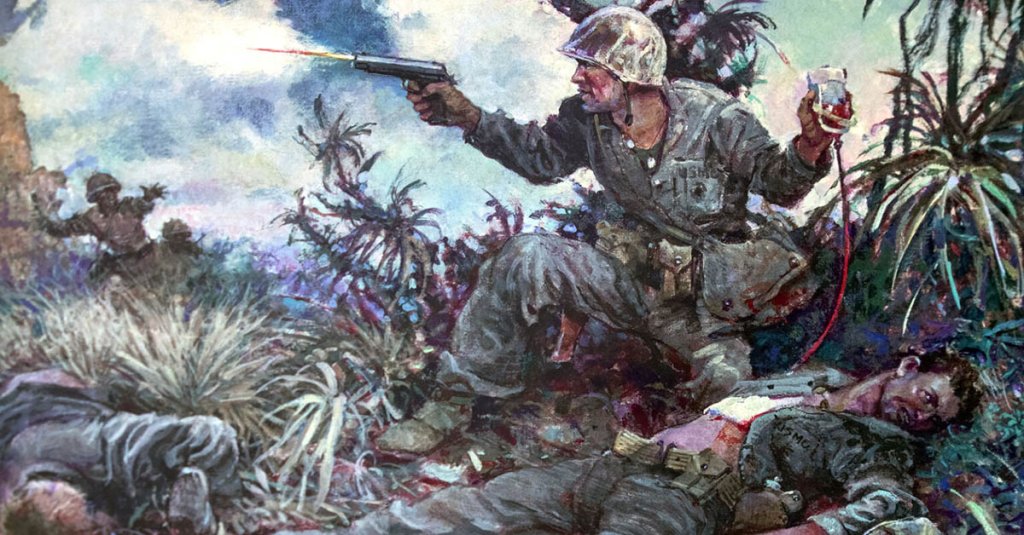
Bush, an 18-year-old hospital corpsman, performed his duties exceptionally well. As the Marines attempted to take Kunishi Ridge on Okinawa, the Japanese shot Bush’s platoon leader, Jim Roach, on May 2, 1945. Bush not only provided medical aid to Roach; he did it while simultaneously defending himself against a counterattack.
Because of his heroism, Bush became one of 24 American service members to receive the Medal of Honor for their actions at the Battle of Okinawa.
“Typhoon of Steel”
Bush grew up around hospitals in Washington state. His mother was a nurse, so her son understood the importance of proper medical care. After Bush dropped out of high school, he joined the U.S. Navy Reserve and pursued training as a hospital corpsman.
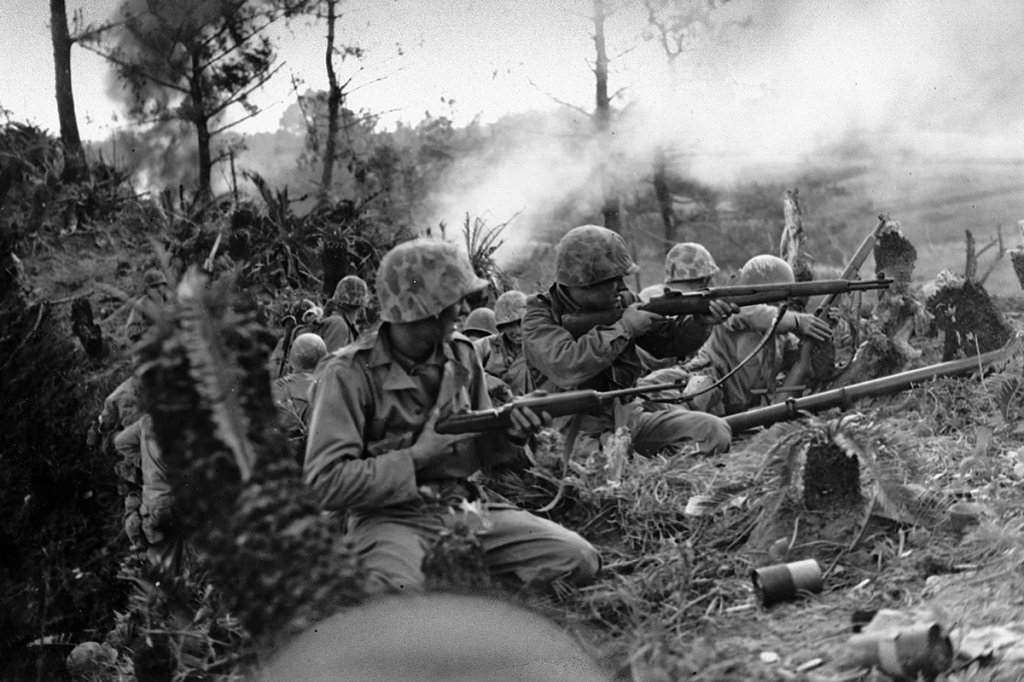
The 3rd Platoon, Company G, 2nd Battalion, 5th Marine Regiment, 1st Marine Division arrived on the first day of fighting on Okinawa. It was April 1, 1945, and the U.S. Tenth Army committed 60,000-plus troops to break the Japanese’s stronghold on the 465 square-mile island.
“The Japanese fought to win—it was a savage, brutal, inhumane, exhausting[,] and dirty business,” author E.B. Sledge wrote in his 1981 book, “With the Old Breed: At Peleliu and Okinawa.” “Our commanders knew that if we were to win and survive, we must be trained realistically for it[,] whether we like it or not.”
The American and Japanese forces waged war for a bloody 82 days until the U.S. finally achieved its objective on June 22, 1945. The Battle of Okinawa was so intense that it acquired the nickname “Typhoon of Steel” because of its never-ending viciousness.
Hospital corpsmen saw their fellow service members in their most vulnerable moments. On Okinawa, Bush observed more than his fair share.
A Split-Second Decision
Once Bush noticed that Roach needed assistance, he thought about his training. Then he just acted.
“The rules of the road for the Navy corpsman are that if you’re going to threaten your own life to go out and get him, you’re better off to reserve that, because you’ve got 57 more men [in his platoon] to take care of,” Bush told “Living History.” “I never adhered too much to that.”
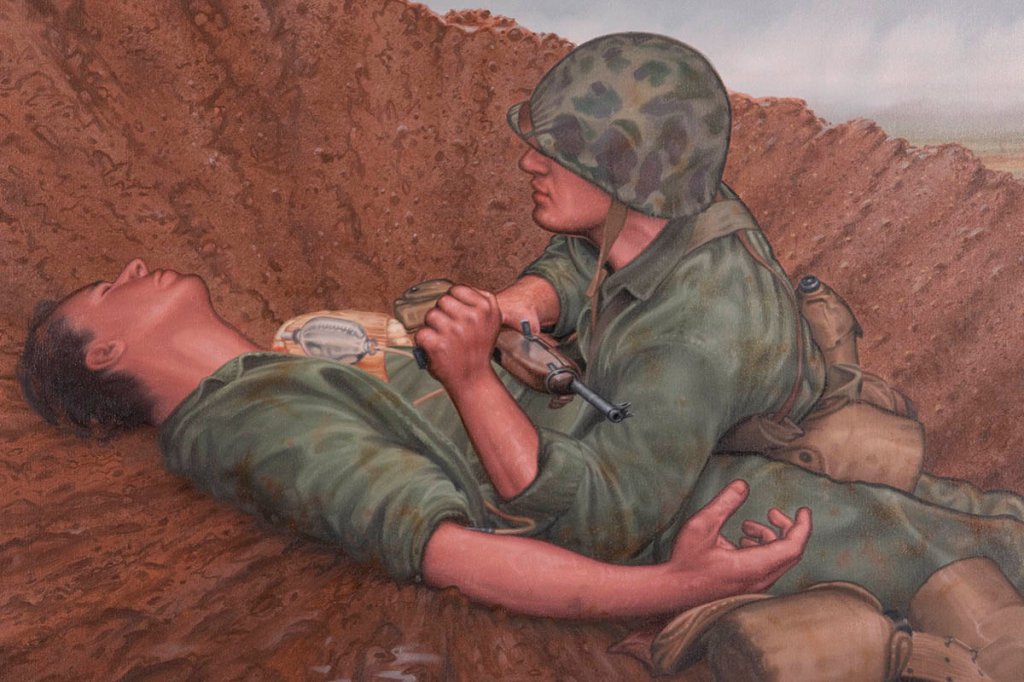
It’s a good thing too. Roach didn’t have much time, so Bush rushed toward his platoon leader. Two Marines went with Bush—one leading the way and the other to Bush’s rear to protect him from attack. The Japanese killed both of them, leaving Bush alone as he reached Roach. Once he got there, he assured the wounded Marine that everything was going to be fine.
Bush began administering blood plasma to the severely wounded Marine intravenously. As Bush did that, he recalled to the Congressional Medal of Honor Society, the Japanese attacked his position. Holding the bottle of plasma up with one hand, Bush reached for Roach’s carbine with his other and began firing. He expended all 15 rounds, according to his account for “Living History.”
“It was just like a shooting gallery,” Bush said. “How many I shot with that thing, I don’t know…. I was thinking one thing: ‘If they’re going to take me, then by God, they’re going to pay the bill.’”
With Japanese forces diverting Bush’s attention, Roach got up. As Bush shouted for someone to get the platoon leader to safety, the enemy threw three hand grenades toward the hospital corpsman.
Bush instinctively threw up his left arm. That gesture saved his left eye. The explosions cost Bush the sight in his right eye, though, and he incurred other injuries.
The Element of Surprise
Bush was battered but not done fighting.
Despite being badly wounded, he started moving. Armed with two guns, he deftly maneuvered himself into a spot behind the Japanese. They could not see him, a fact that played to Bush’s advantage. Bush fired one round for every enemy soldier, he recounted to “Living History.”
“Then I looked up,” Bush stated. “There was nobody standing there with me, so I left.”
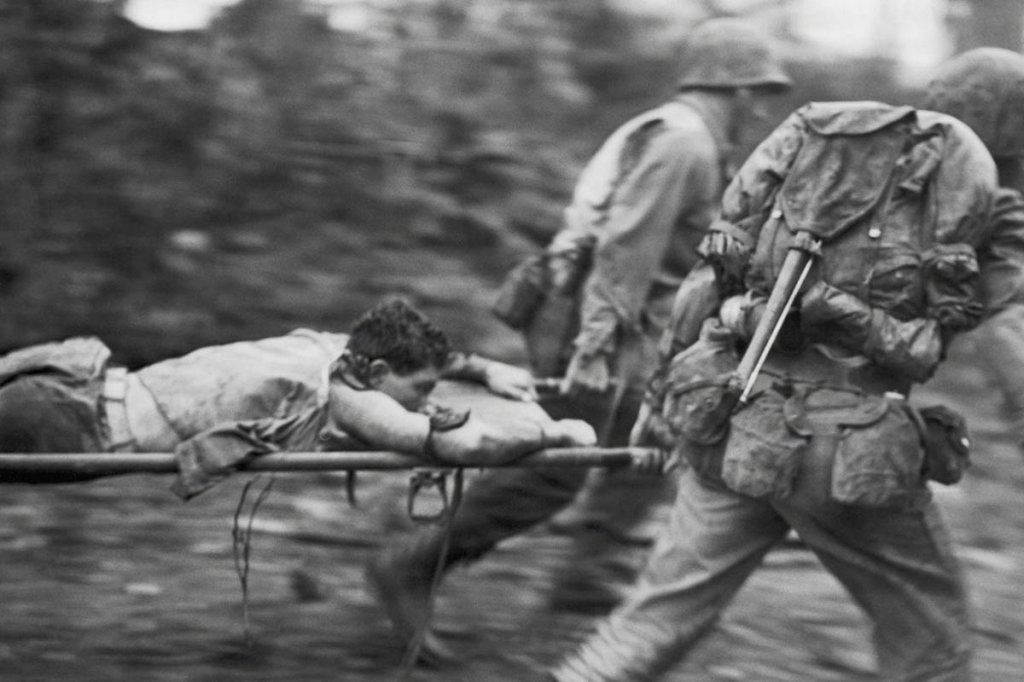
His Medal of Honor citation said Bush refused medical attention until Roach was evacuated. Bush finally collapsed as he walked toward the aid station, but the most important thing is that he survived.
High Death Tolls
More than 12,000 American service members died on the island, and the casualties that the U.S. military sustained totaled more than 49,000. The Tenth Army’s commander, Lt. Gen. Simon Bolivar Buckner Jr., didn’t make it home after a shell fragment killed him.
Ninety thousand Japanese service members died in the Battle of Okinawa, per the National World War II Museum. The death toll among the island’s citizens reached into the six figures. Some died as a result of the fighting, while others died after the Japanese military ordered them to kill themselves.
Bush was one of the lucky ones, and he knew it. He returned home, married his girlfriend, and finished high school. Bush used the GI Bill to attend the University of Washington and became a multimillionaire as a businessman.
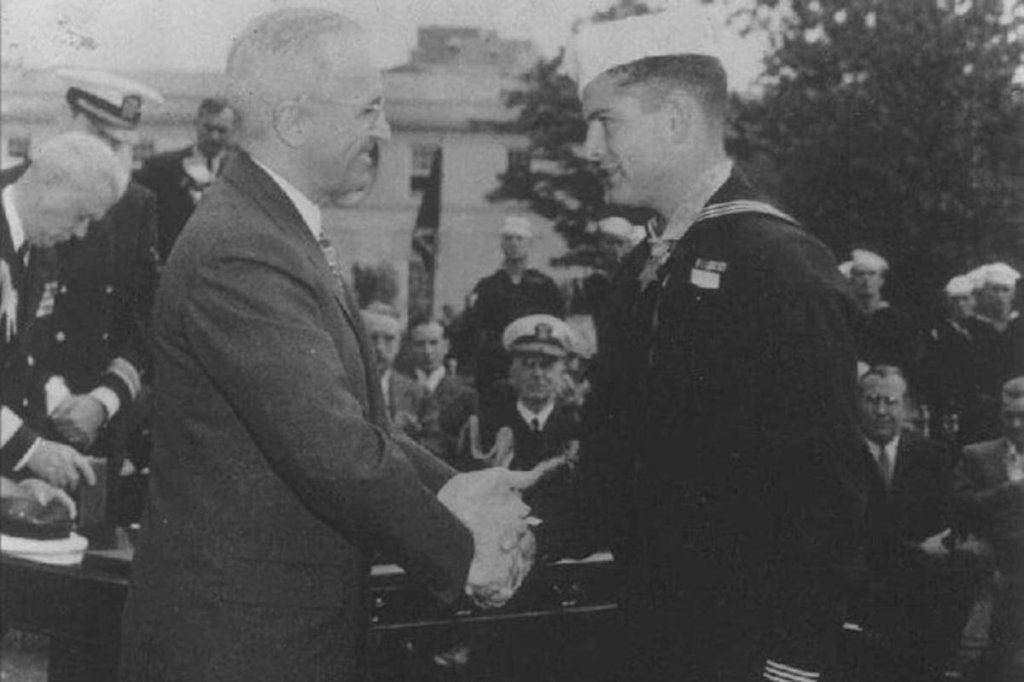
When Bush accepted the Medal of Honor from President Harry S. Truman on October 5, 1945, he was one of the youngest people ever to receive the military’s highest award for valor. Bush served as president of the nonprofit Congressional Medal of Honor Society from 1971 to 1973.
“You have to remember that you weren’t the greatest soldier, the greatest medic of all time,” Bush said in his “Living History” interview. “You were just another one doing your job. The same job that I was doing that day with Jim Roach, I was doing for 31 days before. So my sincere feeling is that we wear the Medal of Honor for those who didn’t get it that should’ve had it and also those that didn’t come home.”
Bush died on November 8, 2005, at the age of 79.
Don’t Miss the Best of We Are The Mighty
• Why the Army’s longest battle ever involved multiple cease-fires
• A former violinist singlehandedly cleared a mountain fortress during World War II
• The Marines and the rare rifles you didn’t know were at D-Day
Loading comments…
Comments couldn’t be loaded. Please refresh the page.