
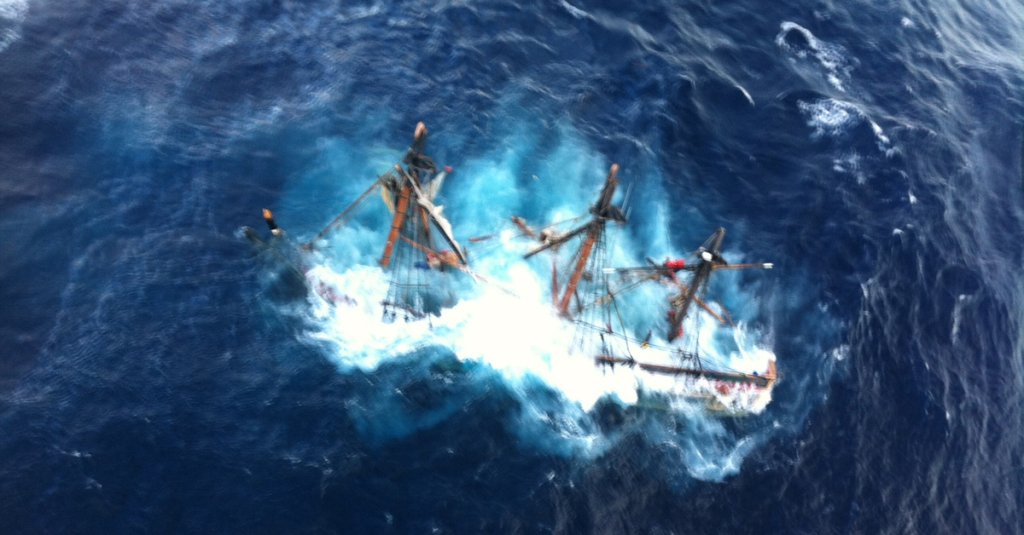
With Hurricane Sandy threatening the United States’ east coast, Robin Walbridge still planned to set sail.
Walbridge, captain of the HMS Bounty, intended to leave New London, Connecticut, on Thursday, October 25, 2012, as scheduled. St. Petersburg, Florida, was the ship’s destination. Being out on the ocean during a hurricane is dangerous for any ship, but Walbridge believed a vessel was safer at sea than it was tied up in port.
Also Read: A close look at the Coast Guard’s biggest rescue ever besides Hurricane Katrina
Aware that not everyone shared his opinion, Walbridge offered his 15-person crew a chance to pull out of the trip with no judgment. Everyone remained on the Bounty. So the ship took off, with Walbridge’s original course calling for it to swing way east of the powerful storm. Everyone on board thought that was the plan until three days into their journey, Walbridge made a fateful decision.
Without any input from his crew, he changed the direction that the Bounty traveled to southwest. Walbridge thought he was doing the right thing by sending the Bounty directly into Sandy’s path. That decision had fatal consequences.
Ship Was in 1962’s “Mutiny on the Bounty”
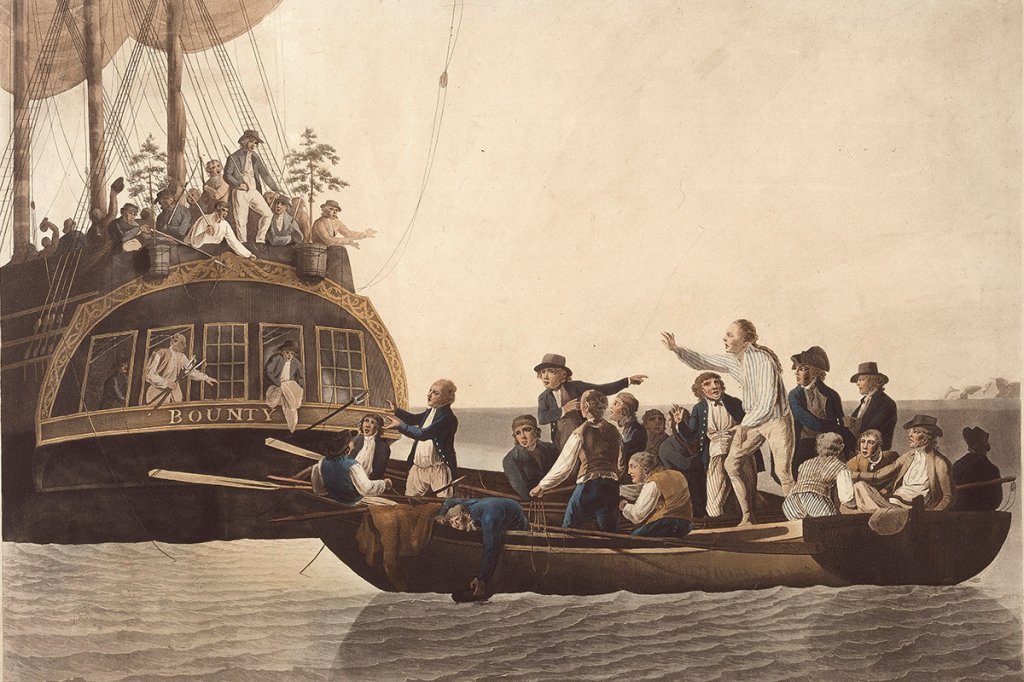
There were few ships with more famous names than the HMS Bounty.
It was named after the British Royal Navy ship on which arguably military history’s most publicized mutinies occurred. On April 28, 1789, mutineers led by master’s mate Fletcher Christian seized control of the Bounty from Lt. William Bligh.
The incident spawned several film adaptations, including one in 1935 that starred Clark Gable (“Gone with the Wind”) as Christian and Charles Laughton (“The Private Life of Henry VIII”) as Bligh. When another version of “Mutiny on the Bounty” hit theaters in 1962, Marlon Brando (“Apocalypse Now”) played Christian, and Trevor Howard (“The Charge of the Light Brigade”) portrayed Bligh.
For the latter movie, which received seven Academy Award nominations, the filmmakers needed a ship. A replica of the HMS Bounty, which set sail during Hurricane Sandy a half-century later, made its debut on screen in that critically acclaimed film. It went on to make appearances in “Yellowbeard” in 1983 and “Pirates of the Caribbean: Dead Man’s Chest” in 2006.
Hurricane Sandy, however, wasn’t some CGI effect intended to improve the moviegoer’s experience. It posed incredible risks, as the HMS Bounty discovered when it started to take on water on Sunday, October 28, 2012. The tall ship—a term that refers to any large, traditionally rigged sailing vessel and not actually to its height—struggled to stay above the surface of the Atlantic Ocean. It was taking on too much water, too quickly.
More than 90 miles southeast of Hatteras, North Carolina, the HMS Bounty was out of power. Walbridge waited as long as he could before ordering the crew to abandon ship early on October 29.
The Coast Guard’s Response
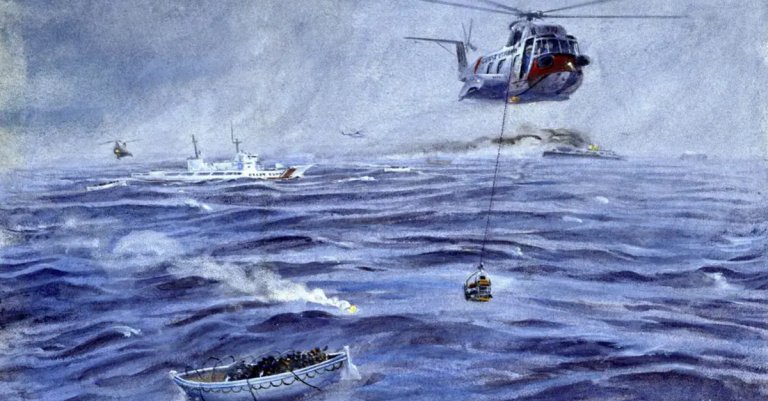
Coast Guard Air Station Elizabeth City deployed aircraft to the scene. The first to arrive, a HC-130J Hercules turboprop aircraft, spied the 180-foot-long Bounty half under water and at a 45-degree angle. The distressed ship had two life rafts, and the Hercules dropped down some more and deployed flares, per a June 2026 account of the rescue from Coast Guard Lt. Stephanie Young.
Just after sunrise, Young reported, the first rescue helicopter—an MH-60T Jayhawk that Lt. Cmdr. Steve Cerveny piloted—arrived. It wasn’t going to be a straightforward extraction. The weather conditions posed a highly formidable opponent. The wind and waves wreaked havoc with the rescue basket, making it difficult to keep in place. The Coast Guardsmen tried adding weighted bags to the basket, according to Young’s article, but when they did, it sank into the ocean.
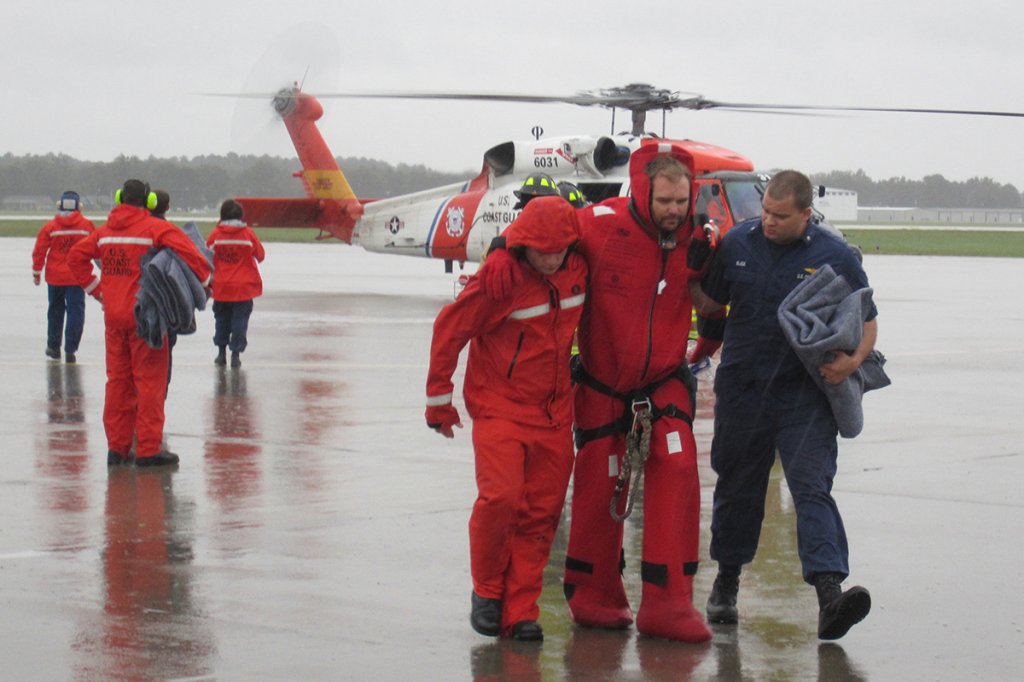
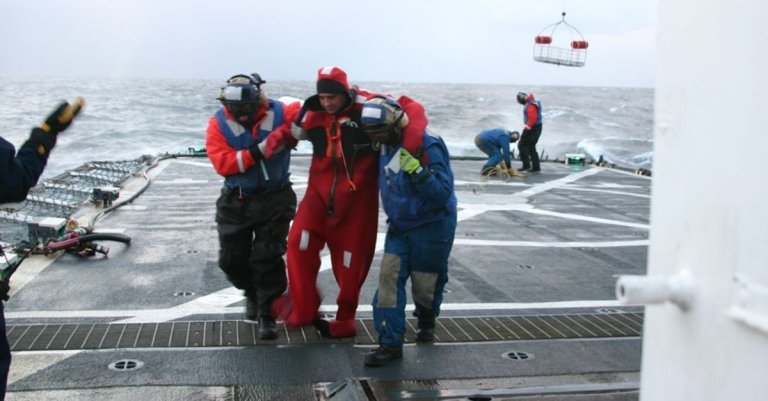
They had to find another way. Once the rescue helicopter hit on a suitable method, it was Petty Officer 2nd Class Randy Haba’s time to shine. Haba was the Hercules’ rescue swimmer, and he began ushering the Mutiny’s crew off one of the rafts.
In the meantime, another Coast Guard rescue helicopter arrived to concentrate on the survivors in the replica tall ship’s second life raft. Petty Officer 3rd Class Dan Todd was its rescue swimmer. When he arrived at the raft, Young reported that he tried to alleviate the survivors’ fears. Todd told them his name and said he heard they needed a lift, as though everyone was normal.
For Todd, it was.
“When we show up, it’s the worst day of these survivors’ lives,” Todd said in the National Coast Guard Museum article. “Using an icebreaker like that helps them relax, knowing that we’re in control and that this is just another day for us.”
A “Reckless” Decision
The Coast Guard saved 14 of the Bounty’s 16 crew members. Three of them sustained serious injuries but recovered. Other aircraft and Coast Guard cutters were deployed to search for Walbridge and deckhand Claudene Christian. While they managed to recover Christian’s body, they never found Walbridge.
It could have been a much worse outcome.
“The difficulty is not necessarily flying so low but maintaining position with the life raft and rescue swimmer in the water,” Lt. Jenny Fields—the co-pilot on the second rescue helicopter—said, according to Young’s article. “The wind and waves were constantly pushing the targets through the water, so it was a lot of work from the pilots at the controls in the helicopters to stay in position.”
Investigations from the Coast Guard and National Transportation Safety Board blamed Walbridge for the Bounty’s sinking. Among their findings, they claimed Walbridge waited too long to issue a distress call and order the abandoning of the Bounty. The NTSB called the 63-year-old Walbridge’s decision to sail into Sandy’s path “reckless.”
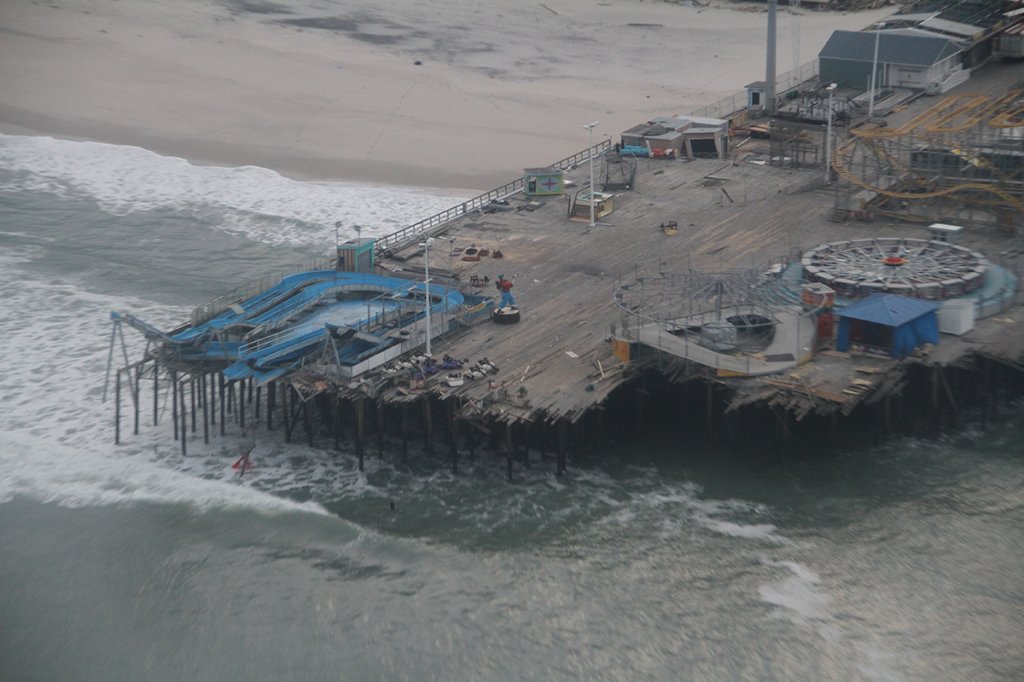
Hurricane Sandy became a historic event. It was a hurricane, then a post-tropical cyclone, and finally it produced blizzard conditions. Sandy made landfall in Brigantine, New Jersey, on October 29, 2012; that’s the same day of the Coast Guard’s mission to rescue the Bounty’s survivors. What became known as Superstorm Sandy impacted 24 states.
The American Red Cross reported 117 deaths in the U.S. related to Hurricane Sandy. Other sources place that total higher.
Don’t Miss the Best of We Are The Mighty
• How the Navy and Coast Guard frantically searched for Amelia Earhart
• Why the Coast Guard is part of the Department of Homeland Security
• This Coastie crossed the English Channel 10 times on D-Day
Loading comments…
Comments couldn’t be loaded. Please refresh the page.