

It’s 1990, a fictional New York street cop has recently taught a generation to fear a gun that did not actually exist.
Bruce Willis, playing John McClane in “Die Hard 2,” warned that terrorists were carrying a “Glock 7,” a porcelain pistol made in Germany that slipped right past airport X-ray machines and cost one month’s paycheck to produce.
Also Read: The fascinating history of the military duffel bags we know and love
Not one word of that was true, of course. No such gun has ever existed; our real Glocks are full of steel, and they light up a scanner like a Christmas tree. The panic it caused was real, though, and beneath the surface nonsense it portrayed to the world, plastic had arrived on the battlefield, and nobody knew what was to come.
War remembers its materials each in their own way. Bronze, iron, and steel still get the monuments, front and center in museum displays, and the close-up camera shots. At the same time, the substance that actually reshaped the modern battlefield gets tossed in a burn pit after lunch.
Plastic gets little to no praise and never asks for it. Even so, this cheap, light, endlessly moldable stuff quietly rebuilt how war is fought, carried, and survived.

The Glock 17 & Die Hard 2 with firearms expert Jonathan Ferguson
Proof is in the Plastic
Long before Hollywood got hold of it, the Glock was an underdog. In 1980, the Austrian army sought a modern sidearm to replace its World War II-era Walther P38, publishing a demanding list of 17 requirements.
Gaston Glock, an engineer who had never designed a firearm, happened to run a small company that made knives, entrenching tools, and other field gear from advanced polymers. Reasoning that a material tough enough for a field knife’s sheath might survive a pistol frame, he assembled a team of European gun experts and built a working prototype in roughly three months.
By early 1982, his design had beaten established rivals from Heckler and Koch, SIG, Beretta, and Steyr, and the Austrian military adopted it as the P80. Most of the world would come to know it by another name, the Glock 17, a label drawn from the company’s seventeenth patent and not, despite the tidy coincidence, from the seventeen rounds in its magazine.
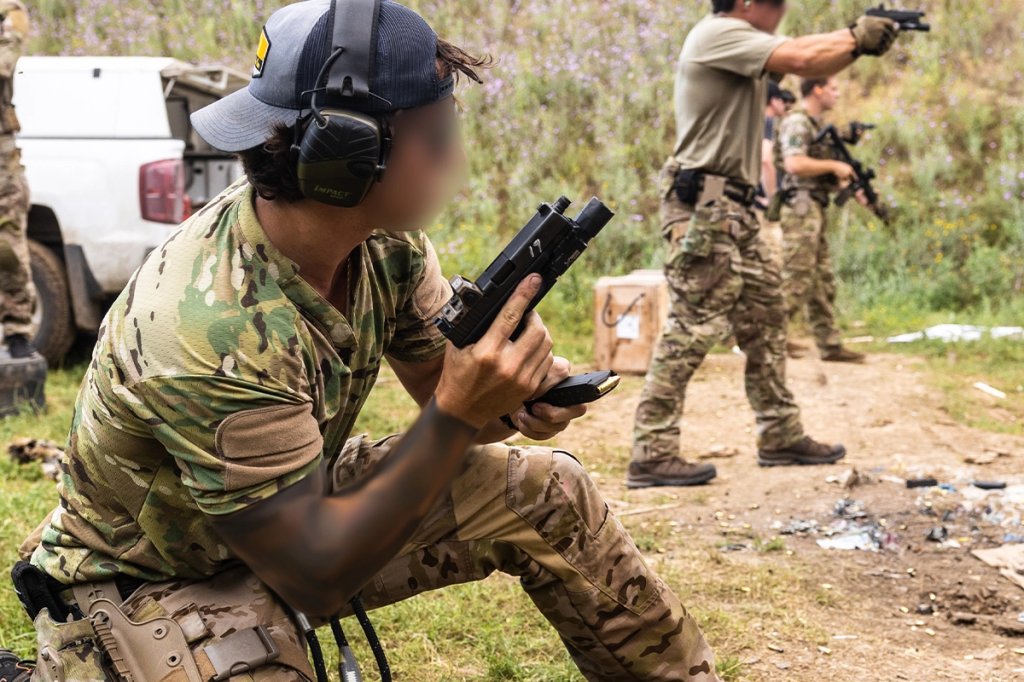
What made the thing groundbreaking was not the steel slide or its barrel, both of which were entirely conventional. The frame took the leap forward.
Building the body of the gun from polymer gave Glock a pistol that was lighter, cheaper to produce, nearly indifferent to sweat and weather, and assembled from only about three dozen parts.
Got Plastic?
Take Kevlar, for example, the fiber most people picture when they imagine a bulletproof vest. Kevlar is not the rival to plastic; it is a plastic, an aramid polymer that DuPont spun in the 1960s into a thread stronger by weight than steel.
Woven into vests and pressed into helmets, it began turning fatal hits into survivable ones, and the casualty rolls of every war since have run shorter because of it.
Science, as it tends to do, pushed further on. A newer polymer, ultra-high-molecular-weight polyethylene, delivered improved protection at even less weight, and it now lines the helmets and plate carriers troops wear into combat today.
The Masked Machine
Protection was only half of the polymer’s gift to modern war; visibility was the other half. As radar turned the open sky into a place with nowhere to hide, engineers needed a way to make enormous machines vanish, and metal, which mirrors a radar beam beautifully, was the problem rather than the cure. Composites and radar-absorbing materials, both built on plastic resins, became the fix.
That angular first stealth jet, the F-117 Nighthawk, and the vast flying wing of the B-2 Spirit that came after it, owed their near-invisibility to skins engineered to drink a radar pulse instead of bouncing it back.
The lightness of the materials was a bonus. The same carbon-fiber composites that defeat radar returns also weigh far less than the aluminum they replaced, which is why a modern fighter or an attack helicopter like the AH-1Z is built largely from them, right down to its composite rotor blades.
A machine made partly of plastic flies farther, carries increased weight, and is far harder to locate. In a war decided by who sees whom first, that last trait is close to priceless.
Cheap and Easy
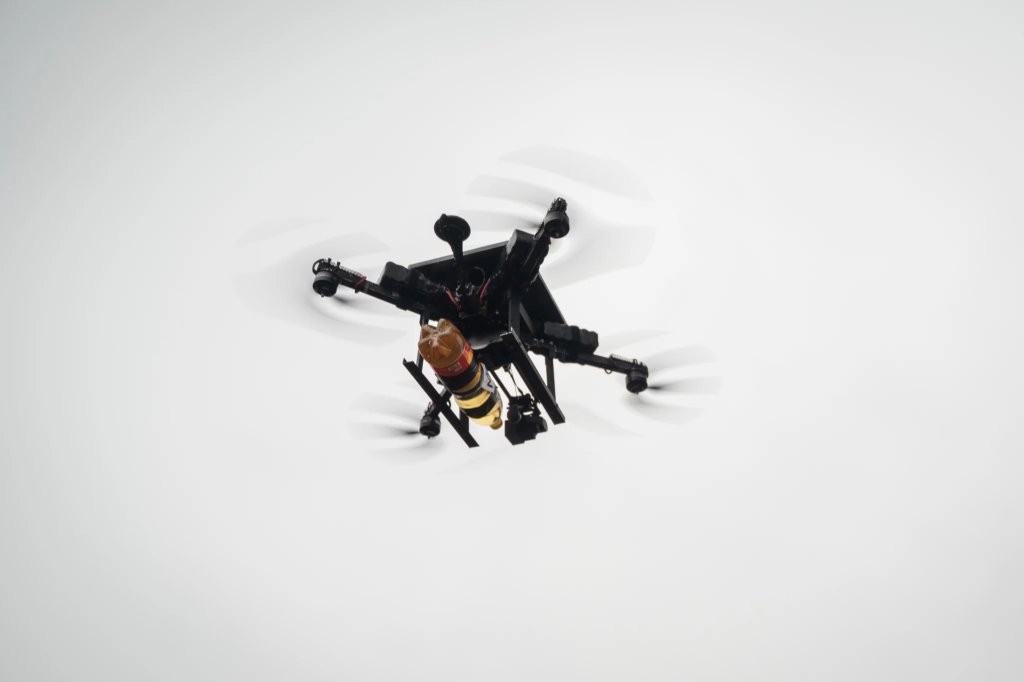
Cheapness, the very quality that once made plastic a family embarrassment, turned out to be the greatest asset. Because a polymer part can be stamped out by the thousand for pennies, it created a whole category of equipment a commander can afford to lose.
Today’s front lines swarm with small, plastic, mass-produced aircraft, some of which are nothing but a 3D-printed frame wrapped around a battery. They cost a few hundred bucks and take out machines worth millions.
Down at the level of the individual, the same logic has quietly filled a service member’s day with a scientific marvel they stopped noticing years ago.
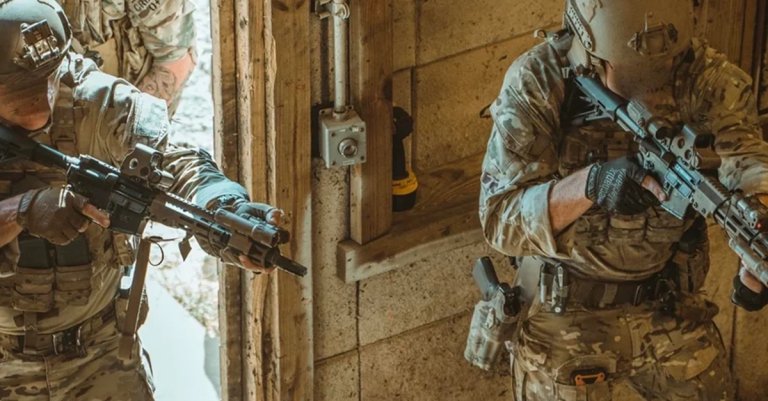
The canteen on your hip, the rifle’s stock and handguard, the magazines, the night-vision casing, the buckles and webbing holding the whole kit together, almost all of it is some polymer chosen for being light, tough, quiet, and cheap. Steel still does the killing, but plastic, more and more, does nearly everything else.
Hold Your Applause
We treat plastic as an afterthought, the stuff our grocery bags are made of, and those damn Legos that act as caltrops, and then we put our lives on it, asking it to stop the bullet, hide the aircraft, or carry the gear on the day when everything seems to go wrong.
Steel will always own the legends, the war films, and a place of honor behind museum glass. Plastic will hook up with Steel’s wife while it’s at a meeting.
So spare a thought for the least glamorous material in the whole arsenal, the one nobody honors, and everybody leans on. It asked for no glory, and it changed the face of war anyway.
Don’t Miss the Best of We Are The Mighty
• A 100-plus year history of iconic US military helmets
• Why the US military wants to take your wisdom teeth so fast
• Iraq’s ‘Triangle of Death’ is still famously dangerous real estate


Loading comments…
Comments couldn’t be loaded. Please refresh the page.