
Shoot, move, and communicate are the basics of combat. The “move” requirement, however, can be extremely difficult in the snow; just ask anyone unlucky enough to get stationed at Fort Drum.
Also Read: TSA is adding dedicated security lines for military, veterans, and their families
With its increasing emphasis on Arctic warfare, the U.S. military is starting investing in existing snowmobiles across the services while adding a new model to expand capabilities.
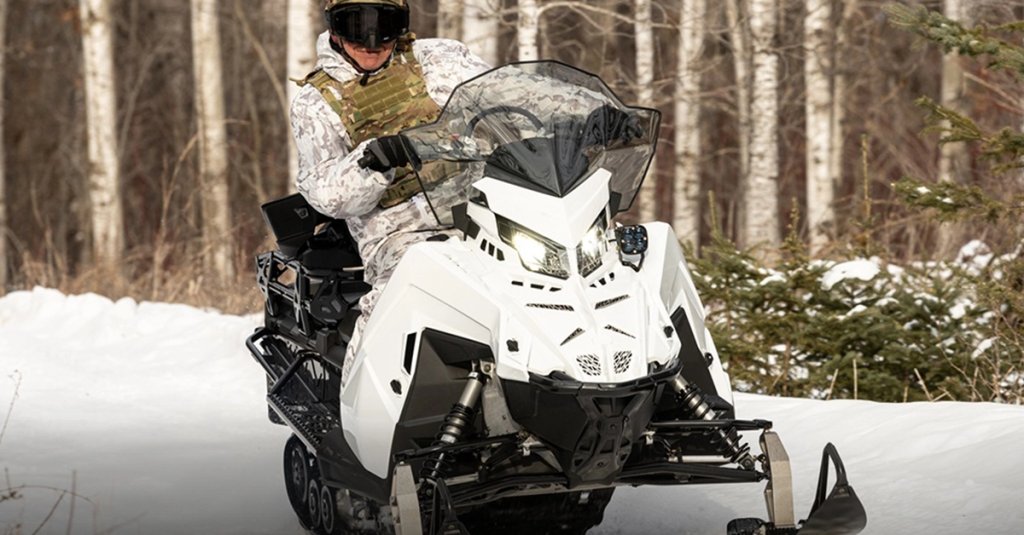
To provide mobility and logistics of light units in snowy regions, the U.S. fields the Polaris Military 850 Titan 155 and the Military 850 PRO RMK 155. Polaris describes the former as “a utility workhorse engineered to handle two passengers, an additional 125 lbs of cargo and 1200 lbs of towing” while the latter is “a nimble and lightweight snowmobile engineered for superior maneuverability for patrol and reconnaissance, carrying one person.”
In order to fill the capability gap between the Titan and PRO RMK, Polaris created the new Military 850 Voyageur. A crossover snowmobile, the Voyageur is lightweight and agile while still being able to carry two people, cargo, and tow up to 450 pounds.
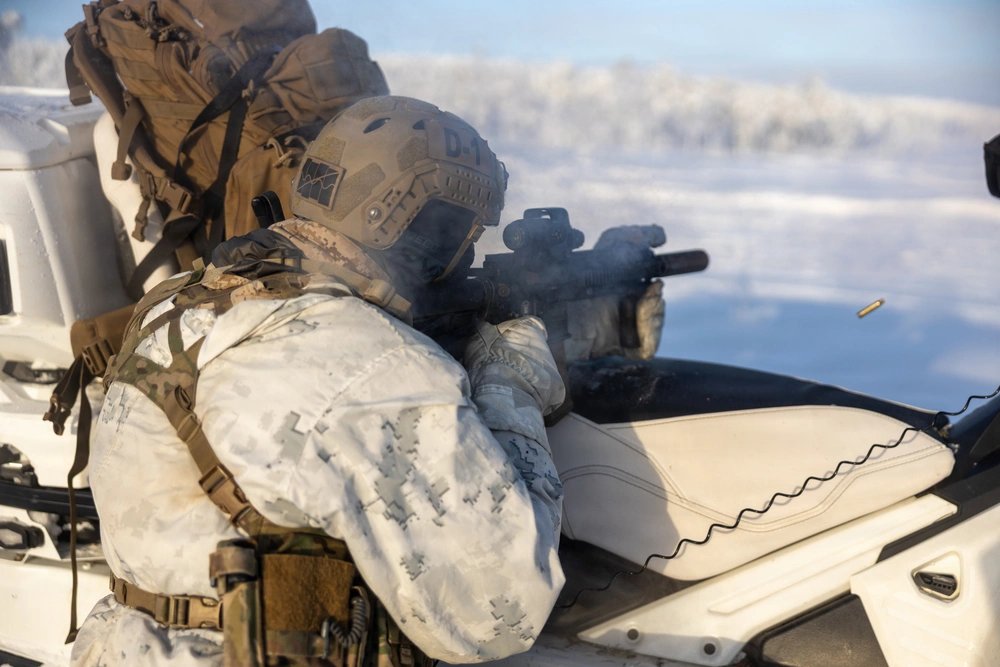
Using the same 850 two-stroke engine as the Military Titan and PRO RMK, the Voyageur helps to streamline maintenance and logistics to keep Arctic warfighters on the move. In addition to militarized snowmobiles, which Polaris calls “over-snow reconnaissance vehicles (OSRVs),” the company enables Arctic mobility with the MRZR Alpha with Arctic Mobility Kit.
The Voyageur features the same switch panel as the other OSRVs so that troops can easily operate any of the three platforms. To enable its use with night vision, a single switch instantly turns off all lights, while another switch turns on an IR light. Its 12V outlets even allow operators to charge mission-essential electronics. No word on integration with a heartbeat sensor.
All three OSRVs use keyless, electric start with a manual, pull-start option for use in extreme cold.
The OSRVs are further militarized with their overall weight reduction, calibrated shocks, and a proven suspension architecture to absorb bumps in shifting terrain. While it certainly sounds capable of weaving between trees to dodge incoming missiles, Polaris could not comment on the ability of their snowmobiles to jump a ski ramp.
Additional testing by UK Special Air Service may be required.
Unsurprisingly, the Army has already ordered 50 of the new Voyageur OSRVs with an MSRP of $23,199 each. A further 25 Titans were ordered at an MSRP of $25,199 each and over 30 RANGER utility vehicles. Of course, spare parts, maintenance, and training support will be provided with all deliveries to the Army planned by the end of 2026.
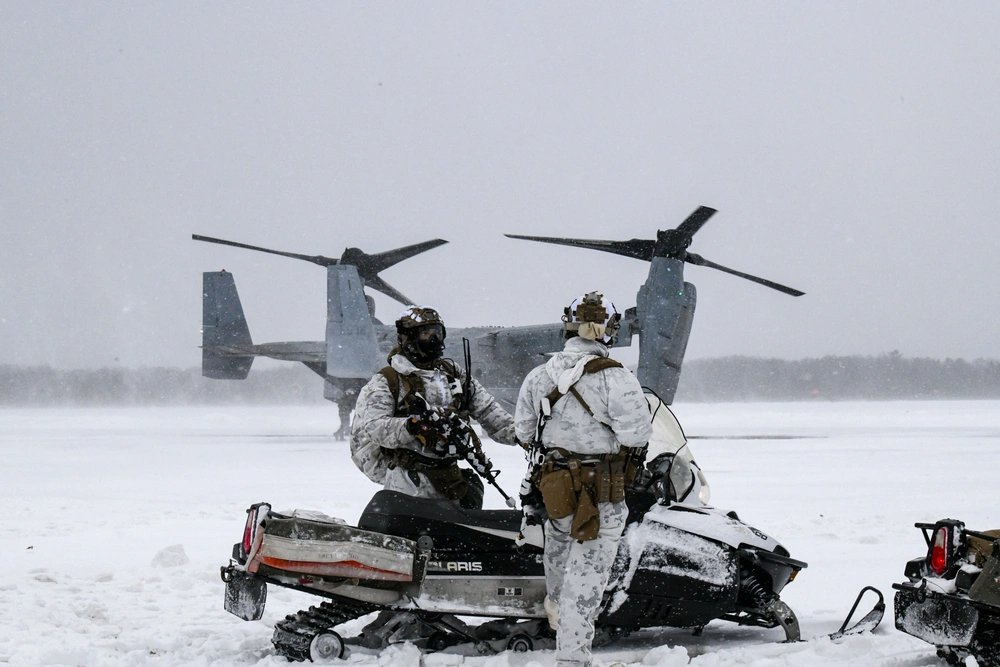
The Marine Corps also maintains a strong Arctic fighting force and placed an order for 60 OSRVs, 20 of each of the three models to be delivered to units based in Norway. This follows a $98M Marine Corps contract to Polaris for “Ultra-Light Tactical Vehicle Production of Logistics and High-Power variants… for employment during littoral operations.”
Whether it’s in the snow or on the beach, the Marines like what Polaris is putting out. As with the Titan and PRO RMK, the Voyageur can be airlifted by C-130, CH-47, MV-22, or CH-53 aircraft.
Even the Air Force is getting in on the new Voyageur with orders placed for the 57th Rescue Squadron in Italy. With that unit, the snowmobiles will be used in support of combat search and rescue, personnel recovery, and casualty evacuation efforts.
The specialized capability that Polaris OSRVs deliver won’t get used by most troops. However, for those warfighters who need to move quickly over snowy terrain, the Military 850 Voyageur is a new tool in the Arctic tool box to help win the fight. Especially if that fight is recovering an ACS module from a downed satellite.
Don’t Miss the Best of We Are The Mighty
• Why 11.5 is the best AR barrel length for most shooters
• The Civilian Marksmanship Program sells M1 Garand rifles, M1911 pistols, and soon M14s
• Boeing wins $75 million contract for jet-powered JDAMs
Loading comments…
Comments couldn’t be loaded. Please refresh the page.