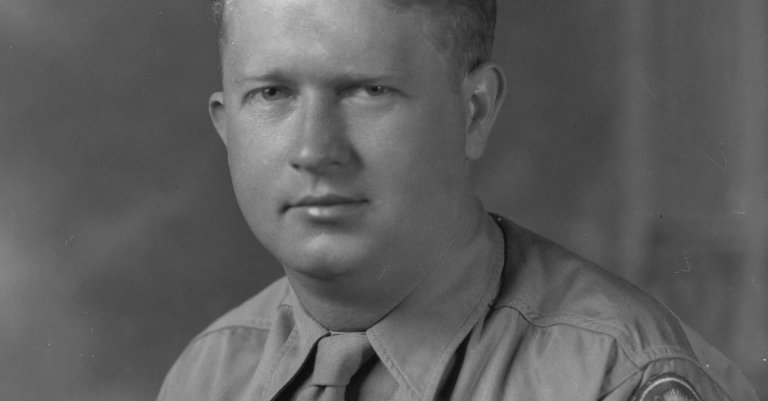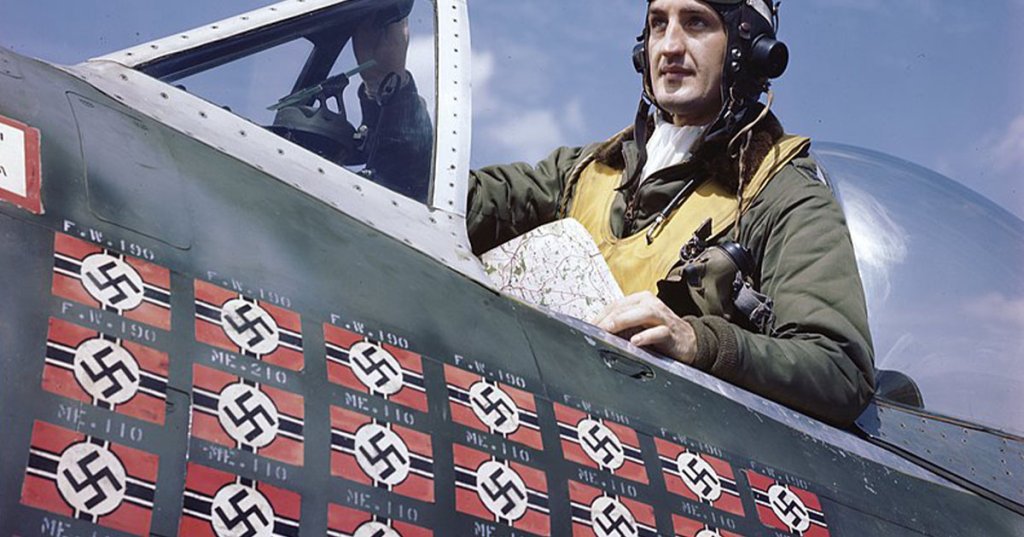
If at first you don’t succeed, try, try again. Or the third time’s a charm. There are many ways to tell someone not to give up, but perhaps an example of dogged determination is more effective than any pithy slogan. In that case, there’s no better example than Air Force fighter pilot Francis Stanly “Gabby” Gabreski, who almost never got off the ground. But it’s a good thing he did, because he would not only be America’s top figher ace over World War II Europe, but he would also become an ace in the Korean War.
Gabby Gabreski was a Polish-American U.S. Army Air Forces pilot whose initial claim to fame was his 28 kills against Nazi Germany’s Luftwaffe. During the Korean War, he notched another 6.5 aerial victories (yes, there’s a half—more on that later) in the United States’ new jet-powered fighters. He was one of only seven pilots who achieved “ace” status in two wars.
“There are no miracles,” Gabreski would later tell an interviewer. “There are no born fighter pilots. Some are a a little better than others… but I would say, time, training, training, training, training, and more training is the key to any success.”

P-47 Ace Francis "Gabby" Gabreski Interview
Gabreski was born on January 28, 1919, to Polish immigrants in Oil City, Pennsylvania. He worked in his father’s store, but his parents had bigger dreams for him. After finishing high school, he was sent to the University of Notre Dame, where he developed an interest in flying and accrued six hours of flight time.
It was there, however, that he had his first brush with near-disaster. He admitted that he struggled with flying smoothly, and his instructor told him he did not “have the touch to be a pilot.” Luckily, not having the touch wasn’t a deterrent. As he began his second year, he enlisted in the U.S. Army Air Corps Cadet Program. That’s when he nearly washed out of pilot training altogether.
“Anything you undertake, you’re not born into it, you’re trained into it,” Gabreski recalled. “And the more training you can get, the longer you do it, the better you become. That was my case.”
Around the same time that the Army Air Corps became the Army Air Forces, Gabby Gabreski became a pilot. He earned his wings in March 1941 and was sent to the 45th Pursuit Squadron at Wheeler Field, Hawaii, where he flew the Curtiss P-36 Hawk. It was in Hawaii that he met his future wife—and shortly after, came under attack from the Japanese.
During the attack, Gabreski and a handful of his fellow pilots managed to get off the ground in their P-36s to fight, but the Japanese Zeros had already headed back to their ships. With the war now on, Gabreski and his wingmen began training on the new P-40 Warhawk and P-39 Airacobra.
He tracked the air war over Britain while he was still learning to fly, paying special attention to the Polish pilots who had fought their way into the RAF and then into the record books. With family roots in Poland and the language skills to match, he asked to serve as a bridge to those squadrons so he could absorb how they flew and how they thought.
Washington signed off. After a brief stint at the Pentagon in September 1942 and a move to the Eighth Air Force the next month, he joined No. 315 Squadron in January 1943 and strapped into a brand new Spitfire Mk IX. Twenty sorties later, he had a pocket full of hard lessons from Polish veterans. On one early scramble, a roving pack of Fw 190s pounced on his flight, and he let excitement outrun judgment. He did not score that day and made a note to master his nerves before trying again.
The next step took him to the big radial engine he would make famous. In February 1943, he joined the 56th Fighter Group and its P-47 Thunderbolts (also known as “Jugs,” because, a Gabreski said, “It looks like a jug.”) and soon earned a flight leader slot. The group shifted to RAF Molesworth in May, he was promoted to major, and when the commander moved up a rung, Gabreski took over the squadron.
It was not a popular promotion. Two senior officers had been passed over, and the new boss had to prove he belonged in his spot. But even the results couldn’t quiet everyone’s complaints. Gabreski downed his first Fw 190 on August 24, 1943, which might have smoothed the edges, but some pilots grumbled that his attack spoiled their own runs.
By November, he was carving out a reputation where it mattered most: over northern Germany with B-17 formations strung out beneath him. Near Oldenburg, he bagged his fourth and fifth victories and crossed into ace territory while shepherding bombers home from Bremen. Not long after, a 20mm hit chewed up his turbocharger and sent his Thunderbolt down through the clouds, a hungry Bf-109 lurking close. He kept the Messerschmitt off until his engine came back to life at low altitude, where the damaged turbo no longer mattered.
From there, his kill tally rose in twos and threes. On July 5, 1944, he stood atop the victory list in Europe with 28 kills, matching Richard Bong’s mark in the Pacific (later, Bong would be recognized as America’s top ace in all of World War II). But shooting down enemy fighters wasn’t his mission.
“Our mission was to prevent the bombers from being shot down,” he said. “In other words, if a Luftwaffe pilot was coming at the bombers and we went out and fired at him, and he pulled away from the bombers, then our job was complete.”
The calendar, however, was catching him. Eighth Air Force rules capped combat time, and by July 20, he had hit the 300-hour limit after 193 missions. He told his fiancée to finish the wedding plans and prepared to board the ride home. But another escort mission to Germany appeared on the schedule, and Gabby asked for one more sortie.
On the return leg, he spotted He 111s parked at a Luftwaffe airfield near Bassenheim and dropped down to strafe them. The first pass looked high, so he swung back for a cleaner line. Tracers stitched over the targets again, and he nudged the nose down, a hair too far. The prop struck the runway, the engine shook itself to pieces, and he slid the Jug onto its belly. He ran for the trees, stayed free for five days before being captured.
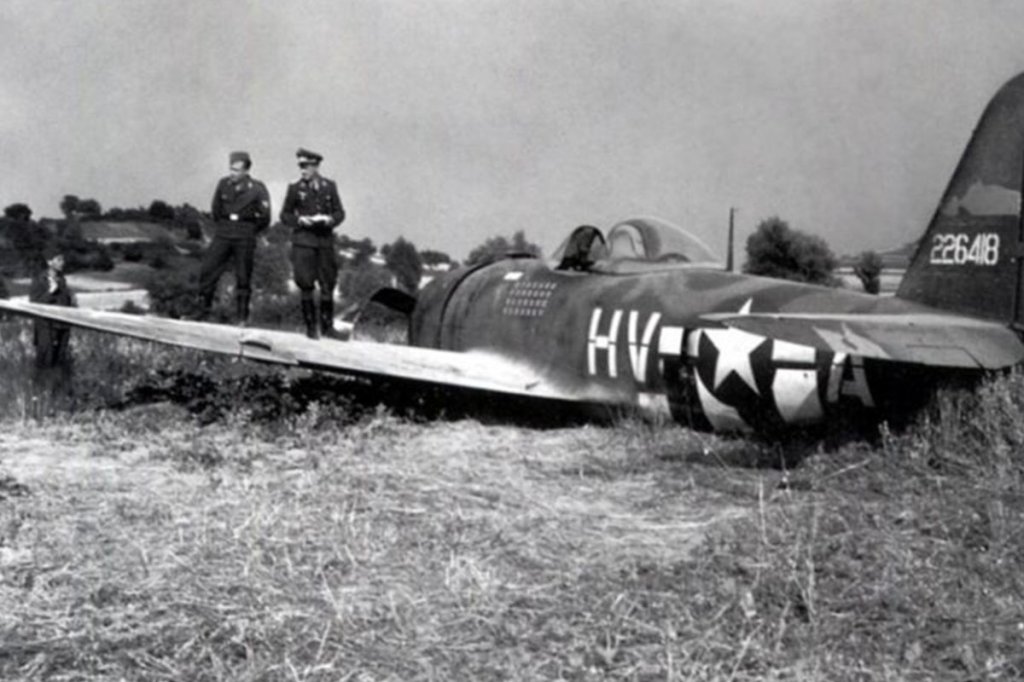
German interrogator Hanns Scharff later stated that he never obtained information of value from the Polish-American. Gabreski rode out the rest of the war in Stalag Luft I.
Home again in June 1945, he married and then headed to Wright Field to lead the Fighter Test Section. He briefly left uniform for Douglas Aircraft, only to be recalled in April 1947 to command the 55th Fighter Squadron at Shaw Field. Columbia University followed, where he finished his degree and added Russian to his toolkit. After graduation, he returned to his old unit, the 56th Fighter Group at Selfridge, as the unit moved into F-86 Sabres. The jet age was upon them.
The Korean War opened a new chapter. In June 1951, he and a handpicked group went to Kimpo Air Base outside of Seoul, then shifted to Suwon to form a second fighter wing just as the communist threat to American B-29 Superfortresses peaked. The unit transitioned from F-80 Shooting Stars (which were already outclassed by the MiG-15) to F-86s in just ten days, and Gabreski introduced new ideas that refined the unit’s tactics and maintenance. The reinvented tactics and new fighter soon turned into a 14-to-1 kill ratio.
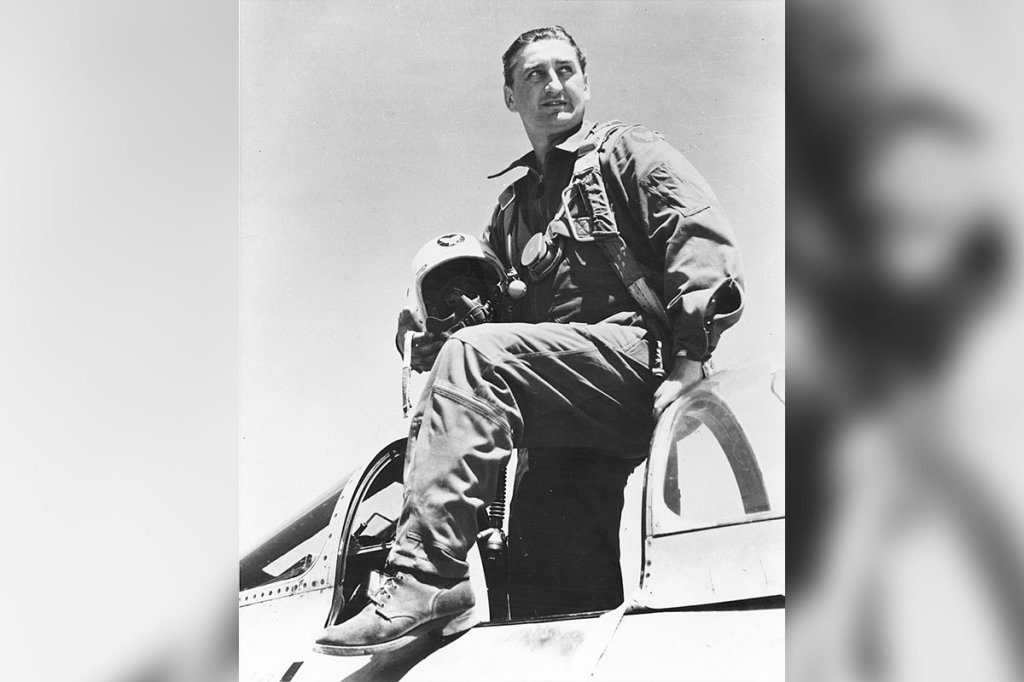
A curious footnote came in February 1952. when Gabreski tore into a MiG-15 and left it mortally mortally wounded and limping back across the Yalu River into China. Gabreski turned back, marking the claim as probable. Another World War II double-ace, Maj. William Wisner, chased the enemy across the river and finished it off, but declined to take credit. Gabreski told him to file the paperwork so the record matched the facts. Wisner later amended his report and reached ace status before anyone else in the wing.
As his Korean War clock neared the limit yet again, Gabreski began leaving some of his flights unlogged so he could keep flying. That ended when the deputy wing commander was shot down. Higher headquarters grounded Gabreski by promoting him in the man’s place.
He returned to the United States in June 1952 to a ticker tape parade in San Francisco, attended the Air War College at Maxwell Air Force Base, and later flew the new F-100. He retired from the Air Force in 1967 and joined Grumman Aerospace. In 1978, New York Gov. Hugh Carey asked him to steady the state-owned Long Island Rail Road. After 18 months of political wrestling with the MTA, he stepped down and returned to Grumman, then retired fully in 1987.
Gabreski entered the Aviation Hall of Fame in 1978, and died in 2002 with a war record and a legacy of service that few could match. Across a nearly 30-year career, he became one of just seven American pilots to earn the title of ace in two wars, was credited with 34 and a half victories, and decorated with a Distinguished Service Cross, two Silver Stars, 13 Distinguished Flying Crosses, and seven Air Medals.