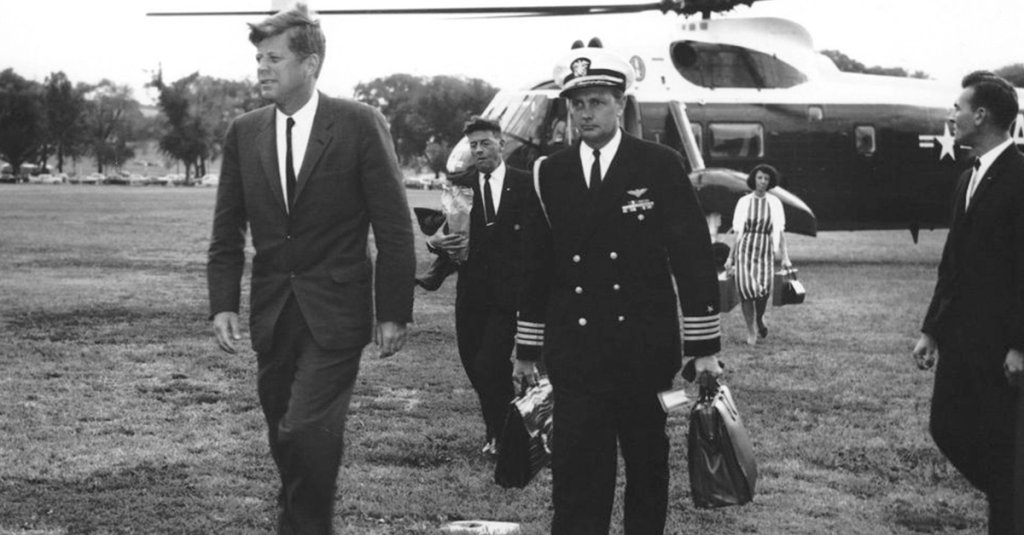
Somewhere near the President of the United States right now, a military aide is carrying a black leather briefcase that could end civilization. He’s not a cabinet member. He’s not a general. He’s a mid-grade officer selected for reliability, discretion, and the ability to keep up with the most powerful person on the planet. He’s with the Leader of the Free World at all times, in any country, under any circumstance.
Also Read: These specialized soldiers train to neutralize enemy nuclear weapons
That briefcase is the Presidential Emergency Satchel, but everyone calls it the “nuclear football.” And the story of how it came to exist is a story about how close we’ve come to blowing everything up and how that almost happened because a president lost a card in his pants pocket.
Actually, it all really began because no one had a plan. Not a good one, anyway.
When President Dwight D. Eisenhower took office, the United States had nuclear weapons, the Soviet Union had nuclear weapons, and there was no really reliable system for the president to actually use them on short notice. Eisenhower actually delegated the command decision to launch a nuke to military commanders—and even some individual pilots.
John F. Kennedy inherited the mess in 1961 and was, not surprisingly, shocked at how many people were able to start a nuclear war. It was Kennedy’s decision to put Permissive Action Links (PAL), locks on all American nuclear weapons, that could only be released with a special code.
It was just in time, too. Because in 1962, it was Kennedy’s patience that saw the United States and the Soviet Union through the Cuban Missile Crisis. If military commanders still had the authority to launch a nuclear attack, things might have ended a lot differently. After the crisis, President Kennedy established the means for the U.S. military to know that the president was ordering the strike. Kennedy was the first president to have the Presidential Emergency Satchel follow him everywhere.
The Origin of the “Nuclear Football” Nickname
The exact origins of the “football” nickname aren’t really known. But in 1965, Associated Press reporter Bob Horton wrote a story about how Kennedy changed the way the president authorizes a nuclear attack. Horton was writing about U.S. Army warrant officer Ira Gearhart.
Gearhart “sat outside in the lobby unobtrusively guarding a brown leather briefcase someone had nicknamed the ‘football,'” wrote Horton.
Some 40 years later, a 2005 AP report said the nickname came from America’s first nuclear war plan, the Single Integrated Operation Plan (SIOP). The SIOP’s code name was “dropkick.” The concept was that a “football” was necessary to execute “dropkick,” and Smithsonian Magazine attributed it to Kennedy’s Secretary of Defense, Robert McNamara.
But it turns out that “dropkick” was actually from the movie “Dr. Strangelove,” and that the real SIOPs were called “dropshot” and “offtackle.” Since “off tackle” is actually a football term, that’s likely its origin. In 1986, Gen. Chester Clifton noted that it was called a football because Army warrant officers handed off their charge to the next person on shift to carry it.
But, again, no one knows for sure. Military aides had long called it the nuclear football, and now the American public did, too.
What’s Inside the Nuclear Football
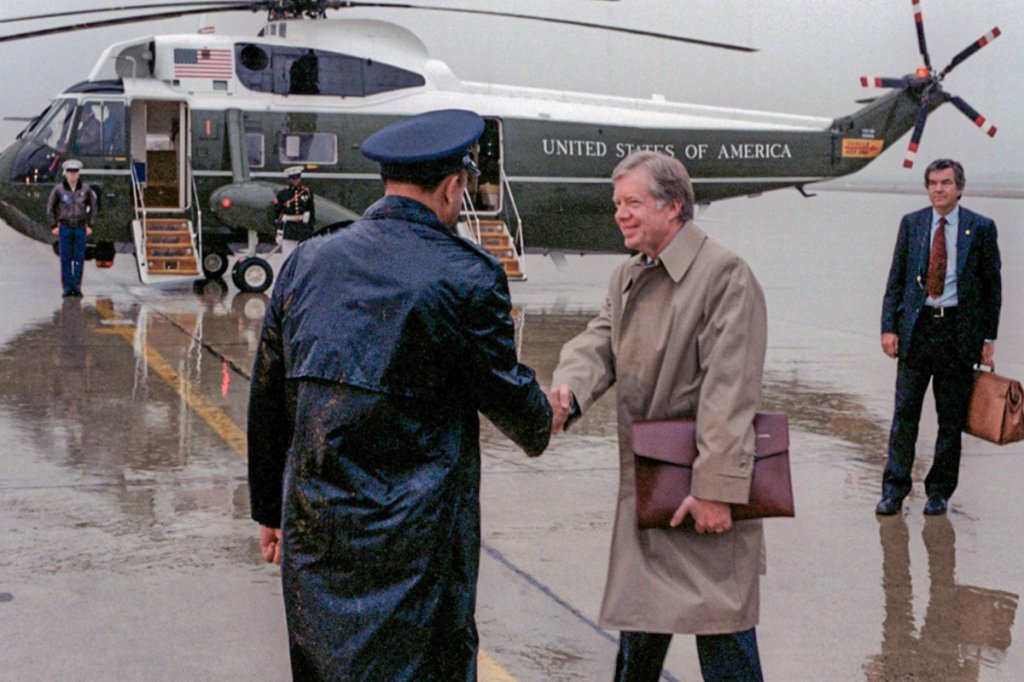
The exact contents of the nuclear football are classified, but we do know there’s no big red launch button. Sorry, Hollywood. The football is a communications terminal and decision support system, meaning it gives the president options and the tools to execute them, not a single trigger.
The centerpiece is called the Black Book: a menu of pre-planned nuclear response options ranging from targeted strikes to full-scale retaliation. These plans aren’t improvised in the moment. Like the SIOP, they were designed by military planners, reviewed through layers of strategic command, and presented as structured choices the president can select under extreme pressure and time constraints.
The football also carries secure communication gear linked to the National Military Command Center at the Pentagon, a list of hardened bunkers and emergency relocation sites, and Emergency Broadcast System instructions so the president can address the country if everything goes sideways—and if any broadcast stations are still standing.
The Biscuit
The nuclear football doesn’t work alone. The president also carries a small plastic card called the “biscuit,” which contains the authentication codes to verify that the order is real and coming from the actual commander-in-chief. The president reads those codes to military command centers. They confirm the president’s identity. Then, and only then, does anything happen.
Ronald Reagan almost demonstrated why this system exists when John Hinckley shot him outside the Washington Hilton in 1981. Reagan was rushed into emergency surgery, and his biscuit got separated from him in the chaos. Nobody knew where it was. It turned up later in a suit he left at the hospital.
Think about that. For a window of time during a presidential assassination attempt, with the country on edge and the world watching, the authentication codes for U.S. nuclear weapons were in a suit jacket. But Reagan wasn’t the first and he certainly wasn’t the last.
Jimmy Carter also left his Biscuit in a suit jacket, but he’d sent that jacket to the dry cleaners. Bill Clinton reportedly lost track of his biscuit for months during his two terms. Months. The codes that verify the president’s nuclear authority were… somewhere. The details are still classified, but that one likely kept some people at the Pentagon up at night.
The Real Transfer of Power
Every four to eight years, at exactly noon on January 20th, the nuclear football changes hands as an incoming president takes the oath of office. The outgoing president’s codes go dark. The incoming president’s codes go live. A new military aide steps forward with a new briefcase. The system is designed so there is never—not for one second—a president without nuclear authority.
Even if the outgoing president isn’t present at the inauguration, a military aide stays with him until the moment his codes go dark, then returns to Washington.
There are actually three nuclear footballs. The one that travels with the President of the United States, one with the vice president, and one stationed at the White House. If the president is incapacitated, authority transfers immediately. The chain of command doesn’t break.
Do We Still Need a Football
It’s not 1962 anymore. The Cold War is over. We have encrypted digital networks, satellites, and hardened command infrastructure. Why does a guy still need to walk around the president with a leather briefcase? The answer is redundancy.
Redundancy isn’t paranoia, it’s doctrine. If the entire digital command network gets taken out in a first strike, that briefcase and those authentication codes still work. The physical football is the last stop, the thing that functions when nothing else works.
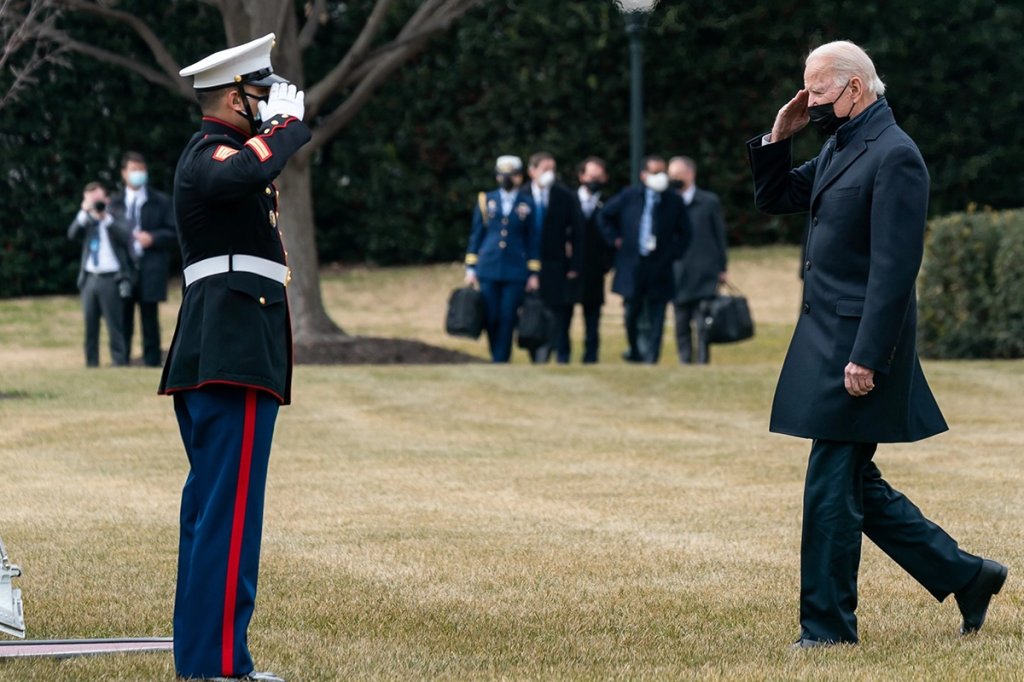
More importantly, it’s a reminder. Every time someone sees a military aide trailing behind the president at a NATO summit or boarding Air Force One, it’s a reminder that the United States maintains the ability to end a nuclear conflict on its own terms, anywhere, on a moment’s notice.
Don’t Miss the Best of We Are The Mighty
• Eisenhower’s ‘Atoms for Peace’ program started Iran’s nuclear program
• 32 times when the U.S. military screwed up with nukes
• These are 10 of the longest-serving weapons in the US combat arsenal