The 1950s were a time of rapid innovation in aviation. The world emerged from World War II with an intense curiosity about new technologies and a heightened interest in military superiority. The Cold War was beginning to heat up, and the U.S. military was focused on developing any technology that might provide a strategic advantage.
Related: The powerful tilt-wing XC-142A was your granddaddy’s Osprey
Among the most fascinating experiments of this era were the Hiller YROE-1 Rotorcycle and the Hiller Flying Platform, two pioneering attempts at creating single-person aircraft that could redefine reconnaissance, personal mobility, and combat strategy. Though neither would ever see operational military service, their development marked a significant chapter in the evolution of vertical flight and personal aircraft.
The Origins of Personal Helicopters
In the aftermath of World War II, the U.S. military recognized that the battlefield was changing. Mobility was critical, and the ability to quickly transport personnel, relay messages, or perform reconnaissance behind enemy lines was increasingly valuable. Traditional helicopters, while revolutionary, were bulky and required significant infrastructure. The idea of a personal, collapsible aircraft, a “one-man helicopter,” emerged as a potential solution for rapid, tactical mobility.
It was in this context that Hiller Aircraft Corp., a company already known for its pioneering work in rotorcraft, embarked on two ambitious projects under U.S. Navy and Office of Naval Research sponsorship: the Hiller YROE-1 Rotorcycle and the Hiller Flying Platform. These experimental designs sought to push the limits of what was possible in personal aviation and vertical takeoff and landing technology.
The Hiller YROE-1 Rotorcycle

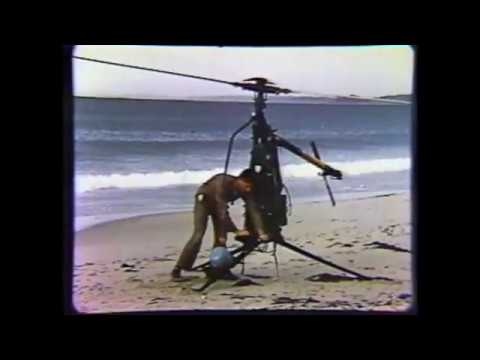
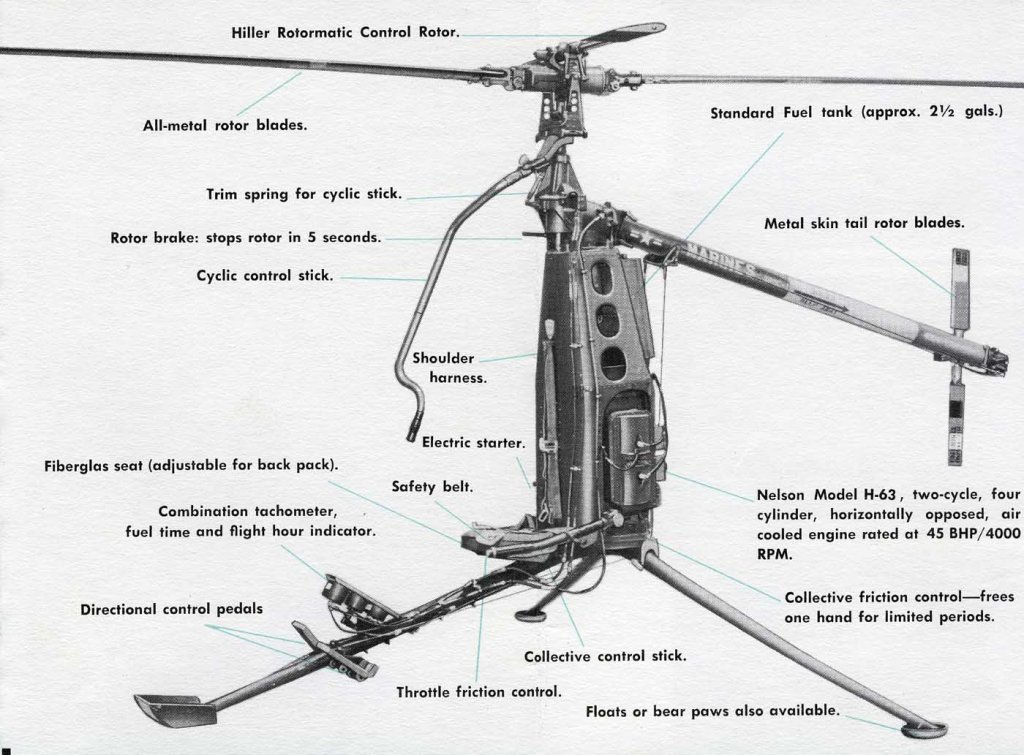
The Hiller YROE-1 Rotorcycle was, in essence, a personal helicopter; a compact, single-person craft designed to be light, portable, and relatively simple to operate. Its primary mission was envisioned as reconnaissance and liaison duties for the U.S. Marine Corps. The Rotorcycle was not intended for high-speed combat or heavy transport. Instead, it was intended for deployment in environments where conventional helicopters could not easily operate.
The Rotorcycle featured a conventional main rotor and tail rotor configuration, much like a scaled-down version of the helicopters that had proven their worth during the Korean War. Its collapsible frame allowed it to be packed, transported, and even dropped by parachute to downed pilots or isolated units, an innovative feature aimed at providing small, dispersed forces with a rapid means of mobility.
One of the most remarkable aspects of the Rotorcycle was its simplicity. According to program descriptions, the aircraft was considered so stable and straightforward that Hiller expected a nonpilot to be able to solo it after only about eight hours of instruction. Its cruise speed was about 52 mph, and it had a practical operational range of about 40 miles in calm conditions, making it suitable only for short-range missions.
Despite its compact design, the Rotorcycle had clear limitations. Its modest speed and short range restricted its operational flexibility, and its lightweight, open structure left the pilot highly vulnerable to small-arms fire. These realities weighed heavily against its potential use in a combat environment.
XROE Rotorcycle
Military Evaluation
The Marine Corps, intrigued by the potential tactical applications of a one-person helicopter, ordered five YROE-1 evaluation models. The goal was to determine whether the Rotorcycle could serve as a personal observation and liaison aircraft in realistic conditions, including rescue, escape and evasion, and special tactical missions. The concept was bold: a single Marine could assemble the compact aircraft, fly short hops across dangerous terrain, gather intelligence, or escape capture using a machine that needed little support.
However, the Rotorcycle faced significant challenges during testing. Its slow speed and limited range constrained its usefulness, and its vulnerability to enemy fire raised serious concerns about survivability in combat. Practical issues such as maintenance in rough field conditions, fuel supply, and the need to keep a collapsible airframe mechanically tight also complicated the picture.
Ultimately, the Corps did not accept the YROE-1 for military service, concluding that its slow speed and minimal 40-mile range made it unsuitable for combat deployment despite its innovative design and promising test results. Even so, the Rotorcycle’s development contributed to understanding light-helicopter dynamics, compact structures, and simplified pilot control systems.
While the Rotorcycle never saw operational service, its legacy is evident in subsequent innovations in personal and unmanned aircraft. The Navy later adopted an unmanned derivative of a competing manned Rotorcycle design from Gyrodyne, the YRON-1, as the QH-50 DASH (Drone Anti-Submarine Helicopter). The QH-50 became an important tool for anti-submarine warfare aboard destroyers, demonstrating that the concept of small, specialized rotorcraft could have practical applications when adapted for unmanned use.
The YROE-1 Rotorcycle also served as a valuable learning platform for rotorcraft engineers. Its development refined knowledge of compact helicopter aerodynamics, collapsible structural design, and rapid training requirements for nonpilot operators. In many ways, it laid the groundwork for further exploration of small vertical takeoff and landing aircraft, including unmanned systems and compact VTOL concepts that continue to evolve today.
The Hiller Flying Platform
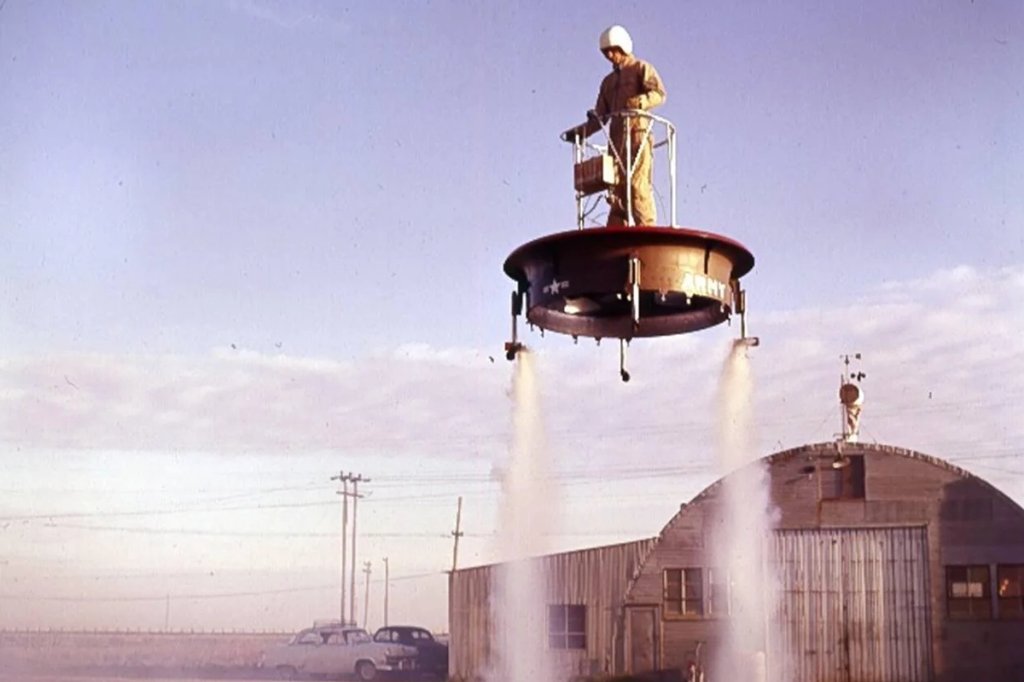
While the Rotorcycle explored the possibilities of a compact helicopter, the Hiller Flying Platform took a different approach to personal flight. Developed beginning in 1953 under an Office of Naval Research contract and later evaluated by the Army as the VZ-1 Pawnee, the Flying Platform was a one-man, hover-capable vehicle designed to provide the operator with intuitive, direct control. Rather than a conventional rotor system, the Flying Platform relied on two counter-rotating ducted fans enclosed within its base. Small Nelson piston engines powered these fans, producing lift and allowing the platform to rise vertically off the ground.
The most innovative aspect of the Flying Platform was its kinesthetic control method. Instead of relying solely on traditional cyclic and pedal inputs, the pilot could steer by shifting body weight in the desired direction while using simple hand controls for power and torque. Lean forward to move forward, tilt to the side to bank, and so on. This system was intended to be highly intuitive, offering an almost instinctive form of control that required relatively little training compared with a conventional helicopter.

The Flying Platform was designed for low-altitude flight and short-range mobility, emphasizing stability and ease of control over speed or endurance. Its creators envisioned it as a potential solution for rapidly transporting individual soldiers across difficult terrain, providing reconnaissance capabilities, or even serving as a mobile observation post hovering just above the ground.
Despite its design’s ingenuity, the Flying Platform faced severe practical limitations. Its speed and range were modest, and it operated primarily within ground-effect altitudes. Later Army-configured Pawnee versions added a third engine and additional structure for redundancy, increasing weight and eroding the effectiveness of pure kinesthetic control, leading to more conventional controls. The small size, limited speed, and low operating altitude made it highly vulnerable to small-arms fire, and its performance outside the cushion of air near the ground was marginal. The U.S. Army ultimately judged the platforms impractical as combat vehicles and did not put them into production.
Pioneering Vertical Flight
Although neither the Flying Platform nor the Rotorcycle entered service, both projects were instrumental in advancing the field of vertical flight. The Flying Platform, in particular, contributed to understanding ducted-fan aerodynamics, direct-lift vehicles, and the concept of single-person vertical takeoff and landing platforms. These lessons influenced later experimental aircraft and fed into the broader lineage of ducted-fan VTOL designs.
The Flying Platform also demonstrated the feasibility and limitations of kinesthetic control systems. The idea that a human operator could influence aircraft movement through natural body motion was ahead of its time. It foreshadowed modern research into intuitive flight-control interfaces, motion-sensitive controllers, and highly automated systems that translate human intent into stable flight.
The Modern Evolution of VTOL
The legacy of Hiller’s personal aircraft is visible today in modern vertical takeoff and landing innovations. The U.S. Air Force, through its AFWERX and related innovation programs, has awarded multiple research and development contracts to Transcend Air to advance high-speed VTOL concepts, including the Vy 400 family, for both civil and military applications. These aircraft are being designed to combine the hover capability of helicopters with the speed and range of fixed-wing aircraft, and to operate independently of runways.
Key aspects of this collaboration include AFWERX and other U.S. Department of Defense funding, which provide R&D contracts to support Transcend Air’s high-speed VTOL work, including “nap-of-the-earth” low-level flight intended to make rescues and small-unit support missions significantly faster than with conventional helicopters. Transcend Air’s Vy 400 concept is designed to cruise at about 405 mph with a range of roughly 450 miles, carrying a pilot and several passengers, according to company and industry reports.
Transcend Air has advanced in the AFWERX High-Speed VTOL Concept Challenge and works with Auburn University on advanced flight-control development for high-speed, low-level VTOL profiles. The company has also signed a memorandum of understanding with IAI North America, which serves as its defense partner for militarizing and marketing Vy family aircraft for missions such as small-unit resupply, casualty evacuation, and runway-independent operations.
This modern initiative illustrates the enduring relevance of early experiments like the Rotorcycle and Flying Platform. The pursuit of compact, highly maneuverable vertical flight platforms has evolved from one-man machines into sophisticated VTOL systems that may shape the next generation of battlefield mobility and regional air transport.

Hiller Flying Platform
Both the Hiller YROE-1 Rotorcycle and Flying Platform underscore the challenges of translating experimental aviation concepts into operational military hardware. Their histories highlight key lessons: the vulnerability of light, compact aircraft in contested environments; the difficulty of combining extreme simplicity with adequate performance; and the value of VTOL and urban air mobility research for future aircraft. They also show how ideas that may be impractical in manned form can succeed when adapted to unmanned platforms.
Today, the dream of personal or highly flexible vertical flight is closer to reality than it was in the 1950s, even if it looks different than early visions. The pioneering work of engineers like Stanley Hiller helped set the stage for modern drones, ducted-fan VTOL aircraft, and high-speed tiltwing designs such as the Vy 400, demonstrating the enduring value of early experimental research.
A Legacy Above the Ground
The Hiller YROE-1 Rotorcycle and Hiller Flying Platform remain fascinating milestones in the history of aviation. Both projects were products of an era defined by ambition, innovation, and optimism, a time when engineers imagined a world in which individuals could rise into the air on vehicles no larger than a motorcycle or circular platform.
While neither aircraft entered operational service, both advanced human understanding of vertical flight, control systems, and personal aviation. The Rotorcycle’s lessons informed later development of light helicopters and unmanned rotorcraft. The Flying Platform’s kinesthetic control concept inspired new ways to think about human-machine interaction. Modern VTOL initiatives, including high-speed tiltwing concepts, continue the pursuit of faster, more versatile, and more flexible vertical lift solutions.
These machines and projects serve as reminders that progress often requires experimentation, even when immediate success is not guaranteed. The spirit of innovation embodied by these vehicles—risk-taking, imagination, and relentless curiosity—remains at the heart of aviation today, inspiring engineers, inventors, and dreamers to redefine what flight can be.