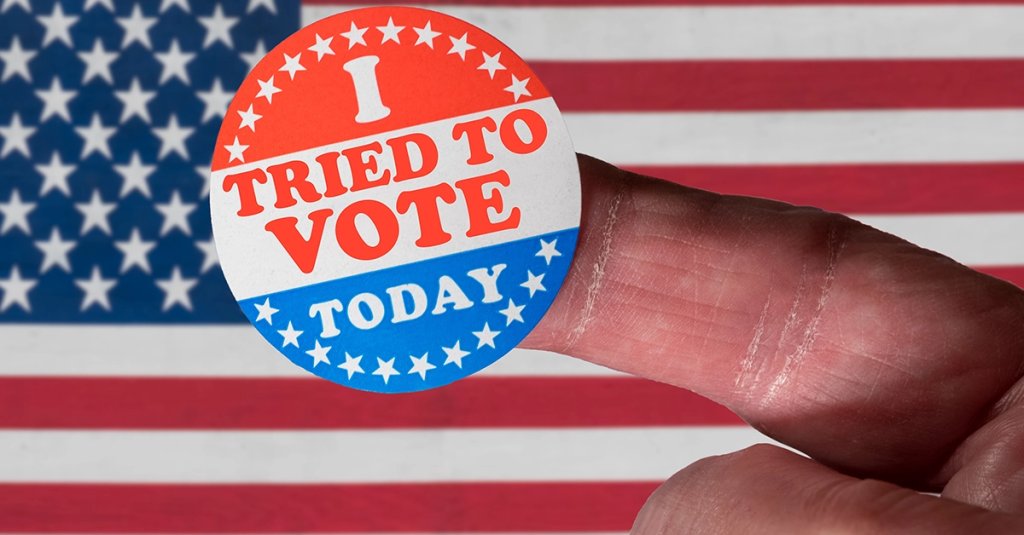
For a veteran who has spent years passing through checkpoints and accessing secure federal zones with a simple flash of a uniformed services ID, the card feels like the ultimate proof of standing. It is a document issued by the Department of Defense (War), a credential that functions as a universal “welcome, sir/ma’am” in most interactions with the federal government.
But as the 2026 election cycle approaches, that piece of plastic is increasingly running into state-level requirements it was never designed to satisfy.
Read Next: Everything to know about military pay and benefits in 2026
A military ID, such as a retiree card or Common Access Card (CAC), is considered proof of identification, although not proof of citizenship. While it will confirm who you are when accessing a base, VA care, or travel within the US, it often fails when used to prove citizenship during voter registration or if you find yourself needing to challenge an existing registration.
This nuance matters more now than it did in past elections, as it will affect not only you but also your family and friends. As usual, we have you all covered like a woobie, so let’s break down what this might mean for 2026 and how you can mitigate potential pitfalls.
Credentials for Service, not Elections
What might come as a surprise is that the U.S. military is not composed exclusively of U.S. citizens. Tens of thousands of non-citizens currently serve on active duty or in the reserves, while many more non-citizens live in the United States as veterans after completing their service.
Because the Department of Defense issues essentially identical identification cards to citizens and legal permanent residents, military IDs do not display citizenship status. The card verifies identity and military affiliation, but not nationality.
Now, this rarely matters in federal or military contexts. Backend systems can verify status through secure databases. In civilian election offices and local polling places, on the other hand, those systems simply do not exist. For election officials tasked with enforcing voter eligibility laws, a military ID may confirm a person’s identity but does not, on its own, provide documentary proof of U.S. citizenship.
As states place greater emphasis on documentation during registration and voter-roll reviews, this gap creates problems for veterans who just assume their service records will speak for themselves. This is a mistake.

Identity vs. Status
The confusion has been compounded further by the nationwide implementation of the REAL ID Act in May 2025. Under the REAL ID rules, military identification cards remain acceptable for domestic air travel and access to federal facilities. Acceptance is limited to identity verification alone.
What the REAL ID Act does not regulate is elections, but its rollout has cemented a common misconception: that federally issued identification is acceptable across the board. Travel security focuses on risk mitigation and identity assurance. Election law, by contrast, increasingly centers on legal status, more specifically citizenship, at the point of registration or whenever a voter’s eligibility is questioned.
This implies that a military ID serves as proof of identity, not proof of legal eligibility to vote. Period.
Proof for the Polls
As lawmakers push for stricter registration standards, this subtlety matters even more. Legislation such as the Safeguard American Voter Eligibility (SAVE) Act, which passed the House of Representatives in early 2025, would require states to obtain documented evidence of citizenship at the time of voter registration.
The bill has not become law, and election rules still vary by state. There is no denying the suggestion of a broader shift already underway at the state level. Under proof-of-citizenship models, commonly held government IDs, including driver’s licenses, REAL IDs, and military identification cards, DO NOT qualify on their own.
Veterans would need not only their military ID, but also an additional form of ID, such as a U.S. passport or a certified birth certificate. Clearly established American citizenship is the core concept.
For example, in some proposals, a military service record, such as a DD-214, may satisfy that requirement ONLY if it clearly lists a place of birth in the United States.
Not all states require such documentation yet, and not all legislation shaping the 2026 landscape has been enacted. Even though some remain hypothetical, the direction these winds are blowing is crystal clear: responsibility is shifting away from sworn statements and legacy registrations and toward individuals producing very specific documents on demand.
The Admin Trap

Several states, including Virginia, Arizona, and Georgia, have made voter-roll maintenance more aggressive, with election officials using state and federal databases to identify registrations that cannot be immediately verified.
The mechanics will differ by state, but the consequences can be similar. A voter flagged during an audit may be required to provide additional documentation to remain on the rolls. In those cases, a retired military ID or CAC card does little to resolve the issue.
Arizona provides a great example. Under its dual-track system, voters who cannot provide documentary proof of citizenship may be restricted to a federal-only ballot, barring them from voting in state and local races. For veterans who registered decades ago, often long before such requirements existed, this can come as a kick in the pants.
For older veterans, the problem is often practical rather than ideological. Many no longer have ready access to a certified birth certificate. Others never needed a passport during their working years. Replacing those documents can take time, money, and persistence, resources not all veterans have in abundance.
This is not a theoretical concern. It can directly determine whether a veteran’s ballot is counted in the 2026 election.
Constant Vigilance
Relying solely on a military ID to protect your voting rights in 2026 is a risky assumption. The same credential that grants access to a VA medical center is often insufficient on its own in states that have adopted, or are moving toward, document-based eligibility systems.
The burden of proof increasingly rests with the individual voter. Prior participation, honorable service, or long-standing registration no longer guarantees insulation from review.
Being prepared now means treating voting documents the same way you treated your LES. Never, ever assume; always verify early and confirm just as often.
Veterans should check their registration status well ahead of state deadlines and ensure they have citizenship documents, such as a passport or certified birth certificate, readily available if questions arise.
Election law is changing, and assumptions that once seemed steadfast are being tested. In a system defined by paperwork, having the wrong document can be the equivalent of having none at all. Waiting for a registration notice to discover the problem may already be too late.