
The term “Broken Arrow” means different things to different people. If it means the 1950 Jimmy Stewart western, you’d be correct. If it’s the 1996 film starring John Travolta, you would also be accurate, and a bit closer to the topic.
If you’re in the military, it’s the last term you want to hear.
In 1950, America was locked in a cold war with the Soviet Union, ready for nuclear war at any moment. Civilians were building bomb shelters in their backyards, and children were drilled on how to hide under their school desks to shield themselves from a nuclear blast. The U.S. military was training forces to respond to a nuclear war, and nuclear weapons were being designed for every branch of the armed forces. The Air Force, for its part, needed to train its pilots and ground crew to fly with the weapons in case of a nuclear war.
In February 1950, Flight 2075, a Convair B-36B Peacemaker assigned to the 7th Bombardment Wing at Carswell Air Force Base, was on a training mission to simulate a nuclear strike on a major city in the Soviet Union. The B-36 was assigned to fly 5,500 miles over 24 hours from Eielson Air Force Base, Alaska, west over the panhandle, then turn back into Washington state. The bomber would then climb to 40,000 feet and head towards California for a simulated nuclear bomb run on its “target”, San Francisco, and then return to Carswell.
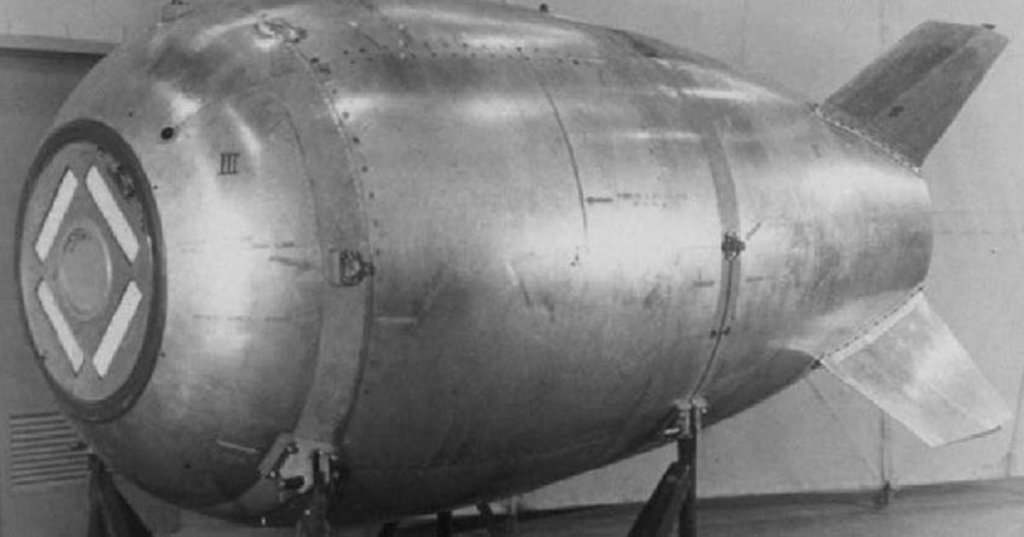
At the time, nuclear weapons were in the possession of the Atomic Energy Commission. Strategic Air Command (SAC) leaders had been lobbying for a nuke to use on a training mission, and the AEC finally loaned them one. The loaner was a Mark 4 atomic bomb, an updated version of the Mark 3 “Fat Man” dropped on Nagasaki. Weighing almost 11,000 pounds, the bomb contained a large amount of uranium and approximately 5,000 pounds of conventional explosives. The plutonium core was not included, and the bomb was fitted with a lead-filled dummy capsule, which prevented a nuclear blast.
The B-36 was a massive, complicated aircraft with a standard crew of 15. This model of the B-36 was equipped with six piston engines. Starting with the D model, Convair added four jet engines, which created the slogan “six turnin’ and four burnin’.” The Peacemaker took off from Eielson, where the ground temperature was -40 degrees Fahrenheit, but since the base is located approximately nine miles from the North Pole, frigid temperatures were a common occurrence.
After takeoff, the mission began having problems due to the cold. Ice started forming on the fuselage and carburetor intakes, causing the Peacemaker to lose altitude at a rate of 500 feet per minute. About seven hours into the mission, flames began shooting out of three of the six engines, and the other three could not keep the massive aircraft and its heavy nuclear payload aloft.
The decision was made to bail out.
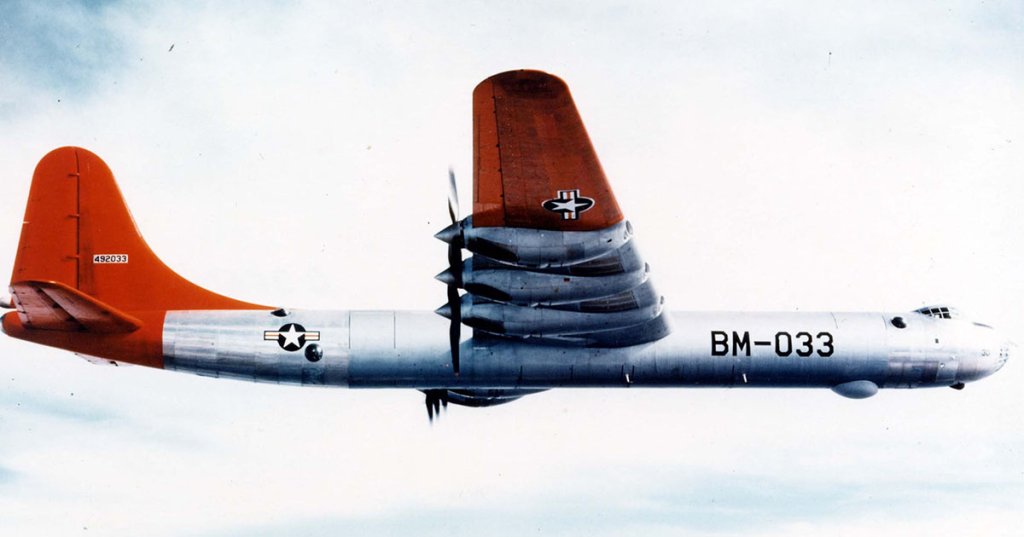
As per protocol, the Mark 4 was jettisoned over the Pacific Ocean, and the conventional explosives were detonated to destroy the bomb and keep the top secret components from the enemy. The pilot, Capt. Harold Barry, placed the bomber on autopilot and the crew began to bail out into the freezing darkness near Princess Royal Island. The B-36 lumbered on for another 200 miles and crashed into Mount Kologet in British Columbia, Canada.
This mission had a crew of 15, a mission commander, and a weaponeer. Of the 17 men aboard, 12 survived. The subsequent search and rescue mission involved over 40 aircraft. One of the crew members was found hanging upside down from a tree, still strapped in his parachute with a broken ankle. Of the five missing, one was recovered years later at the crash site, and the other four were presumed to have landed in the ocean and died of hypothermia. When notified of the crash, the Royal Canadian Air Force launched a rescue mission, but was never told of the nuclear weapon aboard.
Captain Barry and the surviving crew members were questioned by military investigators, who all confirmed that the bomb was jettisoned and destroyed. Ultimately, investigators using additional evidence from the crash site concluded that extreme weather conditions caused the crash.
For years, rumors swirled that there was a nefarious plan to steal the bomb. Of the missing crew members, one was the weaponeer who was familiar with the Mark 4 design. But the crash site was not found until 1953, because the aircraft was presumed to have crashed into the ocean. A recovery team was dispatched, but it was unable to reach the site. In 1954, a U.S. Air Force search team finally reached the site. They recovered top-secret equipment and destroyed the wreckage using explosive charges.
The site remained untouched for 40 years, and in 1997, teams from the U.S. and Canada reached the wreckage to conduct radiation tests, which came back negative.
Unfortunately, America’s first Broken Arrow wouldn’t be its last. To date, the U.S. Military has had 32 nuclear weapons incidents where a weapon was accidentally launched, damaged with nuclear contamination, and six cases in which the device was never recovered.
Don’t Miss the Best of Mighty History
We Are The Mighty is a celebration of military service, with a mission to entertain, inform, and inspire those who serve and those who support them. We are made by and for current service members, veterans, spouses, family members, and civilians who want to be part of this community. Keep up with the best in military culture and entertainment: subscribe to the We Are The Mighty newsletter.