Both wars and those who fight those wars have undergone dramatic changes in the last few centuries. Just as uniforms went from ill-fitting wool to wrinkle-free, camouflaged outfits with their own pesticidal qualities, the role of people has also changed. And not just soldiers, but the spouses who stand behind them.
Even though it was only males who were allowed to join the service until relatively recently, the wives of those males were expected to take on some extraordinary roles—and those roles have also evolved. Take a look at these former military spouse responsibilities that no longer exist today.
1. Making and Creating Supplies
In a time where “in regulation” was flexible—if it was a thing at all—it was military spouses sewing uniforms for all. Not just their spouse, either. If there were a skilled seamstress, she might have sewn uniforms, flags, and more for the entire unit. Extras may have been made if there was enough fabric available. Meanwhile, military spouses were also manufacturing ammunition behind the lines. Stuffing gunpowder or gathering metal pieces to use as cannon shot were also regular military spouse jobs.
Also, soldiers had to eat and there was no DFAC to provide a meal. Instead, wives and other family members cooked for a crowd, delivering meals to training areas or even directly to the front lines of battle. Once again, they didn’t tend strictly to their soldier, but to the unit as a whole, to ensure all were fed and fueled for whatever might be ahead.
2. On-Duty Nurse
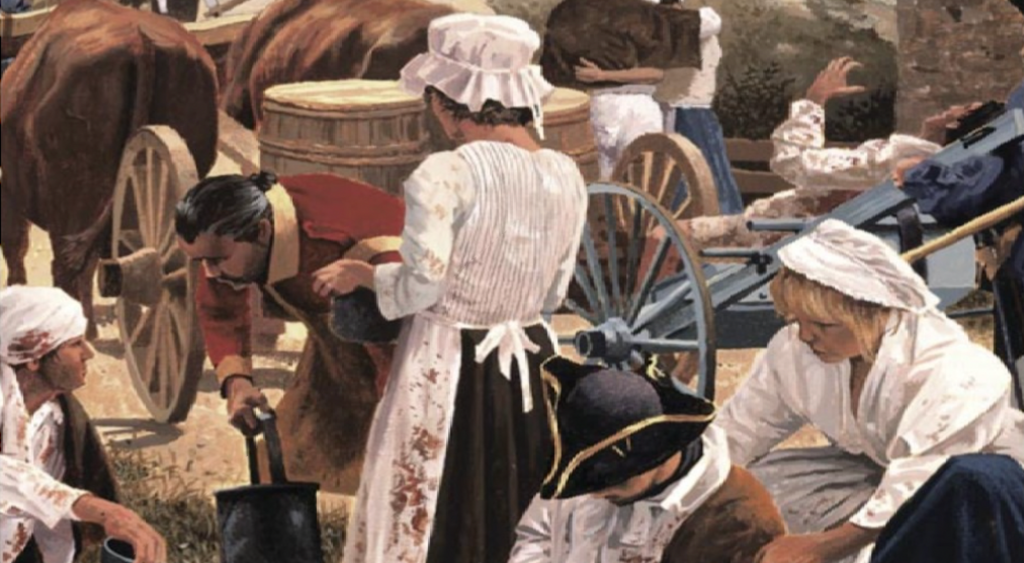
Today, nurses are members of the military themselves, and in most cases, only trained medics are allowed on-site. But during the Revolutionary War, military spouses tended to the wounded, sometimes even during a battle. They would clean and bandage wounds and share information about which soldier needed to be moved. In other cases, military spouses would nurse the wounded back to health in their home. The Continental Army, in particular, hired females to serve as nurses. They were paid $8 a month (about $334 today), and it was considered undesirable due to the constant horrors of the battlefield.
The Continental Army had around 2,000 women by the winter of 1777. Most were employed, but some simply found it to be a safe place among the crowd. Others caused problems, like earning money through prostitution among the soldiers, stealing, or defying military orders, which was a point of contention for Gen. George Washington.
3. Socialization
Military spouses still spend time together, but social norms are far different from those of centuries prior. For instance, the wives of Nathanael Greene and Henry Knox, both generals, hosted events to boost morale, especially during winter camps. During low military activity, Catharine Greene hosted a dance on-site in March 1779. Elizabeth Hamilton served tea in May 1781 at the New Windsor headquarters, while Martha Washington gave dinners at Hasbrouck House headquarters in 1782 and 1783.
It was common for wives to accompany the Continental Army, a result of both the need to provide them with a role and keep them occupied. In fact, George Washington was known to worry about the number of women and children accompanying the infantry regiments. Not only did they consume more rations, but it was also more difficult for units to move with their families in tow.
4. Fighting As Needed
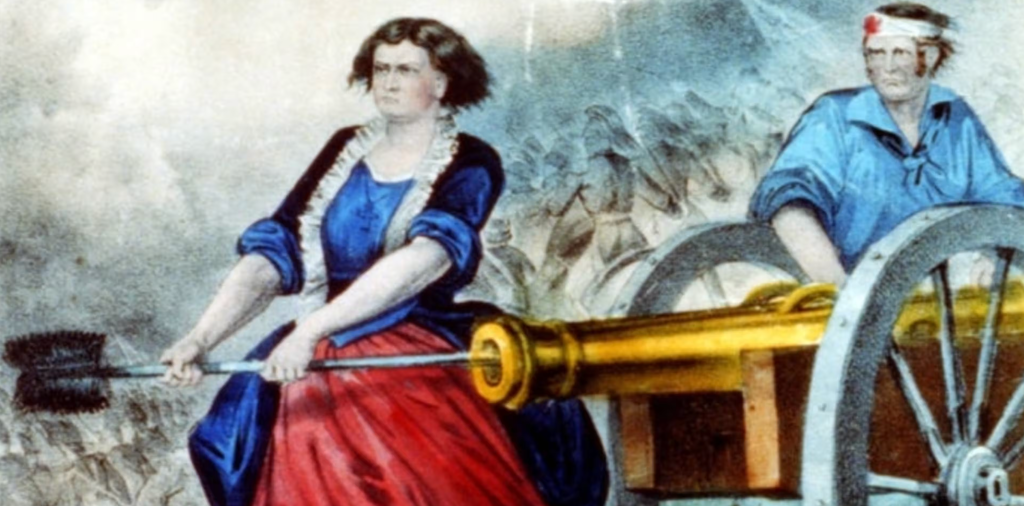
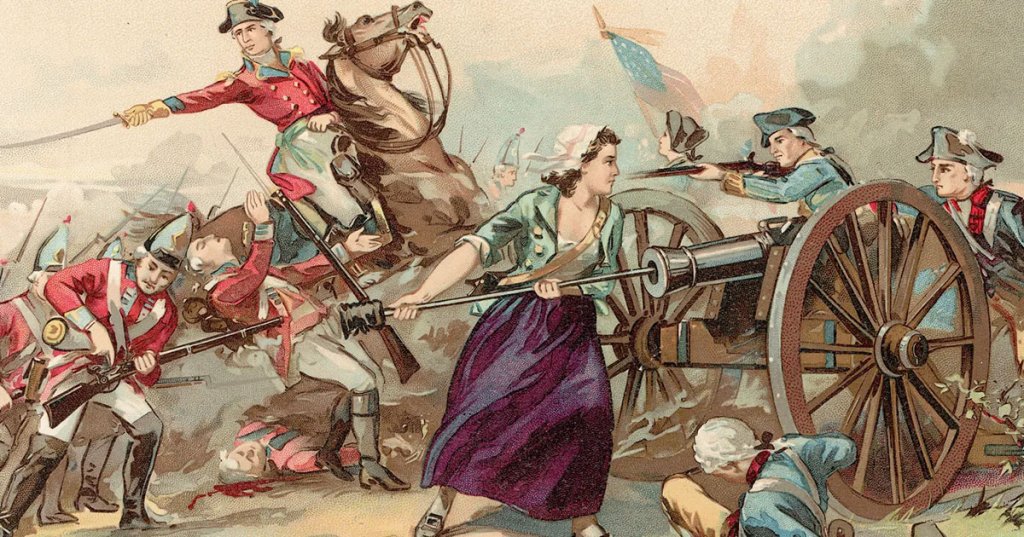
Though rare, there were times when military spouses fought in wars. Some disguised themselves as males to take on the front lines with gusto, while others simply reacted when put into a bad situation. The latter is true for Mary Ludwig Hays, better known to history as Molly Pitcher. A Continental camper, Hays brought fresh water to soldiers from a nearby well during a battle. As she was returning with refreshments, her husband was wounded. Rather than run for help, she took up his position in the artillery and began firing at the British. She is still remembered for these efforts during the Battle of Monmouth in 1778.
Another milspo, Margaret Corbin, did the same thing two years prior, in 1776. Corbin was wounded and left for dead, but recovered from her injuries. Although she remained disabled, she was the first American woman to secure a full pension on her own accord (not her husband’s).
5. Rationing Food and Other Supplies
By the time the First World War came along, military spouses were off the battlefields and left at home. This is also likely because World War I was fought on foreign soil. Not only did that mean women were taking over labor-intensive jobs—cue Rosie the Riveter just a few years later—but they were also making adjustments to support the war effort. When rations on food and common supplies were put into place by Uncle Sam, milspouses who rationed key items were considered patriotic.
6. Entertaining via Writing

Today’s military spouse can call their partner or leave a text at any time of day. But before there were electronics, and before we could call long-distance (without spending a fortune and tying up a single phone line), there were letters.
Writing and receiving letters was all the soldier could do to hear from home, and they would read those letters over and over again. It was up to the spouse to update their soldier with any important news and share what the family was up to. This was the only form of communication most troops had.
7. Off-Site Morale (Sometimes for Strangers)
On a similar note, soldiers were in need of morale, especially those who were single. Milspouses and often other volunteers spent time helping to write letters or send pictures. It was not uncommon for a couple to “court” by writing letters. Some remained a couple after the war, others simply enjoyed the company while it lasted.
It was a way to pass the time and boost spirits for both troops and families. Those at home received updates on what was happening on the front lines, while letters served as a distraction for soldiers and boosted their spirits. This was common up through the Vietnam War, when telegrams became popular. However, letters were more affordable, easier to send, and thus remained part of the normal wartime routine.
8. Volunteering and/or Working
During World War II, the U.S. workforce underwent a significant transformation. Women worked before the war, of course, but when young men went overseas in droves, women then had to work. They took on difficult and labor-intensive careers to keep the country running smoothly.
A power struggle began as men came home, not used to sitting in the backseat to hardworking females. Meanwhile, women enjoyed their jobs and didn’t want to give them up. For some, this meant an impossible thought: returning home for homemaking; they wanted to remain in their careers. In subsequent wars, it remained common for women to work; however, fewer soldiers had been deployed, so the need for a female labor force was not as great.
Today, there remains considerable uncertainty regarding the roles of military spouses. However, there is more in the way of communication and news, and less in what’s expected to be done. Sure, there is still volunteering and socializing, but women don’t man the battle just because of their spouse; they do it because they themselves join the military. The same is true of maintaining living quarters and other outdated practices.