
The C-2 Greyhound is subbing in for the grounded CMV-22 Osprey

Unlike the C-2A Greyhound, the Osprey is able to carry the Pratt & Whitney F135 engine that powers the F-35 Lightning II.
A United States Navy propeller aircraft, marked with the number 22 and "VRC-30," is captured mid-air just above the deck of an aircraft carrier, with the ocean and clear blue sky in the background. The aircraft's landing gear is extended, and several crew members are visible on the deck.
(U.S. Navy)

On December 14, 2021, the CMV-22B Osprey reached initial operational capability with the Navy to perform the carrier onboard delivery mission. Unlike the C-2A Greyhound, which it is replacing, the Osprey is able to carry the Pratt & Whitney F135 engine that powers the F-35 Lightning II. However, following the fatal crash of an Air Force Special Operations CV-22 in late November 2023, all but one Osprey squadron across the U.S. military have been grounded. To pick up the slack, the Navy is relying on the legacy Greyhound.
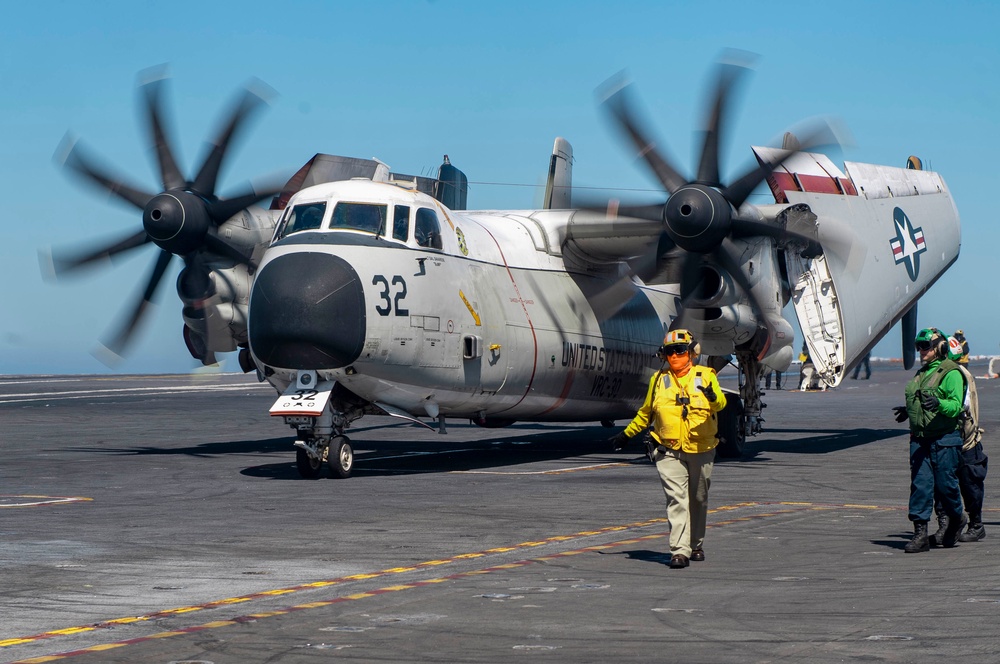
A military transport aircraft with spinning propellers is on the deck of an aircraft carrier. The aircraft is white with the number "32" on the nose and "UNITED STATES" partially visible on the fuselage. Two crew members in green uniforms and one in a yellow jacket and helmet are walking on the deck near the aircraft. The aircraft's tail section is raised, revealing an open cargo door. The sky is clear and blue.
A C-2A taxis on the deck of USS Nimitz (CVN-68) (U.S. Navy)

With F-35s rolling out to the Pacific Fleet, C-2s were transferred from Naval Air Station North Island, California, to Naval Station Norfolk, Virginia. There, the Greyhounds continued to support Atlantic Fleet carriers whose squadrons have not switched over to the F-35. With the CMV-22s grounded, C-2s are conducting COD missions in the Indo-Pacific region, specifically to support the USS Carl Vinson (CVN-70) in the Philippine Sea.
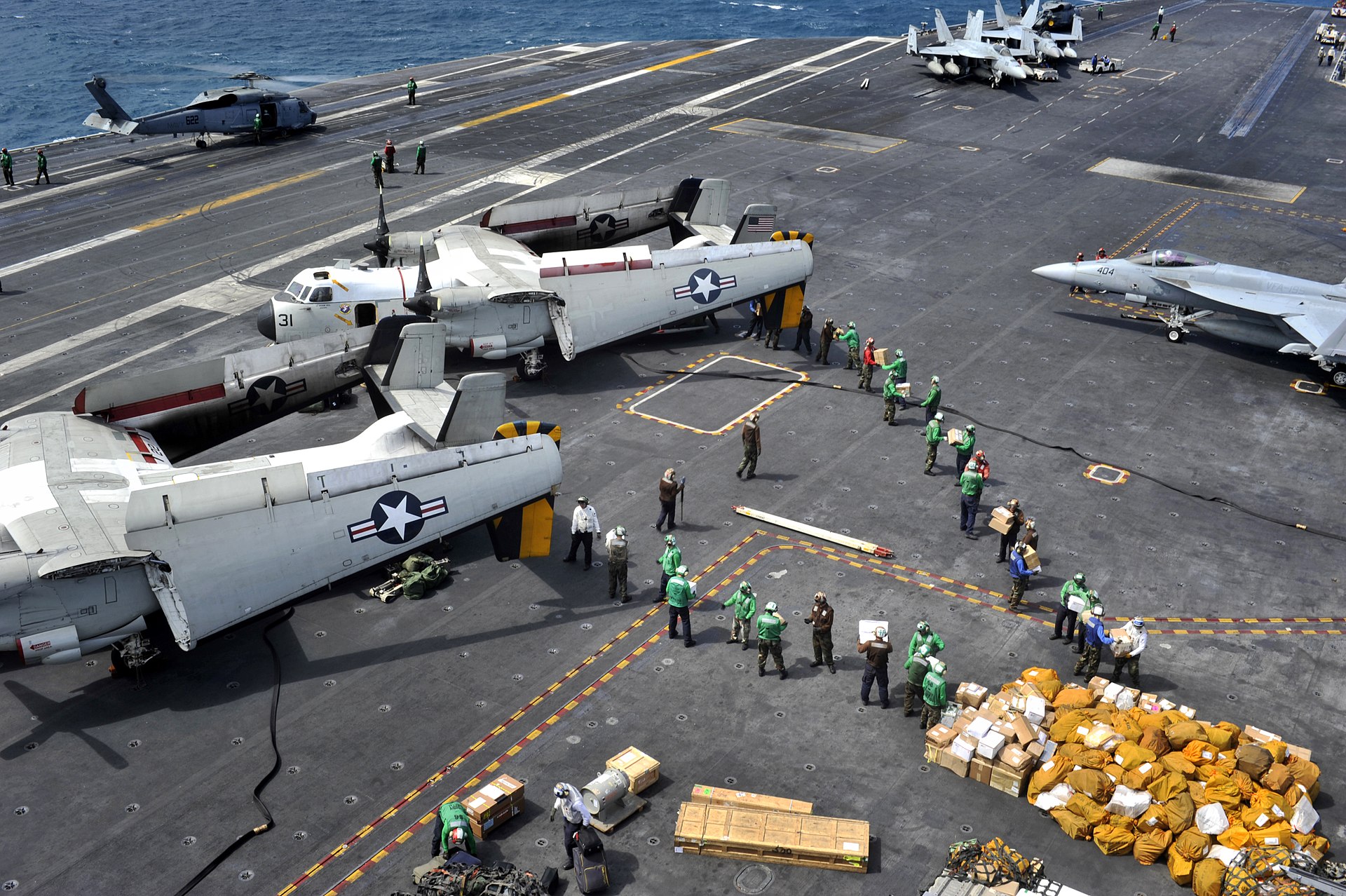
A military aircraft carrier deck with several aircraft, including three propeller planes with U.S. Air Force insignia, a helicopter, and multiple jet fighters. Numerous personnel in green, brown, white, and blue uniforms are handling and passing boxes and supplies in a line near a large pile of yellow and white packages. The ocean is visible in the background.
Mail is unloaded from C-2As aboard USS George Washington (CVN-73) (U.S. Navy)

Introduced in 1966, the Grumman C-2A Greyhound provides vital aerial logistics support to carrier strike groups. The twin-engine aircraft carries supplies, personnel, and mail between shore bases and carriers at sea. Although the C-2 is not as large as the CMV-22 it has a larger payload capacity. Moreover, the Greyhound’s pressurized cabin allows it to fly higher than the Osprey and above weather that the newer aircraft cannot.
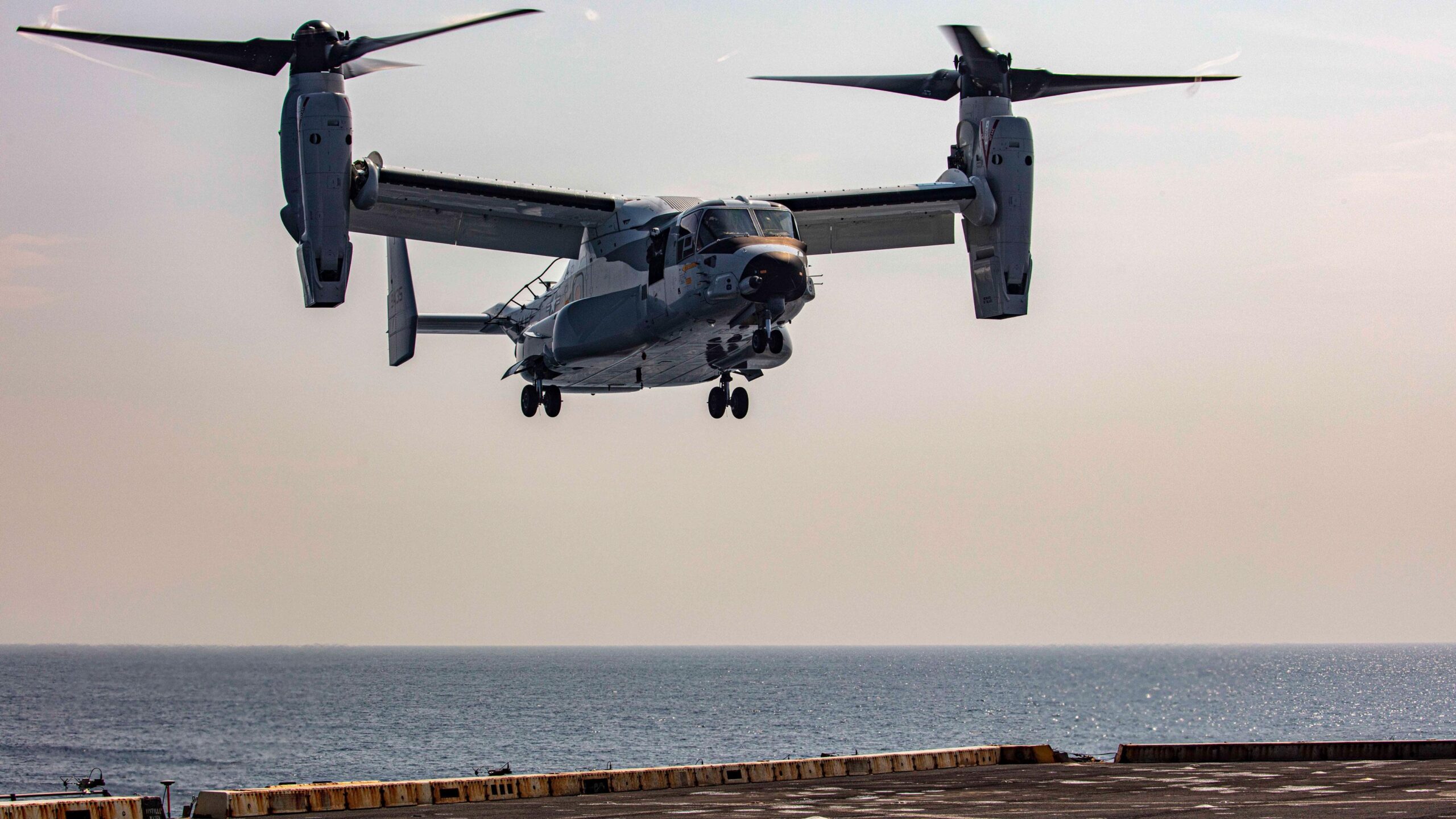
A military tiltrotor aircraft, likely a V-22 Osprey, is hovering above a ship's deck near the ocean. The aircraft has two large rotors mounted on nacelles at the ends of its wings, which are positioned vertically for vertical takeoff or landing. The sky is clear with a soft gradient from light to darker tones near the horizon.
A CMV-22B lands aboard USS New York (LPD-21) (U.S. Navy)

The Bell Boeing V-22 Osprey first flew in 1989. It entered service with the Marine Corps in its MV-22B variant in 2007. Two years later, the Air Force fielded its version, the CV-22B. Navy CMV-22B variants began flying COD missions in 2021. The world’s first production tiltrotor aircraft, the Osprey touts the ability to perform both vertical takeoffs and landings and short takeoffs and landings.
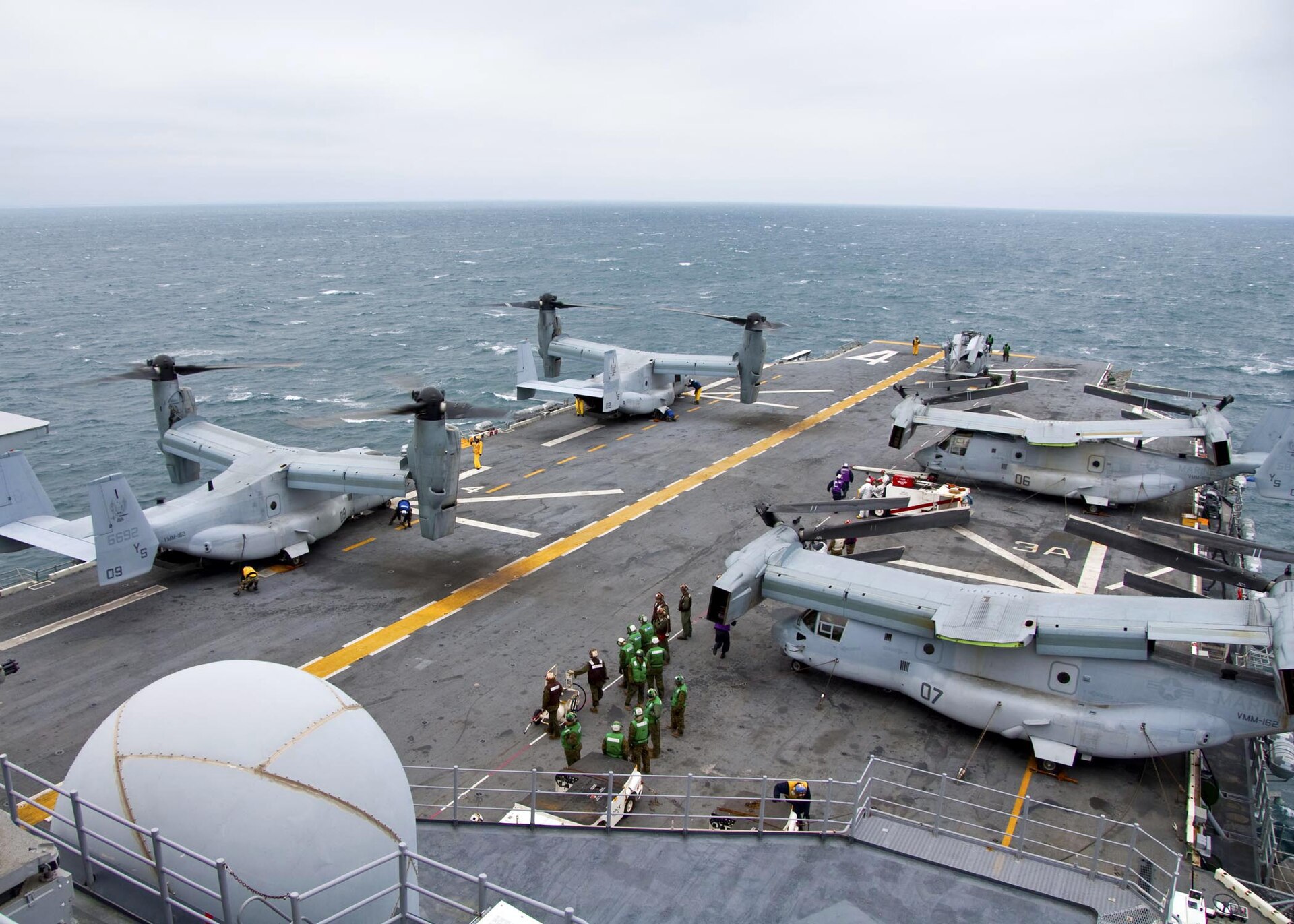
A naval aircraft carrier deck with four V-22 Osprey tiltrotor aircraft parked. Several crew members in different colored uniforms are gathered and working on the deck. The ocean is visible in the background under a cloudy sky.
Ospreys assigned to VMM-162 embarked aboard amphibious assault ship USS Nassau (LHA-4) (U.S. Navy)

In addition to being able to carry the F-35’s engine, the CMV-22’s tiltrotor operation allows it to operate from ships like amphibious assault, dock landing, and transport dock ships. However, the hard clutch of the tiltrotor continues to be a source of mishaps for the Osprey, with 13 crashes resulting in fatalities since it became operational in 2007. Since the November 2023 crash, only Marine Medium Tiltrotor Squadron 162 (VMM-162) continues to fly its Ospreys with special permission to support deployments in the Eastern Mediterranean.

READ MORE ON WATM: 

Miguel Ortiz Avatar

Miguel Ortiz

Senior Contributor, US Army Veteran

Miguel Ortiz graduated from San Diego State University and commissioned as an Army Officer in 2017. His passion for military culture and history led him to freelance writing. He specializes in interesting and obscure military history. When he’s not writing, Miguel enjoys traveling and watch collecting.


Learn more about WeAreTheMighty.com Editorial Standards