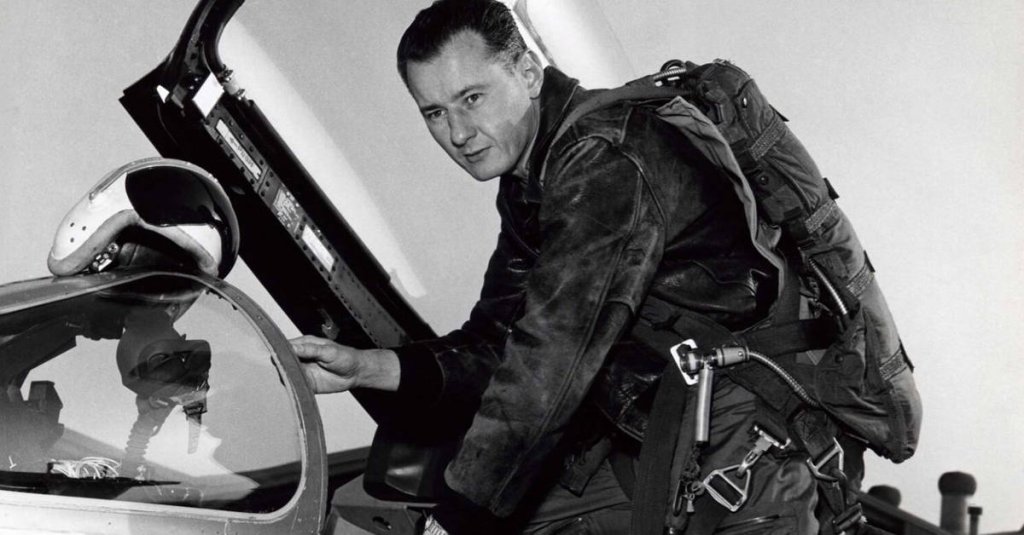
Bob Hoover was a U.S. Army Air Forces pilot stuck in a Nazi prison camp in Northern Germany after being shot down in 1944 over Southern France. By the next year, he’d spent 16 months as a POW and wasn’t going to stay there one minute longer. So he staged a fight between fellow prisoners, jumped over the Stalag’s barbed wire fence, and stole an unguarded Focke-Wulf 190 from the nearby airfield.
He then flew to Holland, which had just been liberated by the Allies. It was just one instance of his daring and his ability behind the stick of an aircraft—a skill he honed over the course of a lifetime.
As a child, Hoover was inspired by his parents talking about Charles Lindbergh’s transatlantic flight. By the age of 15, he had started a flying club at his high school. He took a job bagging groceries for $2 a week to cover the cost of 15 minutes of flying time. After becoming solo-certified, he began teaching himself aeronautical acrobatic moves.
He joined the Army Air Corps after enlisting in the Tennessee National Guard during World War II and was sent to Army Pilot Training School. He wasn’t shot down until his 59th mission.

Video from the Past [33] – Bob Hoover – American Test Pilot
Jimmy Doolittle, famous for his own daring flying raids, called Bob Hoover “the greatest stick-and-rudder man that ever lived.” It was high praise from another aeronautical legend, and for Hoover, who had been flying for only 10 years by the time the United States Air Force became an independent branch of service.
Hoover soon became an Air Force legend in his own right, joining the ranks of Doolittle, fellow Stalag Luft I prisoner Gabby Gabreski, and Chuck Yeager, just to name a few. He flew captured enemy aircraft in the Army Air Forces and later, experimental airframes in the Air Force, including the P-80, F-86, and F-100 Super Sabre, America’s first jet fighters.
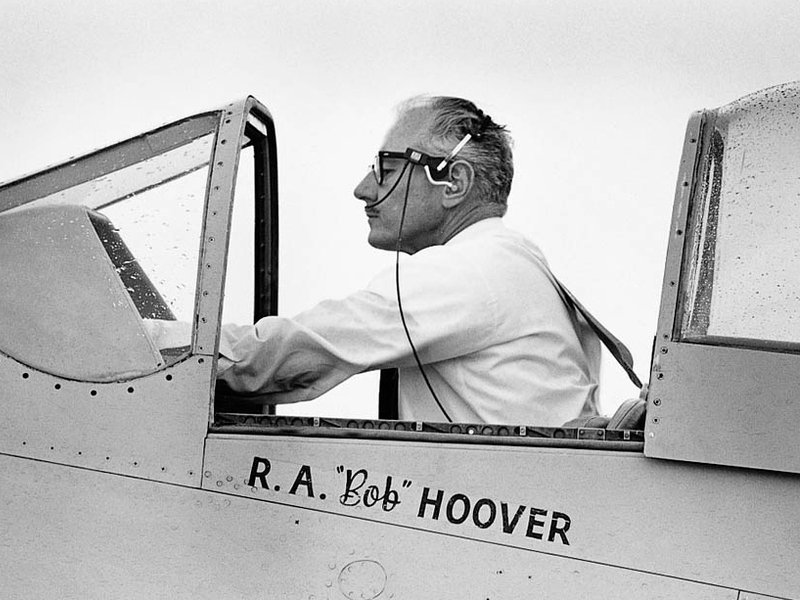
Not for nothing, he was also Chuck Yeager’s backup (and chase plane pilot) when Yeager broke the sound barrier in a Bell X-1 in 1947. His time testing aircraft even led Hoover to design technology to advance aviation development, including the “Hoover Nozzle” and the “Hoover Ring,” both safety devices for refueling piston engine aircraft.
Throughout his life, Hoover earned numerous awards and accolades, including the Distinguished Flying Cross, Purple Heart, and the French Croix de Guerre. He was also inducted into the National Aviation Hall of Fame and Aerospace Walk of Honor. The Blue Angels, Air Force Thunderbirds, and Royal Canadian Air Force Snowbirds inducted him as an honorary member.
After awarding him the Living Legends of Aviation’s “Freedom of Flight” Award in 2006, the nonprofit renamed the award after him the very next year.

Considered a “pilot’s pilot,” Hoover continued to fly in air shows until 2000. He died at age 94 on Oct. 25, 2016, near his home in Los Angeles. His memorial service the following November was a veritable “who’s who” of aviation history, including the granddaughter of his old friend, Jimmy Doolittle. Flying enthusiast Harrison Ford even made a speech, and Hoover’s funeral was one of the very few (if not the only one) that included a three-element flyover.
First came the U.S. Air Force Thunderbirds and the Royal Canadian Air Force Snowbirds, then followed an F-22 Raptor flying alongside two F-86 Sabres, and finally, World War II aircraft in a “missing man” formation.