For Anna Richardson, service was never just about wearing the uniform; it was about becoming someone who could help others heal. She joined the Army at just 19, seeking structure, purpose, and a healthier way forward.
“At that time, my life didn’t have much direction,” she told We Are The Mighty. “I saw the military as an opportunity not just to serve, but to find discipline and meaning.”
What drew her in most was the chance to work in behavioral health, a field where she could make a tangible difference while simultaneously growing into the person she wanted to be.
That path would eventually lead her to Project R3con, a nonprofit focused on one of the most pressing (and often invisible) challenges facing the Special Operations community: traumatic brain injury.
Related: The difference between Special Forces and special operations (and why words matter)
Richardson’s understanding of injury and recovery began early in her Army career. During basic training, she suffered bilateral wrist fractures, an unexpected setback that forced her to confront her own ideas about strength.
“At 19, I thought resilience meant pushing through anything,” she said. “That injury taught me that real resilience sometimes means slowing down, adapting, and asking for help.”
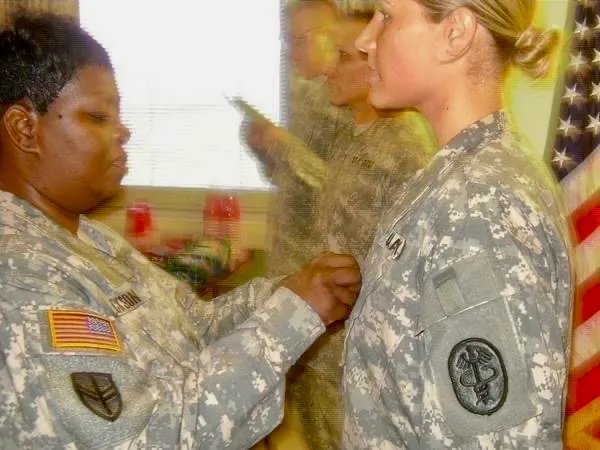
Her experience reshaped how she viewed recovery, not as a straight line, but as a process requiring patience, humility, and support. Later, as a behavioral health technician and drug and alcohol counselor, Richardson worked with service members fighting invisible battles. She also administered neuropsychological testing for TBIs, witnessing firsthand how cognitive injuries can quietly unravel lives.
“I watched service members struggle to finish assessments, forget information I’d just shared, and realize in real time how much they’d lost,” she recalled. “Those moments stayed with me.”
Healing, she learned, isn’t just physical. It’s emotional, mental, and deeply human.
Richardson’s professional journey eventually intersected with Project R3con founder Travis Wilson, a retired Green Beret who had experienced the effects of multiple TBIs himself. After undergoing stem cell therapy and seeing meaningful improvements, Wilson turned his recovery into a mission to help others.

For Richardson, who had supported the special operations forces community for years and who is also married to a now-retired Green Beret, joining that mission felt fated.
“I saw Project R3con as the right next step,” she added. “This work is both personal and professional for me.”
Special operations forces face a disproportionately high risk of TBI due to repeated exposure to blast waves, high-impact training, and combat. The effects can include chronic headaches, memory loss, depression, emotional dysregulation, and an increased risk of suicide.
Too often, these injuries are misdiagnosed, minimized, or left untreated.
“Traditional medicine doesn’t always have answers for the long-term effects these operators are dealing with,” Richardson said. “Stem cell therapy offered a level of healing that went beyond symptom management.”
Project R3con (PR3) is a national 501(c)(3) nonprofit that helps currently serving and veteran special operations personnel access stem cell therapy to treat moderate to severe TBIs. The organization’s goal is simple but ambitious: restore and protect brain health by harnessing the body’s own regenerative potential.
The demand is enormous, and so are the challenges.
“TBI often takes a backseat to PTSD,” Richardson shared. “And stem cell therapy isn’t yet mainstream, so a big part of our work is education by helping people understand that this treatment is real, evidence-informed, and worth supporting.”

The cost of care is significant, and funding remains a constant hurdle. Project R3con raises awareness and resources through grants, donations, merchandise sales, fundraisers, conferences, and community outreach. Every effort is aimed at expanding access while building long-term sustainability.
For Richardson, the impact of TBI isn’t theoretical. She’s seen it from every angle as a clinician, advocate, and spouse.
“TBI doesn’t just affect the operator,” she stated. “It affects the spouse, the kids, and the daily rhythm of life.”
That understanding shapes how Project R3con approaches its mission. The organization isn’t just focused on treatment; it’s focused on hope and creating space for healing where families can begin to rebuild.
“If we can acknowledge that the brain has been injured, that those injuries have disrupted families, and that effective treatment exists,” Richardson said. “From there, we can start creating real pathways to recovery.”
Over the next five years, Richardson hopes to see Project R3con achieve financial sustainability and deliver measurable outcomes demonstrating the effectiveness of stem cell therapy for TBI. Those data points, she believes, could help shift the broader conversation and eventually influence institutional change within the Department of Veterans Affairs and Department of Defense.
“I want PR3 to be the bridge between innovation and advocacy so that veterans living with TBI have access to real, lasting healing backed by evidence,” she said.
For those struggling with severe injuries or considering unconventional treatments, Richardson offers a message rooted in empathy and lived experience.
“Remember that you’re worthy of the same care you’d fight for for someone else,” she implored. “Lean into organizations run by people who’ve been where you are. Ask questions. When someone reaches out a hand, take it.”
Because for Project R3con, healing isn’t something service members should have to fight for alone. For more information, visit the Project R3con website.