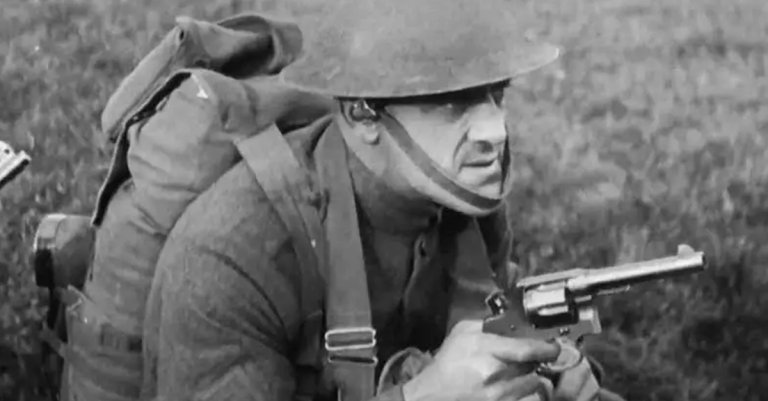
The idea wasn’t born out of a James Bond-esque research and development, or a state-of-the-art factory. It was born in the solemn quiet of a Soviet military hospital in 1942, conceived in the mind of a wounded Red Army sergeant. Mikhail Kalashnikov, a 23-year-old tank commander recovering from a shell wound, listened to the many complaints of his fellow soldiers, whose issued SVT-40 rifles were jamming in the mud and freezing in the bitter cold.
They were complex, temperamental, and failing the men who needed them most. Frustrated and laid up, Kalashnikov began to sketch. He wasn’t trying to build a sharpshooter’s rifle; he was trying to build a soldier’s tool that wouldn’t quit.
Related: This carbine was the predecessor to the AK-47
The result of those hospital sketches was the Avtomat Kalashnikova model 1947, or AK-47, which was formally adopted by the Soviet Army in 1949. The rifle was a powerhouse of common sense. Chambered for the potent 7.62x39mm cartridge, its simple gas-operated, long-stroke piston action could cycle at approximately 600 rounds per minute. With a muzzle velocity of roughly 715 meters per second, it was effective out to about 300 to 400 meters.
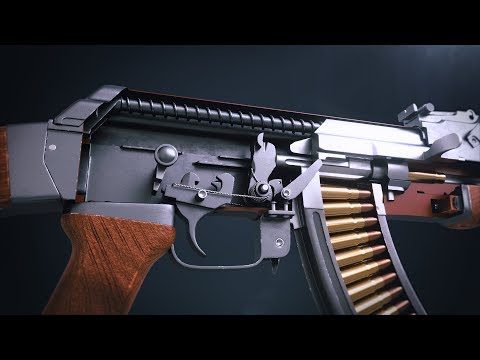
How an AK-47 Works
A Tool for Soldiers, Not Snipers
That laser focus on reliability became the soul of his machine. Kalashnikov knew he was designing a weapon for a huge army of conscripts, composed mainly of farmers and laborers who had little time for mind-numbing maintenance. While its external layout drew comparisons to the German StG 44, Kalashnikov’s true innovation was its radical internal simplicity.
His rifle had to be simple enough to be field-stripped in seconds and tough enough to be abused for years in the harshest environments. Built like a tractor, not a Rolex, the AK’s loose tolerances allow its parts to cycle through mud, sand, and even ice, conditions that would choke out many precision rifles.
How the AK-47 Functions
At its core was the intermediate 7.62x39mm cartridge, a round that offered a perfect combination between the brutal punch of a full-sized rifle and the controllability of a submachine gun. This was then paired with a ruggedly simple and effective action.
When the round is fired, hot gases from the gunpowder explosion are siphoned off from the barrel into a gas tube. These gases then push a piston rearward, which is physically attached to the bolt carrier unit. This single motion unlocks the bolt, extracts and ejects the spent cartridge case, and then cocks the hammer for the next shot. A return spring will shove the entire assembly forward, ripping a new round from the magazine and finally chambering it. This long-stroke system is brutally effective and a key reason for the rifle’s ability to function when dirty.
Trading Precision for Reliability
For all its strengths, the rifle carries one infamous compromise: precision. The AK-47 was never designed to be an American M21. Its varied tolerances and powerful cartridge, the very things that made it so reliable, also work directly against its accuracy.
Maybe a skilled shooter could be effective out to about 300 meters, but beyond that, performance will drop off sharply; this is in contrast to the American M16’s 500-meter reach. However, this wasn’t a design flaw by any means; it was a deliberate choice. Kalashnikov knew that most infantry combat happens at close range and prioritized a near relentless volume of fire over the ability to hit a distant target.
Kalashnikov’s design didn’t stay a Soviet secret for long. During the Cold War, the AK-47 became a primary export of Soviet influence. Moscow and its allies licensed the plans, and factories ranging from East Germany to China began pumping them out en masse. Encyclopedia Britannica estimates that over 100 million AK-style rifles were produced worldwide; it became the most omnipresent weapon in history. It was cheap to make, easy to acquire, and simple to use, making it the tool of choice for insurgencies and armies across the globe.
For American troops in Vietnam and later Iraq and Afghanistan, the distinctive ‘crack’ of the AK became a sound that demanded immediate respect, especially when compared to the higher-pitched ‘pop’ of their own M16s or M4s.

AK-74: Fast Assembly & Disassembly In Russian School
Variants and Evolution: The AKM and AK-74
The original AK-47 design was quickly improved upon. The AKM (Avtomat Kalashnikova Modernizirovanny), introduced in 1959, used a stamped sheet metal receiver instead of a milled one, making it lighter and significantly cheaper to mass-produce. It became the most common version of the AK rifles. In the 1970s, the Soviets developed the AK-74, which was spec’d for a smaller, higher velocity 5.45x39mm cartridge, their answer to the 5.56mm round being used by the U.S. and NATO.
At the end of the day, the AK-47’s legacy is not about being the best rifle on paper. It isn’t the most accurate, it isn’t the lightest, or the most advanced. Its legend was forged by being the most dependable. It is, in essence, a historical artifact; it became a symbol of conflict and revolution, and an education in functional design. This simple tool, forged by a wounded tank commander in a hospital bed, didn’t just equip a rag-tag army; it helped change the face of warfare forever.