
On the morning of June 6, 1944, thousands of Allied soldiers waited anxiously inside landing craft as they approached the beaches of Normandy. German artillery thundered overhead, machine guns swept the shoreline, and steel obstacles rose from the surf like jagged teeth.
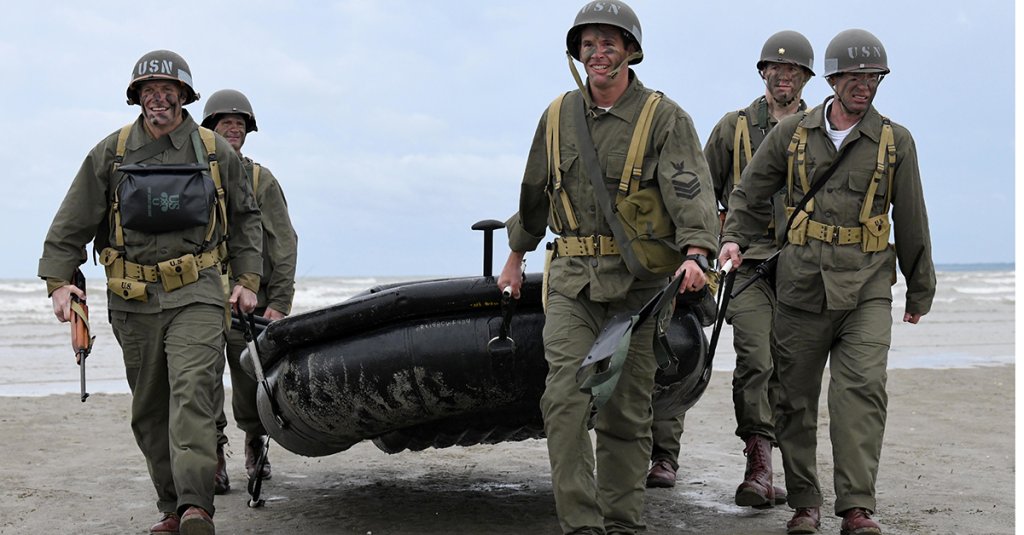
Long before most American troops could step onto French soil, a small group of U.S. Navy sailors entered the water first. Their mission was not to fight the enemy directly but to remove the deadly barriers that stood between the sea and victory. These sailors belonged to the Naval Combat Demolition Units (NCDUs), the direct forerunners of today’s Navy SEALs.
Related: Listen to these D-Day ‘frogmen’ explain their crazy role in the historic battle
Working with minimal equipment and under constant fire, NCDU sailors swam and waded through cold surf while carrying explosives toward enemy defenses. Their actions on D-Day saved countless lives and allowed the invasion of Western Europe to continue. Though their role has often been overlooked, the success of the Normandy landings depended heavily on their courage, innovation, and sacrifice.
Origins of the Naval Combat Demolition Units

WWII Naval Combat Demolition Units Monument Project
Before World War II, the U.S. Navy had no permanent force trained specifically for underwater or beach demolition. Amphibious warfare doctrine was still developing, and early operations revealed serious vulnerabilities. Enemy forces could block landing zones with simple obstacles such as wooden stakes, wire mines, and steel barriers that could destroy landing craft or trap soldiers in exposed areas.
In response, the Navy began forming specialized demolition teams in 1942. These early units were created from experienced naval salvage personnel, sailors who already understood explosives, underwater work, and emergency problem-solving. These men were accustomed to dangerous conditions and were well-suited for this new mission.
Each NCDU consisted of one officer and five enlisted sailors. This intentionally small structure allowed teams to move quickly, make independent decisions, and operate in confined or chaotic environments. Sailors learned about demolitions, obstacle recognition, cable cutting, beach reconnaissance, and small unit tactics. Physical conditioning was relentless, and training often took place in rough surf and cold water to prepare sailors for combat conditions.
The NCDUs’ first operational test came during Operation Torch in North Africa in November 1942. Demolition teams successfully cleared river barriers and harbor obstructions, allowing Allied forces to advance inland. Their performance demonstrated the value of specialized naval demolition forces and led to rapid expansion of the program.
The Expanding Role of NCDUs During World War II
As the war continued, NCDUs became a critical part of Allied amphibious operations across multiple theaters. Their mission expanded beyond harbors and rivers to include heavily defended beaches protected by layered obstacle belts. These defenses were designed to stop invasions before they could begin, and defeating them required precision, speed, and bravery.
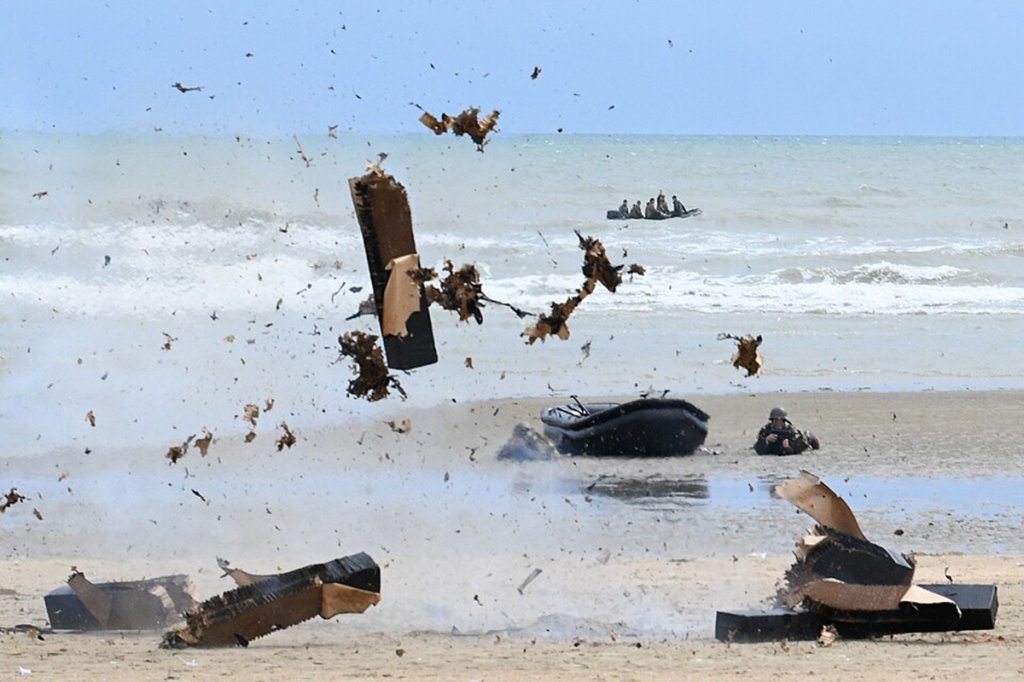
In both the European and Pacific theaters, NCDUs cleared mines, concrete posts, steel hedgehogs, wooden stakes wired with explosives, and underwater cables. Many operations required teams to place charges at low tide, then return hours later under fire to detonate them as landing craft approached.
In the Pacific, NCDUs supported landings at Guadalcanal, Saipan, Peleliu, and Iwo Jima. These operations highlighted the importance of beach intelligence and underwater clearance. In Europe, NCDUs played key roles in landings in Sicily, Italy, and southern France.
By early 1944, the largest concentration of NCDUs assembled in England to prepare for Operation Overlord. Thirty-four units trained intensively for months, studying aerial photographs, building replica beach defenses, and rehearsing demolition under simulated enemy fire. For D-Day, NCDUs were paired with U.S. Army engineers to form gap assault teams that were responsible for creating wide lanes through German defenses.
Tools and Equipment of Early Combat Frogmen

Churchill Swim Fins – The Mask
The equipment used by Naval Combat Demolition Unit sailors was simple by modern standards, but carefully selected to meet the demands of one of the most dangerous missions of World War II. Every piece of gear had to function reliably in cold water, heavy surf, and combat conditions while allowing these early combat frogmen to move quickly and quietly.
One of the most significant tools issued to NCDU sailors was the swim fin. Developed by Owen Churchill, these fins revolutionized underwater mobility and became a defining feature of naval demolition forces. They allowed sailors to conserve energy while swimming against strong currents and waves, especially when carrying heavy explosive charges. Increased speed and maneuverability allowed sailors to reach obstacles faster, place charges more efficiently, and reduce the time exposed to enemy fire. The success of the swim fin during WWII ensured its permanent place in naval special operations.
Related: Why Navy SEALs will storm the beaches of Normandy in 2018
Improvisation played a major role in the equipment used by NCDU sailors. Fishing line became an essential tool for securing demolition charges around obstacles. Its strength, flexibility, and resistance to water made it ideal for underwater work. Sailors also carried knives, wire cutters, and small-hand tools that allowed them to cut through cables, remove obstacles, and adjust explosive placements when battlefield conditions differed from expectations. These tools gave demolition teams the ability to adapt quickly in chaotic environments where rigid plans often failed.
Explosives were at the heart of every NCDU mission, but their use came with significant challenges. Early demolition charges were heavy and required precise placement to be effective. Sailors often had to carry these explosives by hand through deep water while under direct enemy fire. Modern scuba equipment had not yet been developed, and extended underwater operations placed enormous physical strain on sailors. Because of these limitations, every second spent in the water increased the risk of injury or death.
The Higginson Pack and Tactical Innovation
Despite challenges, the tools and equipment used by early combat frogmen proved effective, because they were paired with rigorous training and exceptional courage.
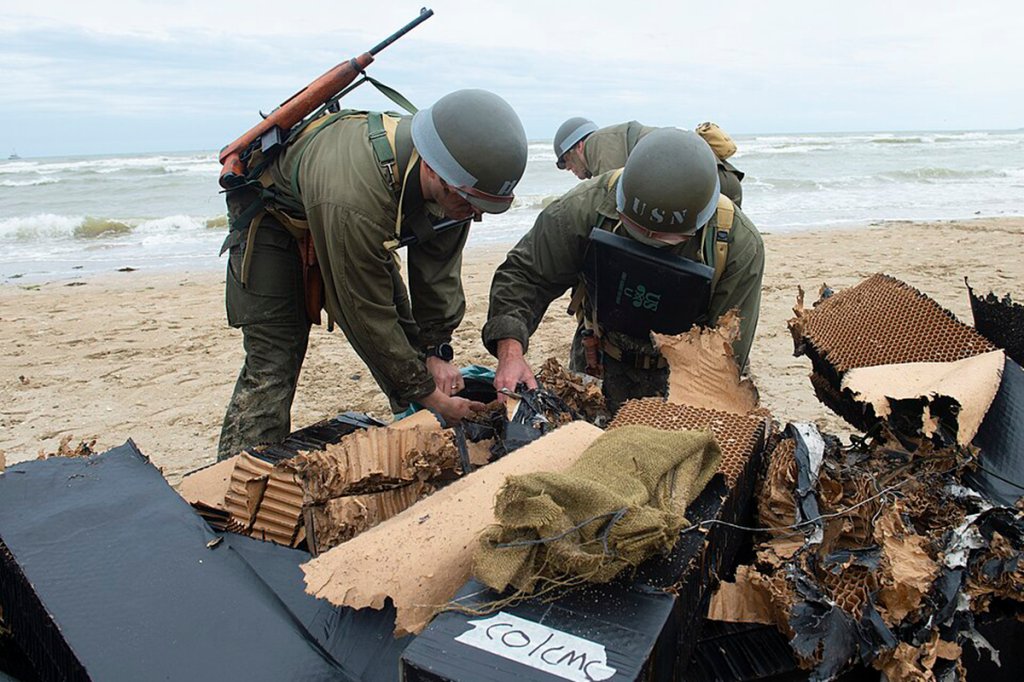
As preparations for the Normandy invasion intensified, NCDU sailors recognized that traditional demolition methods were too slow and dangerous for the heavily fortified beaches they would face. Training in England revealed that rigid explosive blocks were difficult to secure to irregular obstacles and required extended exposure in the surf. In response, NCDU personnel developed a more flexible and efficient solution; the Higginson Pack (sometimes called the Hagensen Pack) represented a crucial shift in how beach obstacles could be destroyed under combat conditions.
The Higginson Pack was made from rubber tubes filled with tetryl, a powerful military explosive widely used during World War II. Weighing approximately 2.5 pounds, each tube could be bent, twisted, and wrapped tightly around objects of nearly any shape. This flexibility allowed sailors to place charges directly against objects without complex rigging. By conforming to the shape of the obstacle, the explosive force could be concentrated exactly where it was needed, making each detonation more effective.
During the D-Day landings, the Higginson Pack proved to be one of the most valuable tools available to NCDU sailors. Its availability allowed demolition teams to clear more gaps in less time, which directly contributed to the ability of Allied troops to land and advance. In the deadly conditions of Omaha Beach, the Higginson Pack stands as an early example of battlefield-driven innovation in naval special warfare.
D-Day and the Crucible of Omaha Beach
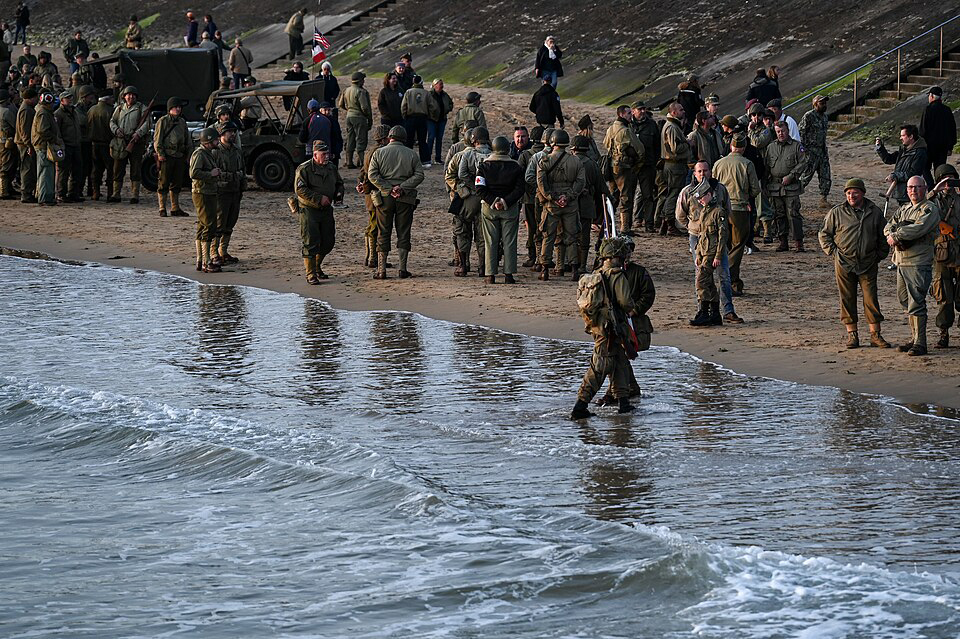
On June 6, 1944, NCDU sailors faced the most dangerous mission in the history of Naval Special Warfare. Omaha Beach was heavily defended, and German resistance was far stronger than anticipated. Demolition teams landed with the first assault waves, carrying explosives through chest-deep water while under direct fire.
The obstacles were dense and lethal. Wooden stakes tipped with mines, steel hedgehogs, and wire entanglements covered the beach. Machine-gun fire swept the surf, and artillery shells exploded without warning. Many landing craft were destroyed before reaching shore.
Related: Medic remembers what it was like to land on Omaha Beach
Despite these conditions, NCDU teams pressed forward. They placed charges, detonated explosives, and cleared lanes through the defenses. By mid-morning, they had opened eight complete gaps and two partial gaps, allowing infantry tanks and vehicles to land and move inland.
The cost was severe. More than half of the NCDU personnel assigned to Omaha Beach were killed or wounded. This casualty rate of approximately 52% makes D-Day the deadliest day in the history of Naval Special Warfare.
The Atlantic Wall Design Construction

As Allied planners prepared for the invasion of Western Europe, they knew they would confront one of the most ambitious defensive systems ever built. This system, known as the Atlantic Wall, stretched along the western coastline of Europe from northern Norway down to the border of Spain. It was intended to prevent any Allied amphibious landing and to turn the coast of occupied Europe into what Nazi leaders called Fortress Europe.
The Atlantic Wall was ordered by Adolf Hitler in 1942, but its final design and implementation were heavily shaped by Field Marshal Erwin Rommel, who was placed in charge of coastal defenses in late 1943. Rommel believed Germany could not win a prolonged battle once Allied forces landed inland. Based on his experience fighting Allied forces in North Africa, he understood the devastating power of Allied air superiority, naval gunfire, and logistics. Rommel insisted the invasion must be stopped at the shoreline, or Germany would lose France.
The Atlantic Wall was not a single continuous wall but a layered defensive system. Coastal artillery batteries were positioned to fire on Allied ships miles offshore. Machine-gun nests and infantry strongpoints were arranged to create overlapping fields of fire across beaches and landing zones. Trenches, communication tunnels, and underground shelters allowed German troops to move and coordinate while protected from bombardment.
One of the most deadly elements of the Atlantic Wall was the extensive system of beach and underwater obstacles. German engineers placed obstacles topped with mines or explosive charges across tidal zones. Barbed-wire minefields and anti-tank ditches extended inland beyond the beaches.
The Atlantic Wall’s Impact on D-Day
At Omaha Beach, the Atlantic Wall defenses were especially dense and well-constructed. High bluffs overlooked the shoreline, providing German defenders with commanding views and natural protection. Concrete bunkers housing machine guns, mortars, and artillery were embedded into the hillsides. These positions allowed German troops to fire directly into the surf, where Allied soldiers and NCDU sailors were most vulnerable.
German defenses inflicted heavy casualties on the first waves of Allied forces, particularly at Omaha Beach, where resistance was far stronger than anticipated. Landing craft were destroyed, troops were pinned down in the surf, and progress inland was nearly halted.
However, the Atlantic Wall also revealed its limitations. While formidable, it was unevenly manned and relied heavily on fixed positions. Once gaps were created and Allied forces pushed inland, German defenders lacked the mobility and reserves to contain the invasion. The courage and effectiveness of the NCDUs played a critical role in exploiting these weaknesses by clearing obstacles and opening lanes through the defenses.
Related: This is what those ‘metal things’ were on Normandy beaches
The Atlantic Wall ultimately failed to stop the invasion, but it succeeded in making D-Day one of the war’s bloodiest battles. Its presence magnified the importance of specialized units like the NCDUs, whose mission to breach these defenses under fire proved decisive. Without their actions, the Atlantic Wall might have turned the beaches of Normandy into a graveyard for the invasion force.
Sailors Recognized for Heroism on D-Day
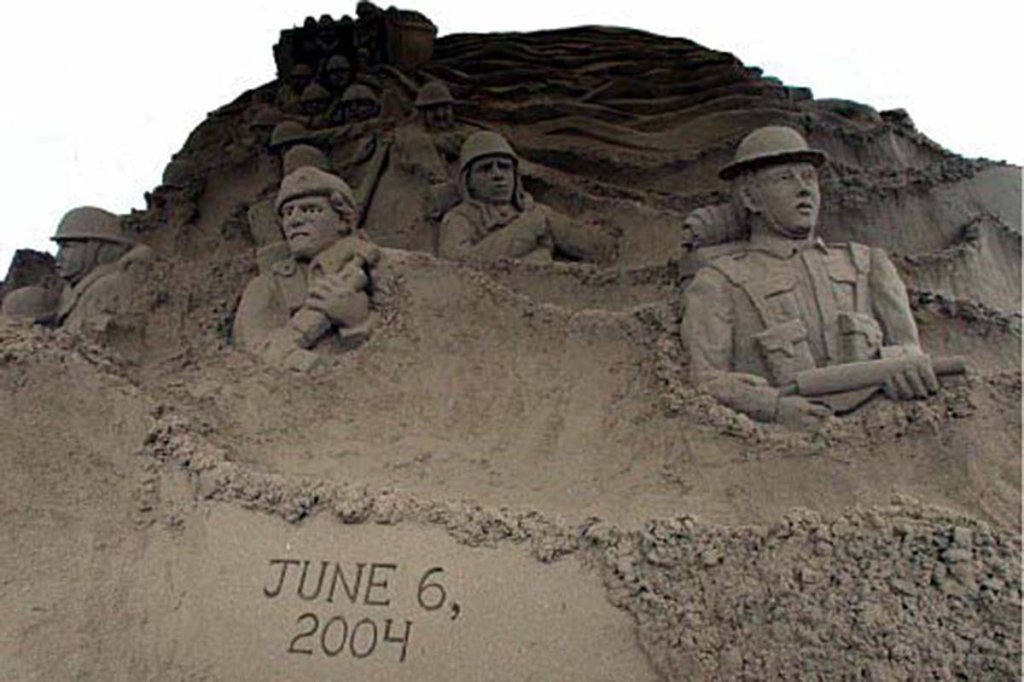
Several NCDU sailors received formal recognition for extraordinary bravery during the Normandy invasion.
Ensign Lawrence Stephen Karnowski of NCDU 45 demonstrated exceptional leadership under fire. He directed demolition operations despite chaos and heavy casualties. He was awarded the Navy Cross and the French Croix de Guerre with Palm.
Lester Meyers, also of NCDU 45, showed personal courage while placing charges under intense enemy fire. He received the Silver Star for gallantry.
Lieutenant Junior Grade William Maxwell Jenkins, the officer in charge of NCDU 43, salvaged equipment after his landing craft sank and led his men to create a 50-yard gap in German defenses. He was awarded the Navy Cross for extraordinary heroism.
In addition to individual awards, the NCDUs at Omaha Beach received a Presidential Unit Citation, honoring their collective sacrifice and achievement.
The NCDUs’ Legacy
After D-Day, the NCDUs continued to support amphibious operations across Europe and the Pacific. As the war progressed, the Navy reorganized these units into Underwater Demolition Teams. Many NCDU veterans formed the core of these new teams, bringing hard-earned experience and proven tactics with them.
In the decades that followed UDTs, expanded their mission to include reconnaissance, intelligence gathering, and special operations. These capabilities eventually evolved into the modern Navy SEAL teams. The lineage from NCDU to UDT to SEAL represents a continuous tradition of innovation, adaptability, and courage.
The NCDUs’ legacy lives on in modern Naval Special Warfare and in the memory of the sailors who risked everything to clear the way for others. The story of the NCDUs reminds us that history is often shaped by those who go first into danger so that others may follow.