
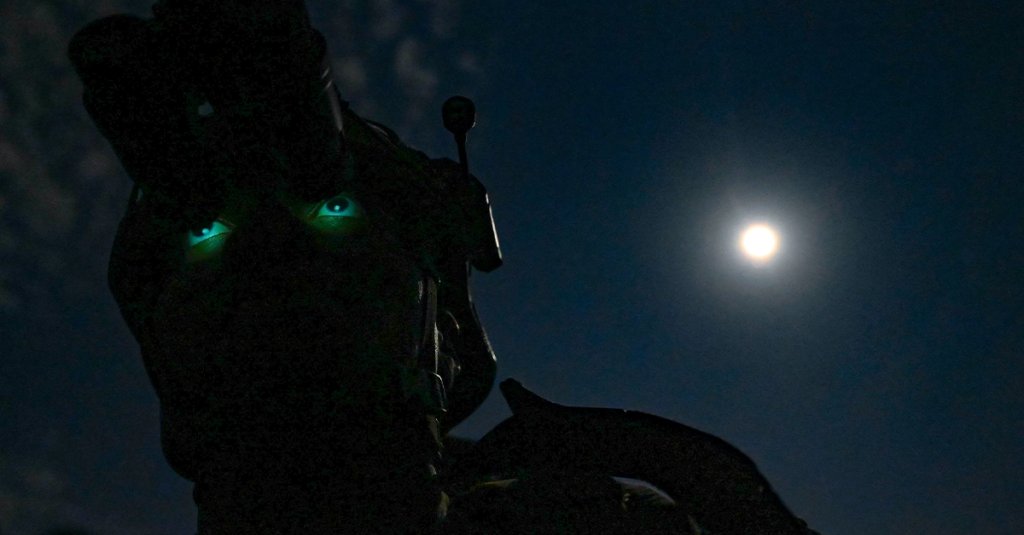
Flip them down slowly, and your worldview will instantly change. Not in a dramatic way, or in a Hollywood CGI slopfest sort of way. In a weird, almost fever-dream-like way, as if someone stretched a green filter over everything you ever knew and forgot to tell you, depth perception was always a luxury.
Read Next: The US military’s drinking water was the worst water you’ve ever loved
Stars don’t twinkle through night-vision goggles; they bloom into existence, fat and so numerous that it looks like someone poked a million holes across the dark sky. Chem lights glow with the intensity of dying suns. A man standing ten meters away looks simultaneously close enough to touch and somehow flat, like a cardboard cutout of a soldier placed in front of a dreamscape version of a treeline.
For over eight decades, the United States military has handed soldiers a device and told them some version of the same creed: we own the night.
What doesn’t get mentioned until it’s too late was the part where you walk face-first into a branch, or a huge unidentifiable divot in the ground, or, if you’re really unlucky, a strand of concertina wire at groin level.
Before the Goggles
Long before anyone strapped anything to a helmet, seeing at night required two things: a scope that could detect infrared light, and a battery-powered IR lamp to flood the darkness with light invisible to the naked eye. Active infrared, they called it.
The concept was to be applauded. The execution, however, was a canvas pack digging into your shoulders, a lead-acid battery roughly the size of a car battery, and a tube that went nearly useless the moment fog rolled in.
Ironically, any enemy equipped with his own infrared scope could see your lamp glowing like a lighthouse. Owning the night in 1944 meant shining a spotlight on yourself to anyone else who owned it.
The Starlight Scope in Vietnam
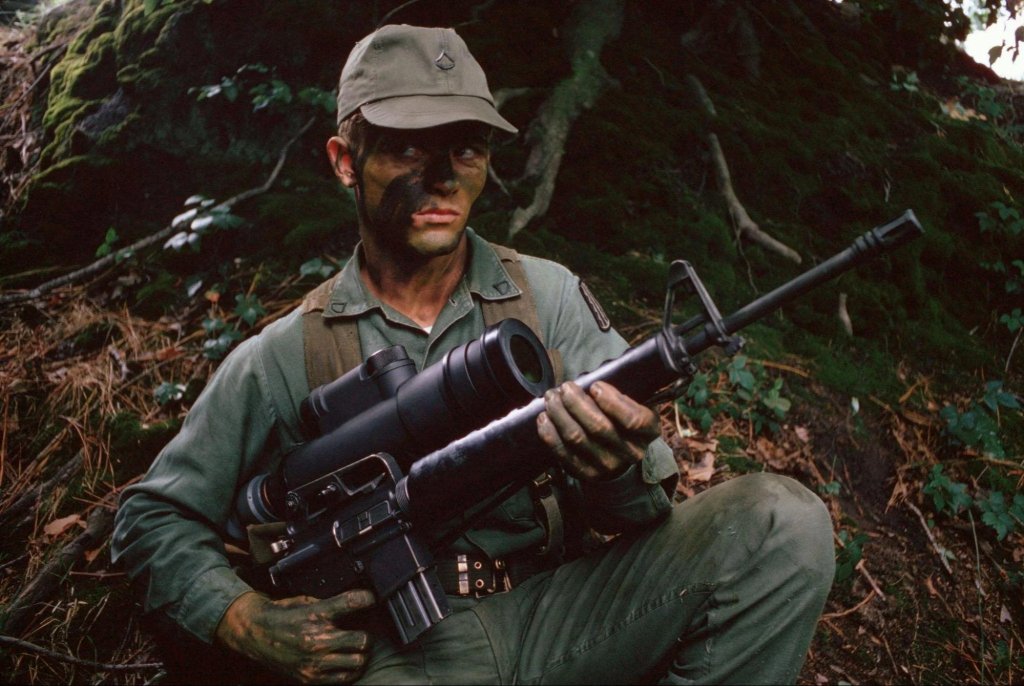
Nobody names military equipment poetically, so it’s really saying something that the Army’s Vietnam-era passive image intensifier was called the Starlight Scope, a name that belongs in a paperback romance rather than a surveillance manual.
Designated the AN/PVS-2 and described in a 1971 Army manual as a passive device requiring no artificial light source when ambient starlight or moonlight was available, it was a genuine leap.
No IR lamp. No beacon advertising your position. Just starlight, amplified through a tube. Five and three-quarter pounds on a rifle in the wet heat of a Vietnamese jungle, and a field of view narrow enough to remind you, hour after hour, that whatever you couldn’t see in the dark was potentially looking back.
The Green New Deal
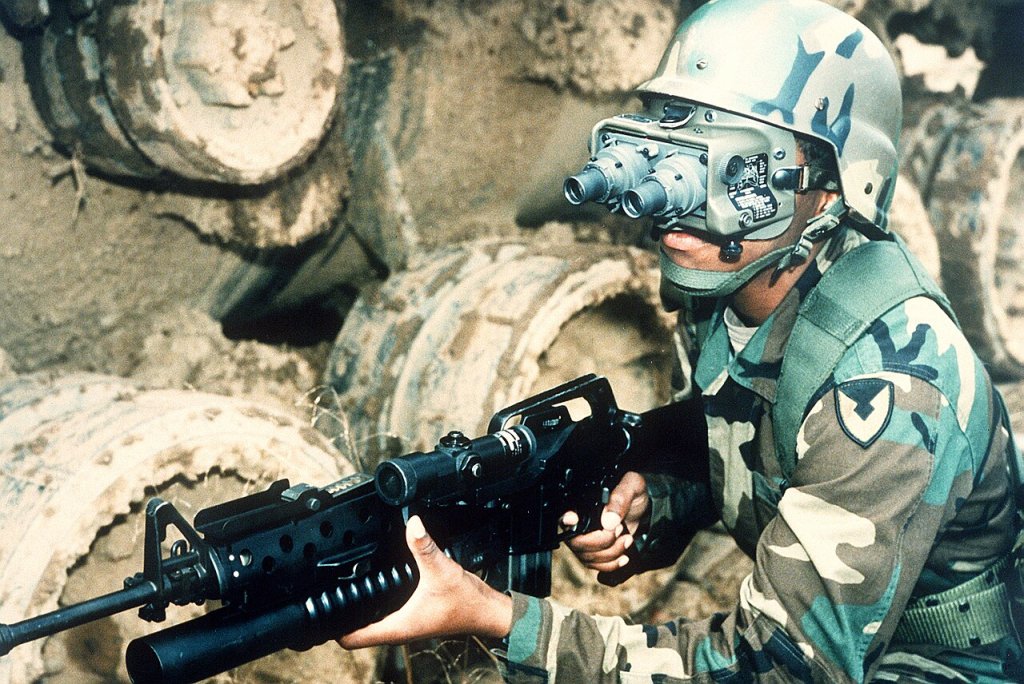
Somewhere between Nam and the Gulf War, night vision jumped from the rifle and climbed onto your face. Head-worn goggles told you where to put your feet instead of just what was in front of your barrel. Aviation got them first, then our Infantry followed.
With the PVS-5, soldiers learned to move at night in a way their fathers never could, not by feel or memory, or luck, or the distant glow of illumination rounds, but by actually seeing… kinda.
Depth perception became the real issue here. What looked like flat ground was a six-inch step. What looked like a manageable gap turned out to be a three-foot drop. Soldiers had to develop the NOD shuffle, carefully testing the length of their steps, which looked crazy in daylight but saved ankles in the dark.
Tunnel vision was the other tax of owning the night. A threat at your 9 o’clock might as well be in another county. This meant experienced soldiers learned to move their heads constantly, scanning in slow, deliberate arcs, compensating for what the goggles took away with what discipline could put back.
Anyone who ever wore a set knows exactly what both looked like.
The GWOT Generation
Ask a veteran of Iraq or Afghanistan what night vision looked like, and most will describe the single or double tube, maybe a rhino arm, the helmet mount, and AA batteries that would either last the whole patrol or fail you at the worst possible time (Note to leaders, always conduct pre-combat checks and pre-combat inspections).
PVS-14. Monocular. Third generation. One eye aided, one eye unaided, and the human brain performing neurological diplomacy between two completely different inputs. Soldiers who wore them long enough stopped noticing. Soldiers new to them spent their first few patrols mildly seasick.
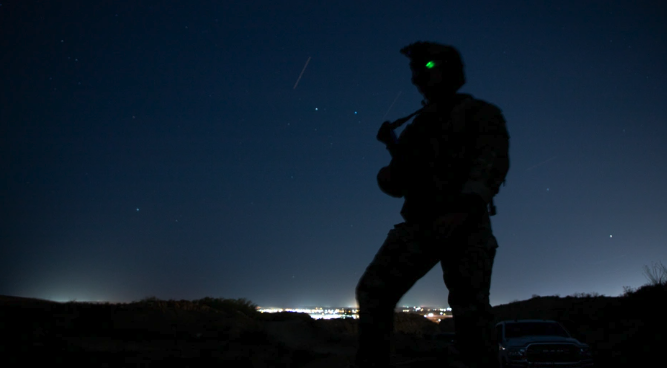
IR lasers turned dark rooms into silent light shows visible only to the people wearing them, a conversation conducted in a language the enemy couldn’t read. The night sky at full gain, with no artificial light competing, was the kind of thing soldiers described in smoke pits afterward, as if they found something they never expected to. It was special to them.
Losing a set of NODs was also a special day in your life. There might be an Article 15 in your future, but you can survive that; heck, the old saying is that every sergeant major has at least one Article 15. The real fun occurred when the entire company would go on lockdown until this one set of goggles was found.
Sometimes this would last a couple of days, with the entire company sitting in one main holding area until they appeared again. All eyes and conversation were on the one who lost them.
Finding one was the closest thing to a miracle that most will ever get. The PVS-14 became an obsession, and entire debrief sessions were quietly dominated by the question of where, exactly, someone last had eyes on their NODs.
White Phosphor, Thermal, and Water Moccasins
Green has been the color of the soldier’s night since the 1960s, chosen for physiology rather than aesthetics. Green sits at the center of the human eye’s sensitivity range. For 50 years, to put on NODs was to enter a green world.
White phosphor changed that, rendering everything in black, white, and grey. Soldiers who switched described sharper edges and faster detail resolution. It looked, as GWOT veteran, U.S. Army Infantry, Spc. David (MilSpec) Miller put so tersely, “it actually looked like the world instead of a video game.”
Thermal added another dimension entirely. During testing at Fort Polk, soldiers wearing fused ENVG-B systems spotted water moccasins in thermal mode that PVS-14 users couldn’t see at all. Target detection pushed past 300 meters for ENVG-B users while PVS-14 users struggled beyond 150, according to a troop commander’s account.
Two generations of war on a monocular and two AAs, then suddenly a binocular fused system linked to weapon sights, digital maps, and your teammates’ positions, all without having to talk to each other.
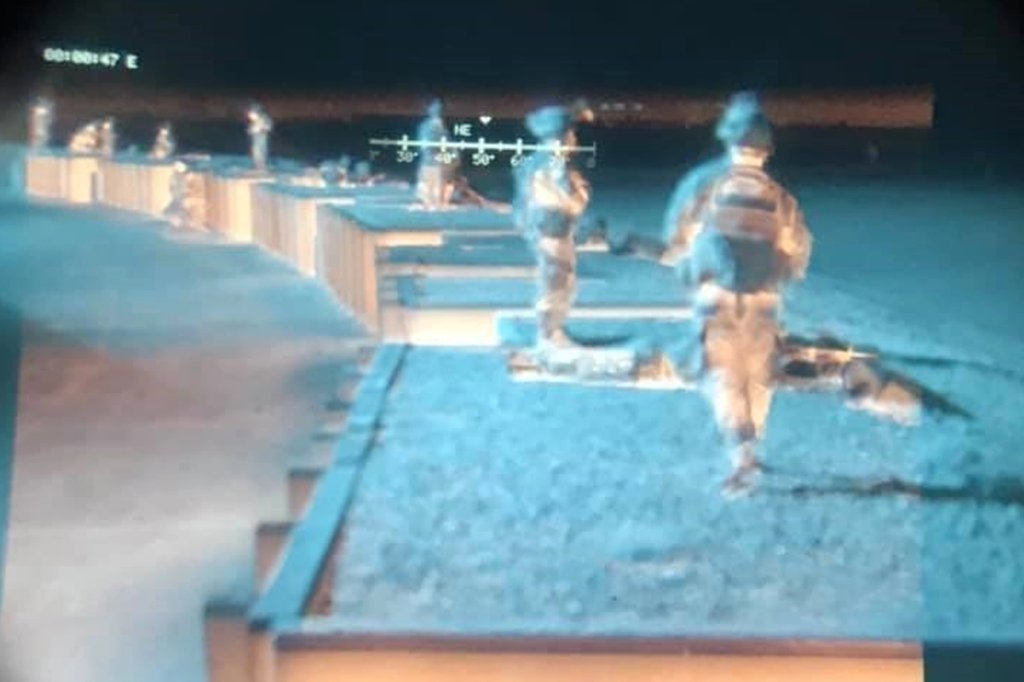
When the Night has Come
Somewhere in an underground secret lair, the next generation of what a soldier sees after dark is already being argued over, tested, revised, put away for a week, and argued over again.
IVAS wraps mixed-reality heads-up display, mapping, sensing, and computing into a goggle that is less a window and more an interface. Early soldier feedback has been honest about reliability and the question nobody from the Sniperscope era could have imagined asking: how much information is too much?
For 80 years, the mantra has been the same: we see in the dark, therefore we own the night. Every generation of American soldier found a different way to carry it, through a canvas bag full of bad batteries, a five-pound tube on a jungle rifle, a rhino arm, and some AA batteries that might last the night, or not.
They shuffled through darkness, walked into branches, fell into every hole in the ground, found simple beauty in a sky full of amplified stars, and handed whatever they’d learned to the generation coming up behind them.
Somewhere tonight, a soldier is flipping down a set of NODs for the first time. The world is going flat and green. Depth perception is about to become a very personal problem.
Some things just don’t change.
Don’t Miss the Best of We Are The Mighty
• A salute to assistant gunners and ammo bearers: the invisible half of every gun
• Some military forces call autism a disqualifier. The IDF calls it an advantage.
• The US Army’s ‘Cattle Truck’ was the worst ride you’ll never forget


Loading comments…
Comments couldn’t be loaded. Please refresh the page.