Nobody ever briefed you on the cattle truck. There was no block of instruction, no safety brief, no introductory PowerPoint with b-roll of a smiling private boarding a pristine trailer.
One moment, you were standing in formation at reception with everything you owned stuffed into duffel bags, and the next, a Drill Sergeant was funneling your entire company into what appeared to be a windowless shipping container bolted to the back of a truck.
Welcome aboard, there’s always room for one more.
Also Read: The M113 armored personnel carrier was supposed to be obsolete
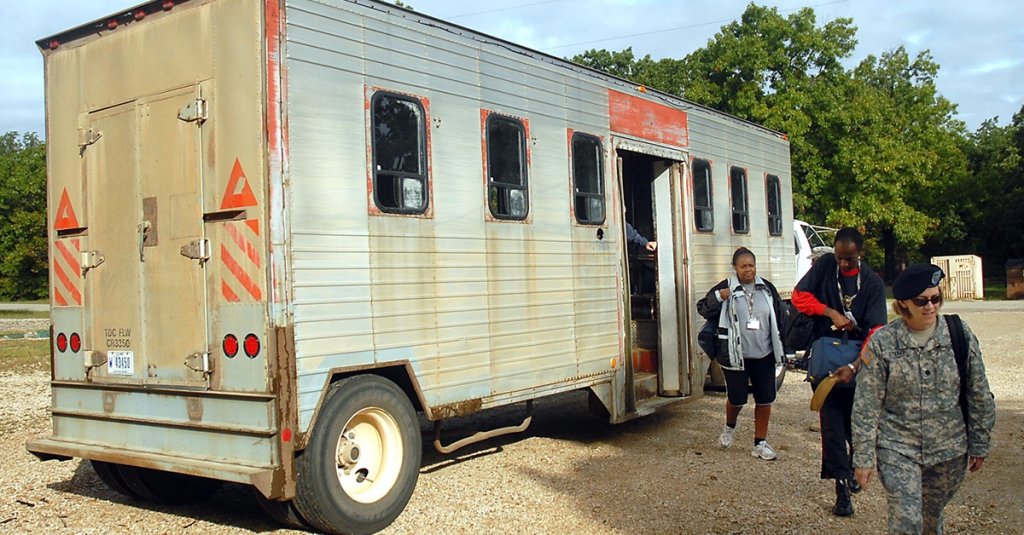
The military “cattle truck,” officially designated as a Troop Transporter (if you enjoy the fiction of formal nomenclature), is one of the most universally shared experiences in American basic training. The Army and Marine Corps each had their own version at one time.
If you went through an Initial Entry Training site at Fort Moore, Fort Jackson, Fort Benning, Fort Leonard Wood, Fort Sill, Fort Ord, Parris Island, or Camp Pendleton at any point between the late 1960s and the early 2000s, you rode one.
And you remember it. Every sensory detail. The feel of heat. The elbow in your kidney that belonged to someone whose name you never learned. The smell of buttholes.
Man vs. Machine
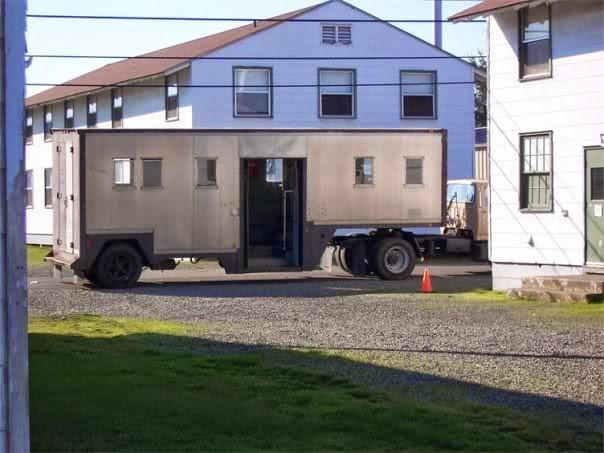
The classic cattle truck was not complicated by any stretch of the imagination. A semi-tractor, often a civilian model like a Ford LN8000 or an International (though some posts used M923 five-ton series trucks or later FMTVs), pulled a specialized enclosed trailer. The classic looked like it would be at home in the Texas Chainsaw Massacre.
Inside this people mover, bare metal walls, maybe some wooden slats along the perimeter that technically qualified as benches, and a series of ceiling-mounted grab bars helped continue the “cross country murder” motif.
Is that rust or blood on the walls? A little from column A, a little from column B. Is that pee smell coming from everywhere? Nope, it’s most likely from one source.
There were no windows, or if there were, they were narrow slats that let in just enough humidity to remind you that airflow was a privilege you hadn’t earned. Climate control was what veterans affectionately called “4-60 air conditioning”: four vents at 60 miles per hour.
Some even had a capacity placard. If one existed, rest assured, it was merely a suggestion. Drill Sergeants treated them the way most people treat terms and conditions, scrolled past without reading.
One soldier who attended basic training at Fort Benning in the 90s perhaps summed it up best: “Our cattle trucks had big black letters stenciled by the doors. “MAX CAP 75” or something like that. Then there would always be a drill Sgt [sic] standing by the door, counting off as privates piled in. 74, 75, 76, 77….110…. I’m pretty sure the numbers were only there to F with us.”
Well, soldier, that’s a distinct possibility.
A Joke or Doctrine
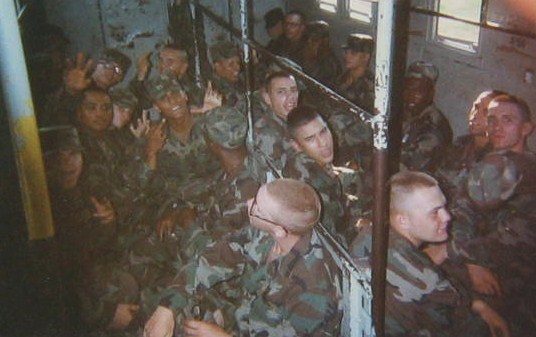
“Nut-to-butt” wasn’t a joke. It was an actual enforced policy. If daylight existed between you and the person in front of you, you were wasting space, and a drill sergeant was going to let you know about it by hanging your soul on the wall next to the firewatch roster.
Protocol here was really simple: keep stuffing bodies in until the doors could barely close, then find room for one more of your mates.
Your senses would be assaulted immediately. An alluring combination of aromas consisting of sweat, CLP gun oil, boot shine polish, diesel exhaust, and whatever life smells like when it’s been fermenting inside a military uniform for 12 hours.
And yet, the cattle truck was also astonishingly a sanctuary for some. It was one of the only places a trainee could close their eyes for five uninterrupted minutes outside the direct line of sight of a drill sergeant.
Soldiers became famous for sleeping standing up, leaning into the person ahead and behind them, creating a kind of human phalanx, as if you were 300 Spartans protecting a narrow pass.
War on Terror veteran David “Thrillhouse” Miller, U.S. Army mortars, enjoyed his time riding to ranges. He doesn’t remember the smells or the risk of tetanus; he only remembers “not having to walk long distances to and from the range once in a while.”
Every Branch Had People Movers
The Army owned the cattle truck brand, but every branch had a version. At Marine Corps Recruit Depot Parris Island, the trailers were painted Marine Corps green and hauled recruits to the rifle range starting in the late 1960s, pulled by International R200 tractors and GMC 6x6s. Marines, staying on brand, never bothered with seats.
At Camp Pendleton in the late ’70s and ’80s, Dodge tractors did some of the pulling, and the ride was, by all accounts, exactly as awful as you’d expect.
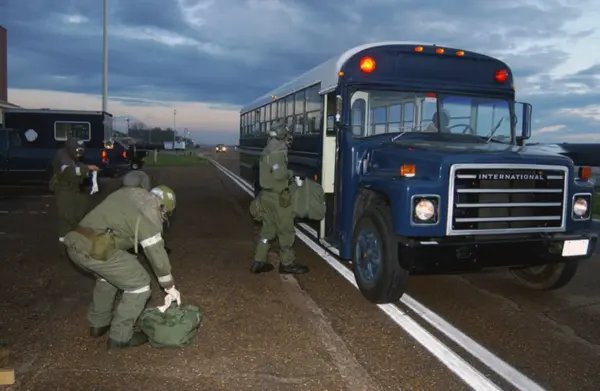
The Air Force, because it’s the Air Force, had what Lackland trainees called the “Blue Goose“, blue-and-white buses. These were marginally more civilized, due to creature comforts like windows and seats. But even with all the windows, they still somehow achieved the core mission of smelling like ass, sweat, and diesel. Admittedly, this was pretty good training for airmen, most of whom would breathe a blend of cigarette smoke, farts, and JP-8 fumes (maybe with a little air mixed in) for most of their careers.
Although different, the name still crossed branch lines; maybe there was a slight variation like “cattle car.” No matter, everyone knew precisely what you meant.
An Upgrade Nobody Asked For
In 2001, Fort Leonard Wood received a prototype of something that shouldn’t have existed: a comfortable troop transport trailer. Mel Globerman, the Director of Vehicle Engineering at the General Services Administration, had designed it.
No evidence can be found, but there are rumors that Mr. Globerman had a personal stake in the project; some believe that he, too, had been smooshed into the original cattle trucks during basic training at Fort Leonard Wood in 1972, and that he decided, three decades later, to fix the issue himself.
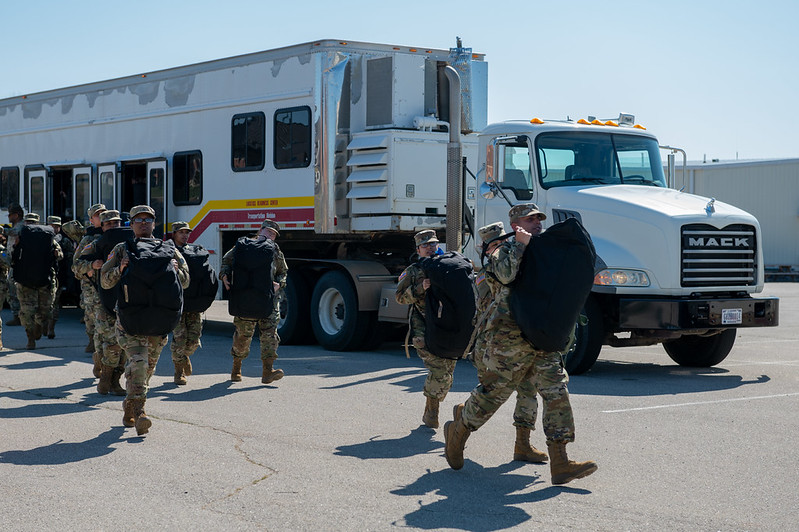
The new 80-passenger personnel carrier vans featured bus seating, air suspension, overhead ruck storage, and a diesel-powered generator running an actual air conditioning system. Fort Benning received four units, and Forts Leonard Wood and Sill each received three during fiscal year 2003, with 10 more scheduled for the following year.
When troops at Leonard Wood first heard what was coming, they didn’t believe it. When it arrived, they thought it was a joke. It was not a joke. It was, however, the beginning of the end.
Proof the Army Has Gone Soft?
The modern troop transports have rows of plastic seats, functional A/C units (though drill sergeants have been known to leave them off because of tradition), seat belts, and regulated capacity limits. They are safer, cleaner, and objectively better in every measurable way. Veterans hate them.
Well, not really. On the other hand, the complaint has some validity, and it goes like this: we suffered together, therefore suffering was the point. The cattle truck was the first small betrayal of civilian comfort, the opening act of a process designed to strip away everything familiar and replace it with shared suck.
Getting shuttled in the cattle truck from point A to B wasn’t the only purpose. You survived the ride, together, pressed against strangers who were about to become the most important people in your life for the next ten weeks, or longer.
Today, cattle truck content floods TikTok and veteran forums. Old-timers post photos of battered trailers and trade stories about which installation had the worst ones. At Fort Lewis, a group of officer candidates began mooning (presenting their bare derriere) during a ride, and the TAC Sergeant ordered them to dismount and march back to the barracks.
At Fort Sill, generations of trainees carved their names into the interior walls, a rolling archive of shared suffering that no one ever thought to preserve.
The cattle truck is mostly gone now, replaced by vehicles that treat soldiers like actual passengers instead of cargo. That’s progress, and it’s the right call. But if you know, you know.
The grab bar. The trust leans against someone you can’t identify. The smell. The five minutes of stolen sleep in a moving metal box with 79 of your new sad friends, and friends were what they were. You may not have liked them, but they left their own friends and families to be with you when you’d need them most.
GWOT veteran Spc. Darin Ehrenrich, U.S. Army Mortarman, reflected on his days at basic, back in 2002; “Some rides in life you will just never forget, especially when it was groin-to-groin with a good buddy.”
Until the next drop, stand easy.
Don’t Miss the Best of We Are The Mighty
• A salute to the Carl Gustaf, the Swedish sledgehammer
• The grunt’s 250-year quest for a weapon that actually works
• An autopsy of Venezuela’s $2 billion Russian S-300VM missile system