In the long history of American military service, few stories better capture the tension between reverence for sacrifice and the anxieties of a changing world than the incident involving Maj. Gen. Joseph J. “Joe” Foss at Phoenix Sky Harbor International Airport in 2002.
Foss was not just any traveler. He was a World War II Marine Corps fighter ace, a Medal of Honor recipient, a former governor of South Dakota, and the first commissioner of the American Football League. At 86 years old, he was traveling to speak about service, citizenship, and duty when he found himself delayed by airport security because of the very medal that symbolized the nation’s highest recognition of valor.
Related: This former Navy pilot became one of the unlikeliest Super Bowl champions ever
The episode became a national story not because it involved celebrity inconvenience, but because it revealed something deeper. It highlighted the confusion and rigidity of post-9/11 security procedures, a lack of institutional memory about military honors, and the emotional cost of treating symbols of sacrifice as threats.
For Foss, the moment was not about personal humiliation. It was about what it said regarding how the nation recognized, or failed to recognize, its heroes.
Born to the ‘Greatest Generation’
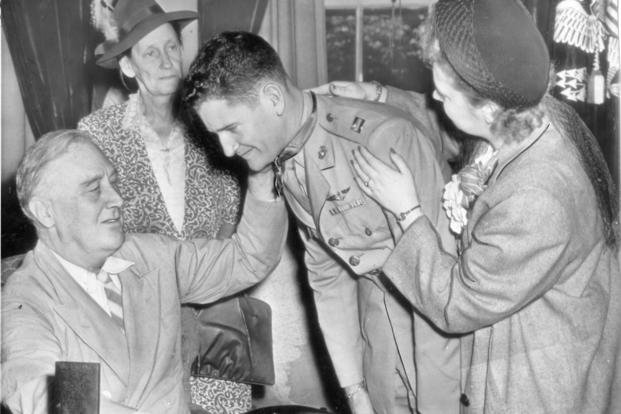
Joseph Jacob Foss was born in 1915 in Sioux Falls, South Dakota, and raised on a farm during the Great Depression. Like many young men of his generation, Foss grew up with a strong sense of duty, responsibility, and patriotism. He joined the United States Marine Corps in 1940, before America formally entered World War II, and soon trained as a fighter pilot.
Foss’s timing placed him at the center of one of the most desperate periods of the war in the Pacific. After the attack on Pearl Harbor, the U.S. struggled to halt Japanese expansion. By 1942, the fight reached Guadalcanal, where Marine aviators and infantrymen endured brutal conditions to hold the island.
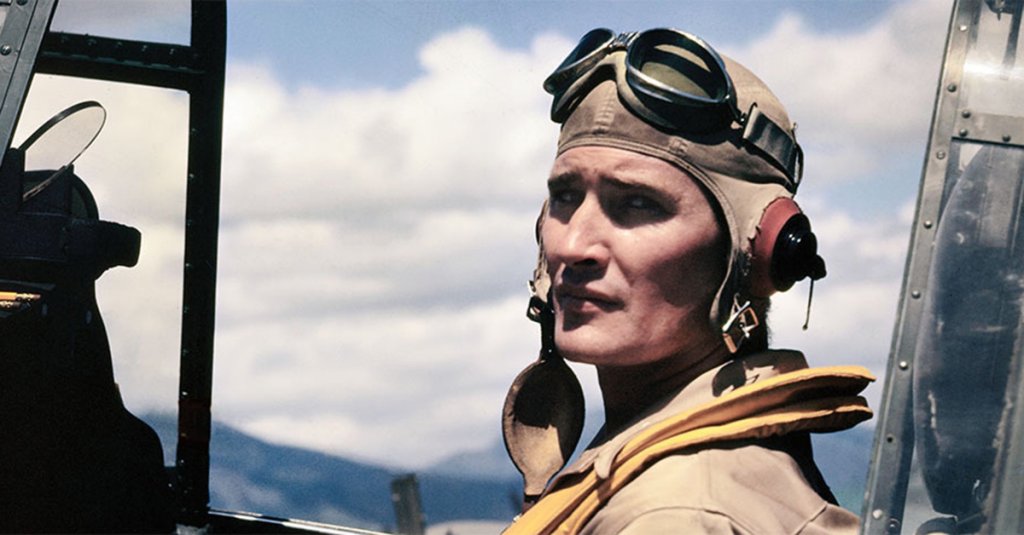
Foss emerged from this campaign as one of the Marine Corps’ most celebrated aviators. Flying the F4F Wildcat, often outnumbered and operating from rough airstrips, Foss demonstrated extraordinary skill, aggression, and leadership. His combat record would earn him the Medal of Honor and cement his place in American military history.
The Medal of Honor

THE MEDAL OF HONOR EXPLAINED
To understand why the Phoenix airport incident resonated so deeply, it is essential to understand what the Medal of Honor represents. Established during the Civil War in 1861 for the Navy and 1862 for the Army, the Medal of Honor was created to recognize acts of conspicuous gallantry and intrepidity at the risk of life above and beyond the call of duty.
Over time, the medal evolved into the most prestigious military decoration in the United States. Its criteria became increasingly strict, reflecting the belief that it should be reserved for the most extraordinary acts of heroism. Today, the Medal of Honor is awarded sparingly, often posthumously, and only after exhaustive review.
Recipients are not honored simply for bravery under fire, but for actions that clearly distinguish them from their peers, often involving self-sacrifice in situations where survival was unlikely. The medal is more than metal and ribbon. It is a symbol of the highest ideals of military service and national character.
Because of this significance, Medal of Honor recipients are traditionally treated with profound respect. They are saluted regardless of rank, invited to presidential inaugurations, and recognized as living embodiments of courage and sacrifice. Any misunderstanding involving the medal is therefore not a minor oversight but a symbolic misstep.
Joe Foss’ Medal of Honor
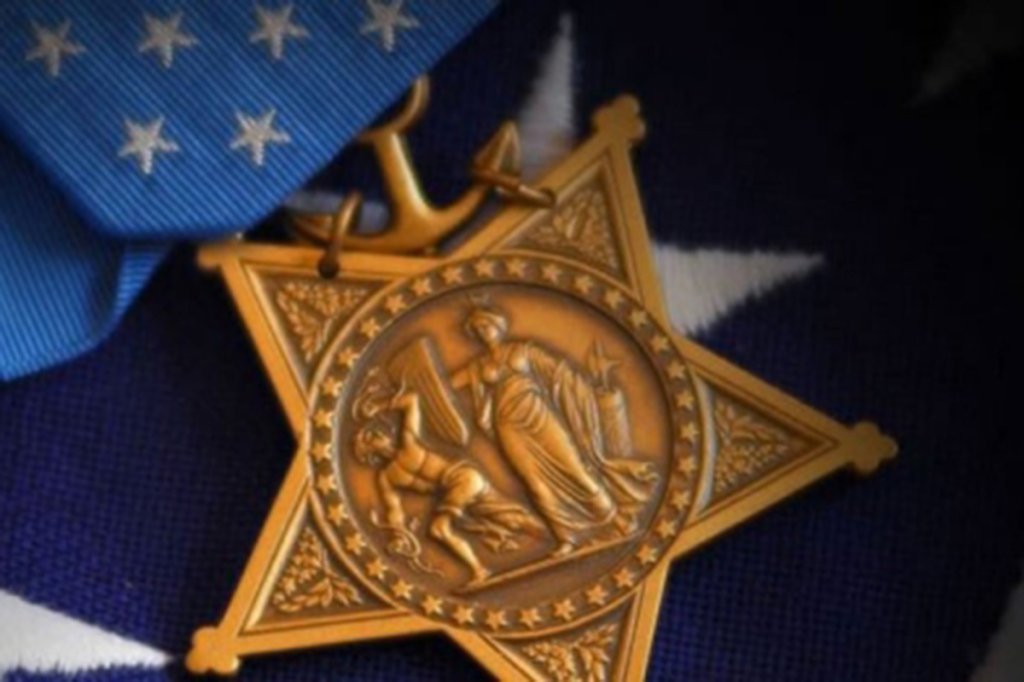
Joe Foss received the Medal of Honor for his actions as a Marine Corps fighter pilot during the Guadalcanal campaign in 1942 and early 1943. At a time when the Marine Corps desperately needed air superiority, Foss repeatedly placed himself in harm’s way to defend American forces and challenge Japanese dominance in the skies.
Over the course of less than a year, Foss was credited with shooting down 26 enemy aircraft, tying the American record at the time. More important than the numbers, however, was the context. Foss often flew missions when American airfields were under constant threat, supplies were limited, and enemy pilots were experienced and aggressive.
Related: Why the Battle of Guadalcanal was a turning point in WWII
His Medal of Honor citation highlights his fearless leadership, skill, and determination. Foss frequently led flights against superior numbers, personally engaging enemy aircraft to protect bombers and ground troops. On several occasions, he returned to combat despite being physically exhausted and under intense pressure, knowing that failure could result in devastating losses for Marines on the ground.
Foss’s actions were not just tactical successes. They were morale boosters during a dark period of the war. His courage symbolized the resilience of American forces in the Pacific and demonstrated that the Japanese advance could be stopped.
A Citizen Leader

Joe Foss, Flying Ace | American Ace: The Joe Foss Story
After the war, Foss did not retreat into quiet retirement. Instead, he became a public servant in multiple arenas. He returned to South Dakota, entered politics, and served as governor from 1955 to 1959. Later, he became the first commissioner of the AFL, helping to shape professional football during a pivotal era.
Throughout his life, Foss remained a vocal advocate for veterans, patriotism, and civic responsibility. He frequently spoke at schools, military academies, and public events, emphasizing the importance of understanding history and honoring those who served.
By 2002, Foss was in his mid-80s, still traveling and speaking. He wore his Medal of Honor not as a display of ego, but as a teaching tool and symbol of service. It was during one such trip that he encountered a moment that shocked him and many Americans.
The Phoenix Airport Incident

In April 2002, Foss was traveling through Phoenix Sky Harbor International Airport on his way to speak at an event hosted by the National Rifle Association and later at the United States Military Academy at West Point, New York. Like many older veterans, Foss wore his Medal of Honor around his neck.
As he passed through security, the medal triggered metal detectors. Transportation Security Administration personnel, relatively new in the wake of the September 11, 2001, attacks, examined the medal and reportedly determined it could be used as a weapon. Foss was detained, questioned, and delayed.
The situation escalated when Foss was told he could not carry the medal through security. Eventually, after a prolonged discussion, he was allowed to board his flight, but only after being required to mail the Medal of Honor and a small pocketknife back to his home at his own expense.
For Foss, the experience was deeply embarrassing. Not because he had been inconvenienced, but because the medal itself had not been recognized or understood. He was careful in how he addressed the incident publicly, emphasizing he was not personally angry. Instead, he expressed concern that the security personnel did not know what the Medal of Honor was.
Foss worried that if such a symbol could be treated as a potential threat, it suggested a loss of historical understanding and respect. His comments resonated with veterans and civilians alike, many of whom saw the incident as emblematic of a broader cultural problem.
Unintended Consequences
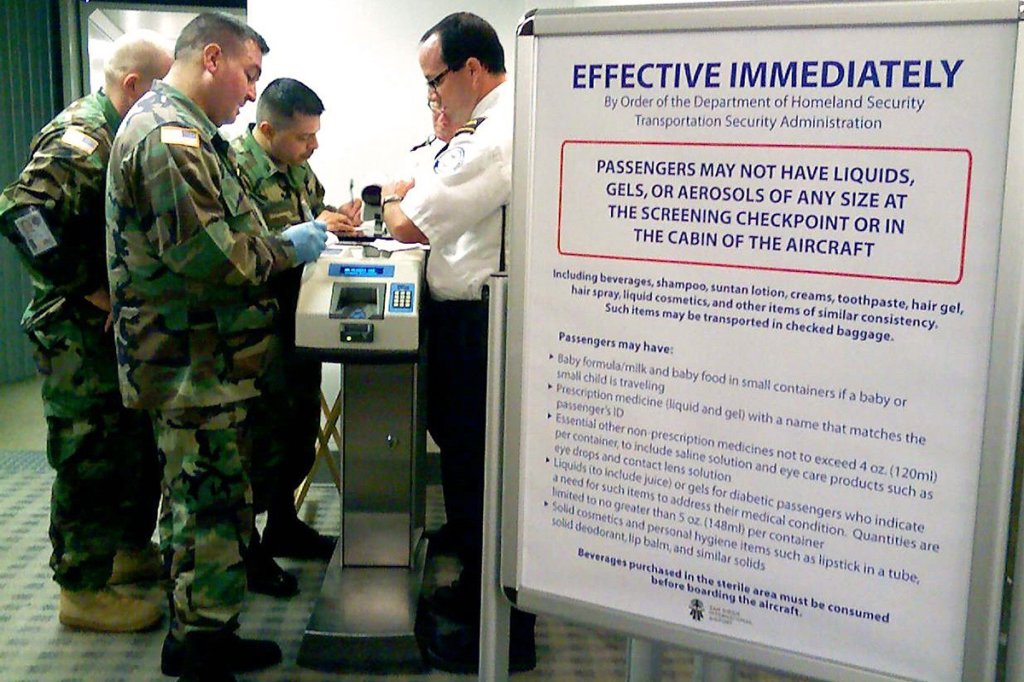
The early 2000s were a period of intense adjustment for American airport security. In response to 9/11, the TSA was rapidly expanded, and new protocols were implemented with urgency.
These measures were designed to prevent another catastrophic attack, but they were often applied rigidly and without sufficient training or historical context. Many TSA agents were young, newly hired, and under pressure to follow rules precisely rather than exercise discretion.
The Foss incident became a widely cited example of how these policies could produce unintended and embarrassing outcomes. Critics argued that while security was essential, it should not come at the expense of common sense or respect for national symbols.
Veterans groups, politicians, and commentators expressed outrage and disbelief. For many Americans, the idea that a Medal of Honor recipient could be treated this way felt like a betrayal of core values.
In response to public criticism, TSA officials acknowledged the incident and indicated that additional training and guidance would be provided regarding military decorations. While this did little to undo Foss’s experience, it suggested that the episode had prompted some institutional reflection.
Honor and Memory
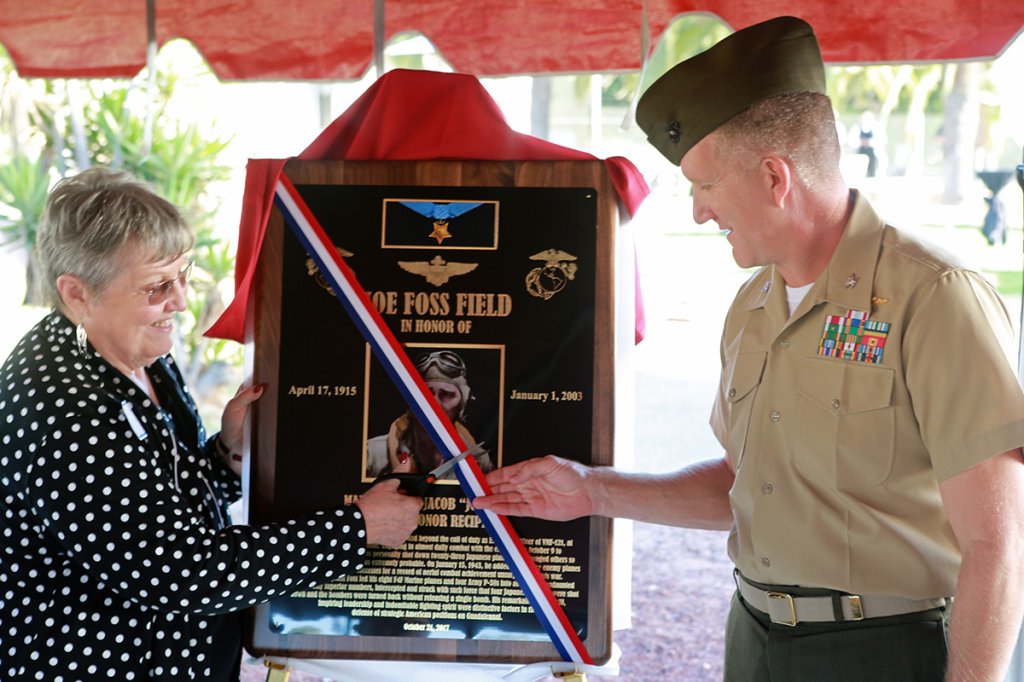
Foss died in 2003, just a year after the airport incident. His legacy, however, extends far beyond that moment. He remains remembered as a fearless Marine aviator, a civic leader, and a man deeply committed to the principles he fought for. The Phoenix airport episode, while unfortunate, became part of his story because it illustrated his character. Foss responded with dignity, focusing not on his own inconvenience but on the broader implications for respect and remembrance.
Foss received the Medal of Honor for his extraordinary courage, risking his life repeatedly to protect his fellow Marines and defend his country. Decades later, that same medal became a source of confusion and embarrassment in a moment shaped by fear and procedural rigidity.
The incident challenged Americans to reflect on how they honor sacrifice in an age of heightened security and rapid change. It reminded the nation that respect for heroes is not automatic. It must be taught, remembered, and practiced.