If you’ve been in a military marriage for more than five minutes, you’ve seen these words come through in a text at some point. They’re not malicious. They’re not even intentionally vague. They’re just the default setting of a life lived on shifting timelines and need-to-know updates.
“Leaving soon.”
“Might be back early.”
“Actually delayed.”
For civilians, a text means clarity: where, when, and why. For military couples, a text is the opening move in a multi-hour puzzle where half the pieces are redacted. And if you’ve survived enough of them without throwing your phone across the room, your marriage is probably unshakable.
“Call you in a sec” = radio silence
Somewhere, at some point, your spouse hit “Send” on “Call you in a sec,” fully intending to do so. Then time collapsed into whatever mission, meeting, or logistical nightmare was eating their day, and “a sec” became “maybe later” became “oops, it’s midnight.”
Inevitably, you’re going to go through some stages. Let’s not call it grief, exactly. Or even anxiety. Let’s call it what it is: the weird, slow unraveling of a person who’s read this sort of text once or twice before.
- Hopeful: Phone on loud, Bluetooth earbuds in, mentally clearing the next twenty minutes.
- Confused: It’s been forty-five. Maybe they’re still busy.
- Irrational: Clearly, they’ve been eaten by a coyote.
- Resigned: You pour a glass of wine, mute the ringer, and that’s when they finally call.
“Landed” = no update until they’re walking in the door
The text comes in: “Landed.” To you, that means TDY is finally over! They’re off the plane, grabbing their bag, and maybe thirty minutes from home. You put your phone within reach. You mentally decide what’s for dinner.
But “landed” in military-speak is more like “step one of twelve.” There’s still a head back to base, then the equipment turn-in. Never mind, they still need to wait on transport, and who knows? There might even be a formation tossed in there for good measure. Of course, there’s a brief that they didn’t tell you about.
At some point, they’ll get food. At another point, they’ll stand around in a parking lot for an hour because someone, somewhere, has to sign a piece of paper before they can leave.
By the time they do make it home, the next update you get is the sound of the front door opening. No warning, no “on my way,” just a “What’s for dinner?” like they didn’t vanish somewhere between the runway and your driveway.
The genre of “vague because they have to be”
Sometimes it’s not forgetfulness. Sometimes it’s not bad timing. Sometimes it’s just… classified.
Operational details are off-limits, so you get the broadest, safest version of the truth:
“Might be home late.”
“Running behind.”
“Heading out for a bit.”

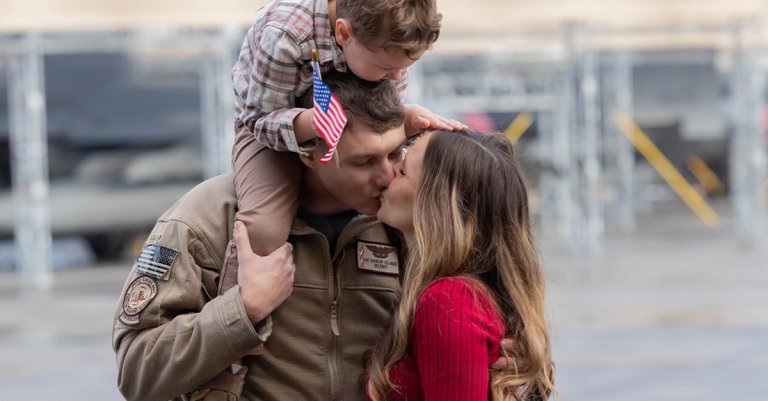
It’s not that they don’t want to tell you more. So often, they literally can’t. So you learn to translate. “Might be home late” means eat dinner on your own. “Running behind” means cancel whatever the two of you had planned for the evening. “Heading out for a bit” means you should probably kiss them like it’s goodbye, because you don’t know when “a bit” ends.
Inevitably, the rest of the day becomes a fill-in-the-blank exercise: reshuffling carpools, rescheduling appointments, making just enough space in your own life for the hole their absence leaves. You adapt without asking follow-up questions. Of course, you want answers, but you know you’re not going to get them.
The “changing the plan without saying it” text
It’s “Be there in 20” when they’re actually still on base.
It’s “On my way” when they haven’t left the motor pool.
It’s “We’re leaving soon” at 1500, followed by no actual movement until 2100.
In the beginning, you’d scramble to line up dinner, keep the kids up, or leave the house just in time to meet them, only to spend the next hour killing time in a parking lot or staring at the clock.
Now? You’ve stopped rearranging your whole day for those messages. You build in a mental translation: “20 minutes” means “at least an hour.” “Tonight” means “tomorrow, maybe.” And “soon” means “put your phone down and go live your life until further notice.”
The context clues Olympics

Soon enough, you start to realize the real skill in a military marriage isn’t patience. It’s fluency. You know the difference between “soon” and “soon soon.” You can tell if “running behind” means five minutes or five hours based on how many ellipses are in the text.
You keep mental files: how long their unit takes to wrap up after a meeting, the gap between “rolling out” and actually rolling, the way “all good here” means the exact opposite of “we’re fine.”
Military marriage is ultimately about trusting that “call you in a sec” actually means “I’ll talk to you when I can.” That “landed” means “I’m alive, don’t worry.” That “we’re good” means “I can’t tell you everything, but I want you to know enough.”
If you can navigate a relationship built on context clues, half-finished updates, and more plan changes than a toddler’s bedtime, you’re doing amazing.