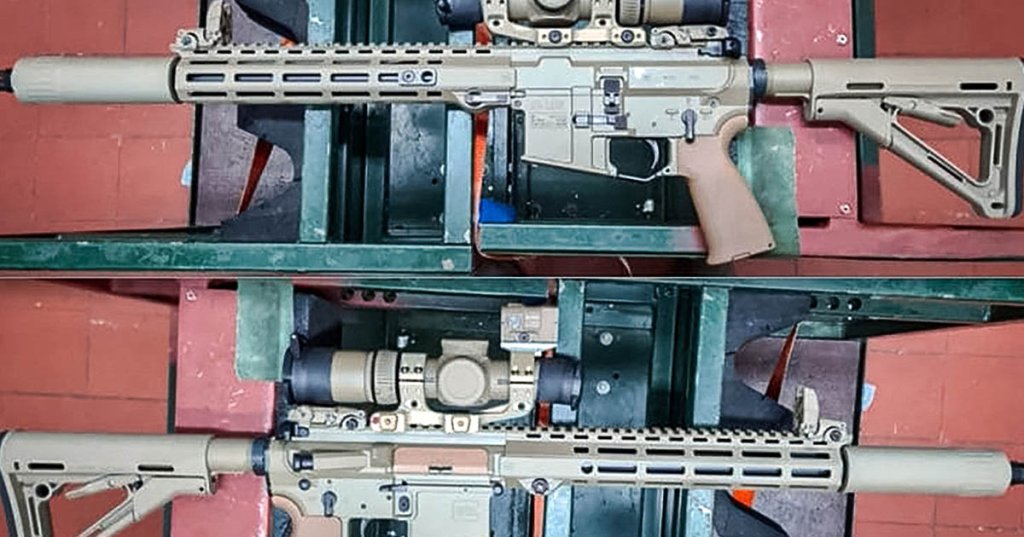
No, it doesn’t take Glock mags. And no, you can’t put a switch on it. The iconic Glock firearm manufacturer has finally broken out of the handgun market and made a rifle. Unsurprisingly, it’s an AR-15 chambered in .223. And no, it’s not called the Glock 15.
First seen as a submission to Project Hunter, the British military’s special operations rifle project, the GR-115 has been spotted in the wild, and technical data has leaked, too. Here’s what we know.
Per the Project Hunter requirements, the first GR-115 we saw features a flat, dark earth color scheme. FDE really is the new hotness in the tactical world. However, the latest iterations have been seen in the hands of police officers and are more basic.
Though designed by Glock Austria, the GR-115 is reportedly built in Slovakia. The country has a history of firearms manufacturing going back to the days when it was part of Czechoslovakia. Naturally, a standard version of the GR-115 was spotted in the hands of Slovakian police officers.
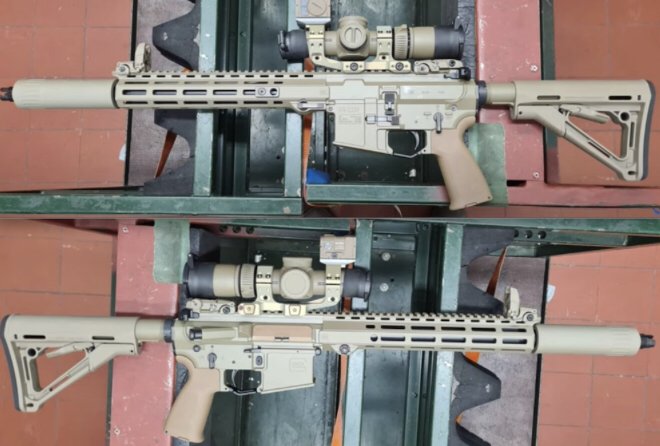
Surprisingly, for a European manufacturer, the GR-115 employs an internal piston gas-operating system. In contrast, Heckler & Koch’s HK416 utilizes an external piston system, which European customers, including the French Army, Norwegian Army, and German Special Forces, generally prefer. Moreover, Glock’s rifle features a handguard with M-LOK attachment points at all angles versus the KeyMod interface that is more popular in Europe; at least M-LOK is less phallic.
Although the Slovakian police rifles spotted in the wild both sport 11.5-inch barrels, documents from a Brazilian law enforcement contract reveal that the GR-115 can also be equipped with a 14.75-inch barrel. This is notable for the U.S. market, where rifles must have a 16-inch barrel to be legal. By permanently attaching a muzzle device like the extended A2 bird cage seen on Glock’s rifle, the overall length of a 14.75-inch barrel can be made 16 inches. That said, there is no word on the GR-115 coming to the U.S. for civilian or law enforcement sale.

The Brazilian documents also show that the GR-115 comes with a Magpul stock, pistol grip, and back-up iron sights. On the left side of the rifle, the M-LOK handguard attaches to the upper receiver with a quick-detach interface. Speaking of the receiver, the upper and lower are billet and accommodate an enlarged trigger well, bolt catch/release, and ambidextrous controls. Notably, the trigger is a Geissele and should be crisp and reliable.
The weight of the 14.75-inch rifle is listed as 6.79 pounds, and the 11.5-inch rifle weighs in at 6.2 pounds. For reference, a standard U.S. military FN M4A1 carbine weighs 6.36 pounds. The increased weight of the GR-115 may be a result of its consistent medium profile barrel, as opposed to the government profile barrel that tapers under the handguard. We’ll have to wait for a closer look at the Glock to know for sure.

What we have heard from end users sharing their experiences online is that the GR-115 has been reliable, at least in its latest iteration. During Project Hunter testing, the Glock rifle reportedly failed to pass the first week. Issues apparently stemmed from both the suppressor and the selector switch, which would get stuck when rotating between fire modes.
Law enforcement users reported to pro shooter Ben Stoeger that their agency has been testing the GR-115 for a year. They note that the receivers are fitted very tightly, the firing pin retaining pin is captured (a feature that NCOs wish the M4 had so that Private Snuffy wouldn’t lose his during maintenance), and none of the rifles have failed.
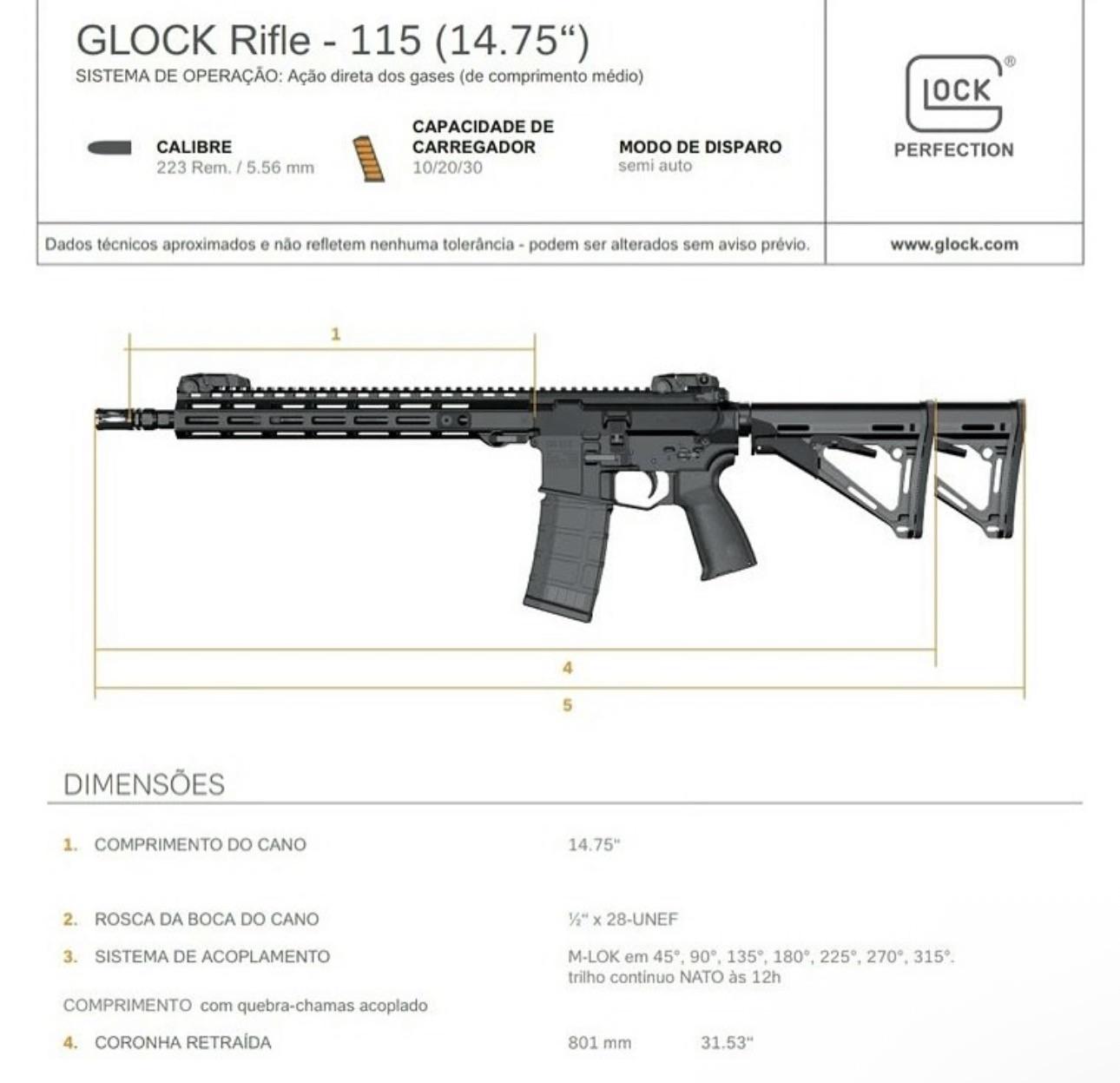
At $2,000 per rifle, at least for the Brazilian contract, the GR-115 is positioned similarly to high-end duty rifles, such as those sold by Daniel Defense and LMT. While the QD handguard is a novel feature, especially if the barrel can also be quickly changed, Glock’s rifle appears to be just another AR-15 in a saturated market. The big difference is the Glock name on the receiver.
To law enforcement executives who are better at field stripping a pen than a rifle, consolidating department weapons purchases could be very appealing. In fairness, acquiring duty pistols and rifles from the same manufacturer makes sense from the financial and logistical perspectives. As long as the Glock rifle performs as reliably as its handguns, the Austrian powerhouse may have a winner on its hands.