If you spend enough time around military hospitals, you develop a healthy cynicism for the word “breakthrough.” Every year, the Pentagon promises us game-changing technology that usually amounts to a new rifle nobody asked for, that is five pounds heavier, requires knowledge of advanced engineering to operate, and probably runs on batteries for some reason.
Related: Wounded Ukrainian soldiers with bionic arms want to return to the front lines
We are used to the potential of promise: sexy, futuristic gear that looks great in a briefing room but fails the second it touches the training areas.
For the amputee community, soldiers who have left pieces of themselves in places like Kandahar, Ramadi, and the Donbas, that cynicism runs even deeper. For decades, the promise of prosthetics has been almost entirely visual, never tangible.
They’d promise limbs that look like hands. They promise robotics that move like hands. Maybe, if the R&D budget was high enough, or an election drew near, they might promise servos that can grip like hands.
But for the operator on the ground, the reality of wearing a prosthetic has always been a liability; a hindrance to their passions. Until now, that is.
For 2026, the way society thinks about disability, or how we think in general, has to be revisited. A breakthrough trial involving researchers from Florida International University and Walter Reed National Military Medical Center hasn’t just built a cinematic robot hand; they have successfully wired a machine straight into the human nervous system. Ladies and gentlemen, welcome to the future.
It’s called the Neural-Enabled Prosthetic Hand (NEPH). It doesn’t just move, it actually feels. For the future of soldiers’ quality of life and warfare, that changes everything.
Why Plastic Hands Fail
To understand why this is a technical revolution and a marvel of researchers’ ingenuity, you first have to know why current prosthetics suck in kinetic environments.
Standard prosthetics, whether they are body-powered hooks or advanced myoelectric hands, operate on what engineers call an “open loop” system. You, the user, send a command. Flex a muscle in your residual limb, sensors pick it up, and the hand closes.
That’s the “easy” part. The hard part is that the hand never spoke back.
For example, if you have a regular old biological hand and you close your eyes, you still know exactly where your fingers are. You know if you are making a fist, or if you are holding a baseball, perhaps a can of beer. You’ll also know how hard you are squeezing. This is called proprioception, and it might be one of the most underrated survival skills in the human arsenal.
Current prosthetics lack this capability. If you want to know if you are successfully holding a rifle magazine, a door handle, or a tourniquet with a prosthetic, you have to look at it. You have to visually confirm the grip.
In a civilian setting, that is an inconvenience. In a firefight, it is a massive liability.
Combat is a game of bandwidth. Your eyes need to be scanning the horizon, watching your sector, or reading the body language of a threat. If you have to burn even two seconds of visual focus to check if your robotic hand is actually holding your weapon, you have already lost. You are slower than the enemy, and that means trouble for you and your mates.
This is precisely why so many amputees ditch the high-tech “Terminator” arms and go back to much simpler hooks. The cognitive load of managing the robot is just too demanding.
The NEPH System
The Neural-Enabled Prosthetic Hand solves the bandwidth problem by closing the loop. It stops asking the soldier to visually supervise their own gear and starts sending data directly to the brain.
Forget the sci-fi movies where a guy wakes up on a table with a perfectly functioning metal arm, prepared to fight crime in the city of Detroit. The reality is, honestly, much more impressive.
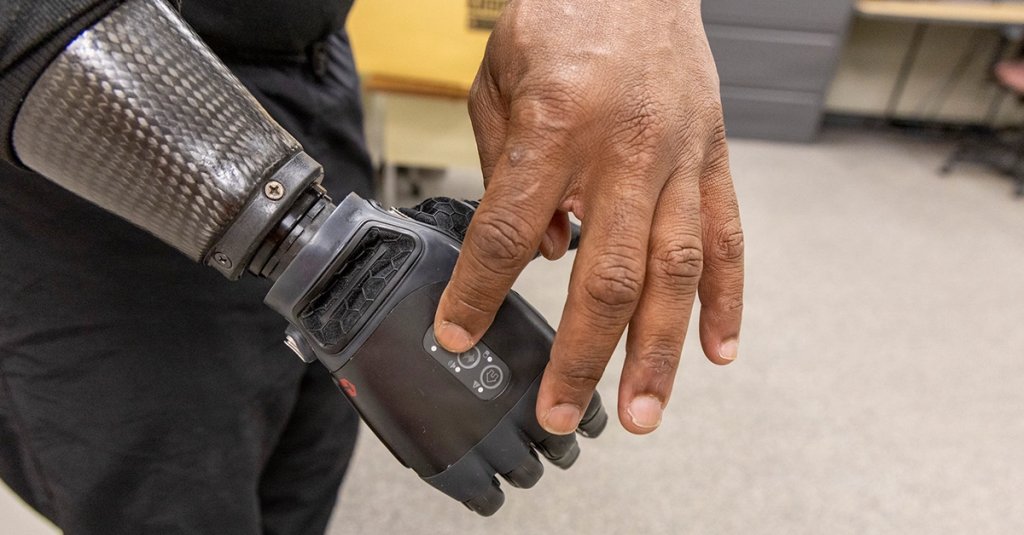
Developed by absolute legends like Ranu Jung and James Abbas, the NEPH tech relies on a hard-wired interface. Basically, surgeons implant a neurostimulator (think of it like a sort of pacemaker) directly into the upper arm of the amputee.
Once inserted, they’ll then thread very thin wires (fascicular electrodes) directly into the median and ulnar nerves. These are the same biological pathways that carry sensations from the hand to the brain before the injury.
This creates, in essence, a bridge. The neural-enabled prosthetic hand itself is outfitted with advanced sensors in the fingertips and palm that measure two things: grip force (how hard am I squeezing?) and hand aperture (how wide is my hand open?).
When the user grabs something, those sensors broadcast the data to the internal implant. The implant translates that digital signal into electrical pulses and “zaps” the nerve fibers with a specific frequency.
The result? The brain receives a message it hasn’t heard since the IED went off: “I am holding something.”
It bypasses the eyes entirely since the user actually feels the pressure. They will feel the resistance. They regain the ability to adjust the amount of force without thinking about it.
The Psychological Impact
While the tactical implications are what get the funding, the psychological impact of this tech might be the real story.
Most amputees live with a “ghost.” It’s called phantom limb pain, the sensation that the missing limb is still there, often contorted, shriveled, or clenched in a painful fist. It happens because the brain is desperate for that data; it keeps dialing the phone number for the missing hand, and when nobody answers, it gets anxious.
The NEPH system effectively exorcises this ghost. How the heck could it possibly accomplish this miracle? Because the brain is finally receiving valid data from those nerves again, it is starting to relax, then accepts the metal hand as “Self” rather than an artifact.
During the Walter Reed trials, participants reported a phenomenon called “telescoping.” Before the implant, their phantom hand felt like it was shriveled up inside the stump. Once the system was turned on, the phantom hand “extended” back to its normal length to inhabit the prosthetic fingers.
One soldier described the sensation of grabbing a pillow and knowing it was soft. Another spoke about the ability to hold his wife’s hand and feel the connection. That sounds like soft, human interest stuff, and it is, but in the context of soldier recovery, it is vital. If the soldier accepts the limb as part of their body, they will train harder with it. Once this connection is made, the trust will start to set in.
Neural-Enabled Prosthetic Future
It is easy to look at the list of recent breakthroughs, the Iron Beam lasers, the nuclear backpacks, the invisibility cloaks, and think we are entering an era of warfare where technology solves everything.
We are entering the era of the true man-machine team-up. We aren’t just handing 22-year-olds rifles anymore; we are handing them the power to integrate directly with their weapons systems. If you haven’t noticed yet, the NEPH system is the proof of concept for something much larger than prosthetics.
Think about this: if we can hard-wire a hand to the nervous system to restore touch, what else can we Netflix stream into the brain? Could a drone operator “feel” the turbulence of their UAV? Could a bomb tech “feel” the chemical composition of a device through sensors in their fingertips?
The “Luke Skywalker” hand is no longer a dream from a galaxy far, far away. It is potentially a piece of issued kit that turns a disability into an extraordinary.