

The 107-country Outer Space Treaty signed in 1967 prohibits nuclear, biological, or chemical weapons from being placed or used from Earth’s orbit. What they didn’t count on was the U.S. Air Force’s most simple weapon ever: a tungsten rod that could hit a city with the explosive power of an intercontinental ballistic missile.
It’s technically not a weapon.
Related: 4 strange weapons of the Vietnam War
During the Vietnam War, the U.S. used what they called “Lazy Dog” bombs. These were simply solid steel pieces, less than two inches long, and fitted with fins. There was no explosive—they were simply dropped by the hundreds from planes flying above Vietnam.
Lazy Dog projectiles (also known as “kinetic bombardment”) could reach speeds of up to 500 miles per hour as they fell to the ground and could penetrate nine inches of concrete after being dropped from as little as 3,000 feet. Or go right through a squishy communist’s body.
The idea is kind of like shooting bullets at a target from space, except instead of losing velocity as the projectile travels, it gains velocity and energy that will be expended on impact. The Lazy Dog program was basically shotgunning a large swath of jungle, raining bullet-sized death at high speeds.
That’s how Project Thor came to be conjured.
Instead of hundreds of small projectiles from a few thousand feet, Thor used a large projectile from a few thousand miles above the Earth. The Rods from God idea was a bundle of telephone-pole sized tungsten rods, 20 feet long and one foot in diameter, dropped from orbit, reaching a speed of up to 10 times the speed of sound.
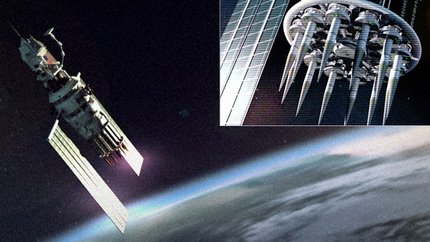
The rod itself would penetrate hundreds of feet into the Earth, destroying any potential hardened bunkers or secret underground sites (along with anyone who might be working that day). More than that, when the rod hit, the explosion would be on par with the magnitude of a ground-penetrating nuclear weapon—but with no fallout. The best of all possible worlds (unless you happened to be working that day).
Most importantly, it was quick and responsive. It would take all of 15 minutes to destroy a target with the Rods from God.
One Quora user who works in the defense aerospace industry quoted a cost of no less than $10,000 per pound to fire anything into space. With 20 cubic feet of dense tungsten weighing in at just over 24,000 pounds, the math is easy, the cost to the Department of Defense is much harder. Just one of the rods would be prohibitively expensive. It would cost around $230 million dollars per rod, which was somehow unimaginable, even during the Cold War.

These days, cost isn’t so much of a factor, apparently. The Bush Administration even considered revisiting the idea to hit underground nuclear sites in rogue nations in the years following the 9/11 Attacks. Interestingly enough, the cost of a single Minuteman III ICBM was $7 million in 1962, when it was first introduced (more than $74.6 million adjusted for inflation in 2026).
The trouble with a nuclear payload is that it isn’t (necessarily) designed to penetrate deep into the surface. And the fallout from a nuclear device can be devastating to surrounding, potentially friendly areas. There’s no problem with penetrating the surface of the Earth or cleaning up the radioactivity caused by the Rods from God. It also doesn’t put American lives at risk (unless they happen to be working in the blast area that day).
It’s almost as if there’s no real downside.

A core takeaway from the concept of weapons like Project Thor’s is that hypersonic weapons pack a significant punch and might be the future of global warfare, even in the face of how much it costs to send telephone poles of tungsten into orbit. Anyone with a space program and enough raw material could launch a Thor-like project without (technically) violating any existing nuclear or weapons treaties.
Try not to think about which other countries might have an idea like this.
Don’t Miss the Best of We Are The Mighty
• This E-4’s grave is the most dangerous gravesite in the world
• The Massive Ordnance Penetrator is a 30,000-pound bunker buster bomb
• You have to see this Flintlock Machine Gun from the 1700s





Loading comments…
Comments couldn’t be loaded. Please refresh the page.