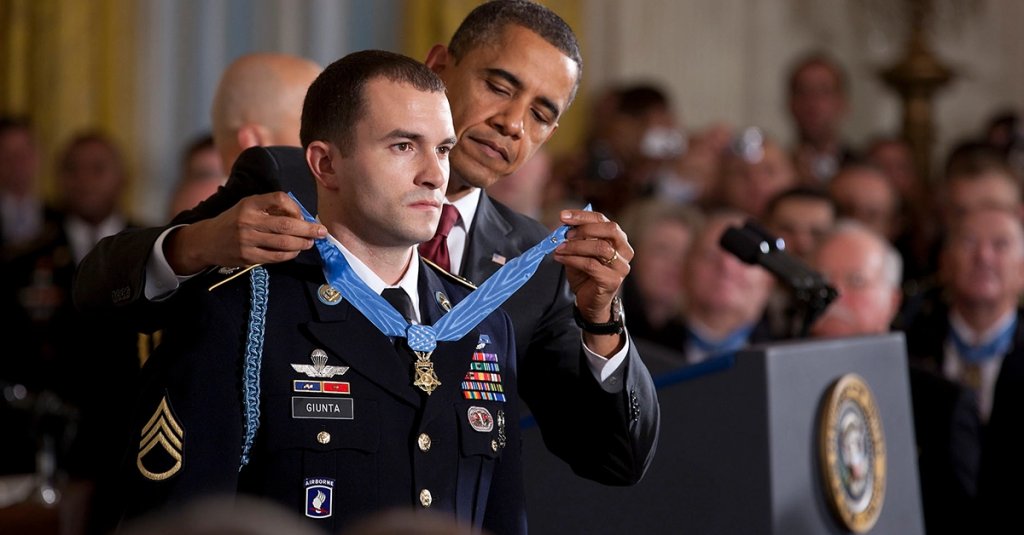
A military medal is not supposed to be a vibe, a rumor, or a good story that grew legs. It’s an official claim that this person did this thing, in this place, at this time, and it met a written standard. The higher the medal, the less the system trusts adjectives, and the more it demands receipts.
Related: ‘The Iron Major:’ James Capers Jr.’s long road to the Medal of Honor
But first, a little clarification. The problem with so many military medal explainers is that they usually mash together valor awards (earned doing something that was probably insane under fire) with service awards (earned doing something huge in a job with a lot of responsibility). Those are different lanes, different approval chains, and they’re not interchangeable.
Simply put, different medals have different meanings. But let’s break down what the top medals actually are, who can get them, and how the paperwork monster turns an amazing act on the battlefield into a ribbon on a uniform.
1. The Medal of Honor
The Medal of Honor sits at the peak. It is awarded for conspicuous gallantry and intrepidity at the risk of life above and beyond the call of duty, under specific combat-related conditions. It exists in three versions: Army, Air Force, and a Navy version used for the Navy, Marine Corps, and Coast Guard.
Because it is the country’s highest military decoration, the review is built to withstand the test of time. The act has to be described in detail, tied to a combat circumstance, and supported by strong evidence. The standard is so high that even truly heroic actions may be recognized with a Service Cross or Silver Star instead, if the documentation doesn’t meet the Medal of Honor bar.
It is presented by the President in the name of Congress, which is why people often call it the “Congressional” Medal of Honor, even though the official name is simply the Medal of Honor.
2. The Service Crosses
The Distinguished Service Cross is the Army’s second-highest decoration for valor. It recognizes extraordinary heroism in combat conditions. The key point is comparative: the action must be above what would justify other combat awards, but short of the Medal of Honor standard.
The Navy Cross is the Navy’s and Marine Corps’ second-highest valor award, also available to Coast Guard members when operating under the authority of the Department of the Navy. That last clause matters, because it reflects how authority and command relationships shape award eligibility in joint environments.
The Air Force Cross is the Air Force’s second-highest decoration for extraordinary heroism in combat conditions, and it is treated as the equivalent of the Distinguished Service Cross and the Navy Cross.
The Coast Guard Cross was only authorized in 2010 and has never been awarded, but it fills the same “second-highest valor” space for the Coast Guard, recognizing extraordinary heroism in combat. In practice, it lives in the same moral neighborhood as the other Service Crosses: rare, heavily scrutinized, and meant to signal a level of heroism that is unmistakable.

3. The Defense Distinguished Service Medal
If the medals above are mostly about gallantry under fire, the Defense Distinguished Service Medal is different. It is a joint decoration, and it is typically associated with exceptionally meritorious service in a position of great responsibility, tied to joint operations or joint duty at the Department of Defense level.
Because it’s a department-level award, the approval authority is usually aligned with the Department of Defense (War) rather than a single service chain. The “evidence” isn’t eyewitness statements from a firefight. It’s performance at a strategic level: mission outcomes, responsibilities held, and impact on joint force success. The review tends to be exhaustive in a different way, because it’s measuring leadership and responsibility rather than a discrete act of valor.
4. The Silver Star
The Silver Star is the third-highest U.S. military combat decoration for gallantry in action, available across the Armed Forces. It is still a high bar, but it is more common than the Medal of Honor or a Service Cross because it captures a wider range of gallant actions that are clearly heroic, yet not at the “extraordinary heroism” threshold those higher awards demand.
In the issuance process, the Silver Star often highlights the system’s balancing act. Leaders must weigh intensity, risk, effect on the fight, and corroboration. A single act might last seconds, like exposing oneself to enemy fire to pull a wounded teammate to cover, or it might unfold over a longer stretch, like holding a collapsing position long enough for others to break contact.

5. Service-Specific Distinguished Service Medals
After the Defense Distinguished Service Medal comes the family of Distinguished Service Medals issued by the individual services. They’re not awards for valor under fire; they’re senior-level decorations for exceptionally meritorious service in a duty of great responsibility, usually tied to major commands, strategic billets, theater-level staff work, or career-capping assignments where outcomes carry national weight.
In practice, the “proof” isn’t eyewitness statements from a firefight. It’s a record of the scope of authority, mission impact, measurable results, and endorsements from commanders.
The recommendation package typically reads like a campaign narrative in miniature: what the officer or senior leader inherited, what they changed, what improved, and what it meant for the force. Approval authority is generally high, and scrutiny is heavy because these medals are meant to stay rare and meaningful.
6. Defense Superior Service Medal
If the Defense Distinguished Service Medal is the top joint-service award, the Defense Superior Service Medal is the next rung down, but still focused on joint duty. It recognizes superior meritorious service in a position of significant responsibility while serving in a joint assignment or joint activity.
In plain terms, it’s the medal that often shows up when someone delivers outsized results in a joint headquarters, a combatant command staff, a joint task force, or a similar environment where the job isn’t service-specific first, but department-level.
The issuance process mirrors other high-level service awards: a detailed justification, a tight timeline, senior endorsements, and review at levels that can confirm the assignment was truly joint and that the performance meets the standard.
7. Legion of Merit
The Legion of Merit is a widely recognized decoration for exceptionally meritorious conduct in the performance of outstanding service and achievement. It often marks sustained excellence over a demanding tour, especially in command or senior staff roles, but it can also recognize a singular, high-impact accomplishment when the scope is sufficient.
Unlike purely joint decorations, it’s commonly issued within a service chain, which means the supporting record leans hard on assignment performance, mission outcomes, and the level of responsibility held.
The package usually lives or dies on specificity. What was the mission, what was the baseline, what changed, and what was the measurable effect? The citation language tends to be polished and formal, but the approval logic is simple: this person’s performance was notably above their peers, and the consequences mattered to the organization.
Don’t Miss the Best of We Are The Mighty
• He fought seven MiGs and kept it secret—70 years later, he’s getting the Medal of Honor
• This Medal of Honor recipient came up with the idea for the Super Bowl
• Soldier killed protecting a Polish officer in Afghanistan will receive Medal of Honor