You survived the TRICARE delivery and navigated the hospital. You’re home. Now the real fun begins. The first week with a newborn is a Nickelodeon-style gauntlet of exhaustion and flying fluids. Still, it will hit different when it also requires signing a stack of arthritis causing DoD forms, and your spouse’s “paternity leave” turns out to be more of a polite suggestion. These are the truths you only understand if your baby’s first lullaby was “Taps.”
Also Read: 7 base housing neighbors every service member knows
1. Reveille is now your baby’s least favorite alarm clock.
That 0600 bugle call was charming… at first. Now, it’s a precision-guided alarm bomb that wakes the baby exactly 15 minutes after you finally got them to sleep.
2. You have precisely 48 hours to make the baby “mission essential.”
You’re not just “enjoying newborn cuddles.” You’re on a deadline. That baby isn’t exactly “real” until it’s in the system and they are enrolled in DEERS and TRICARE. The paperwork waits for no one, plus hearing that your baby doesn’t exist during an emergency might cause you to make the evening news.

3. The base “meal mobile” is more efficient than battalion logistics.
There is one upside. Spouses you’ve met once will appear at your door with lasagna. It’s a lot of cheese; however, the coordination is terrifying and beautiful. You’ll never be more grateful for an old tinfoil pan or potential constipation in your life.
4. You’ll get a “congrats” text from your spouse’s First Sergeant.
You haven’t even texted your family yet, but the chain of command already knows; they even hooked up a Chinook with a new parent supply drop. It’s somehow both supportive and vaguely threatening. Be sure to set a proper landing zone.
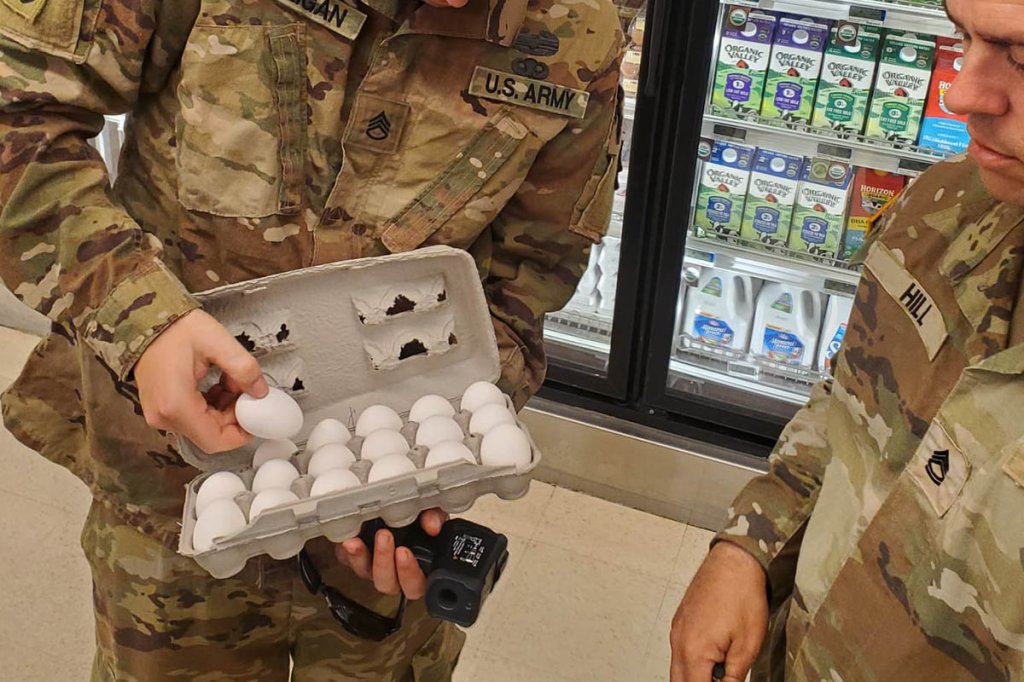
5. Your first major outing is a tactical raid on the Commissary.
This isn’t a moment to yourself, it’s a full-blown operation. You need Huggies, formula, caffeine, and, for some reason nobody else would understand, a snot sucker. You have a 40-minute window. You’ll take down slow-moving retirees, pray the baby stays asleep, and feel like you just sprinted across Normandy. But hey, you didn’t draw first blood; they did… or maybe it was you, you haven’t slept in a while.
6. “Paternity leave” means your spouse is on a Zoom meeting in the nursery.
They technically have 10 days off. But “just one email” becomes the “urgent call” which inevitably becomes “I just have to run into the office for a few minutes.” You’re left holding the baby, listening to them say “roger that” in the next room. Don’t worry, though, you’ll both be enjoying cold pizza crusts together by midnight.
7. You’ll get very good at 2 a.m. time zone math.
Your mom is 2,000 miles away. Your best friend is in Kansas. Your 2 a.m. “Is this normal?” questions are all directed at FaceTime. By the way, yes, it’s most likely normal.
8. You learn to fear spit-up on a freshly-pressed uniform.
Spit up on a new onesie? Fine. But the laws of physics dictate that a newborn will always find the one piece of clothing that cannot be easily washed, usually five minutes before your spouse has to be at formation.
9. Base housing cares more about your lawn than your recovery.

You’re still in a waking coma, but you get a gentle knock on the door about that darn grass on your front lawn being 0.5 inches too high. You seriously contemplate weeping on the porch until they go away.
10. You finally understand what “adaptable” really means.
You thought “always flexible” was about PCS moves and deployments. My, how you were wrong. It’s about surviving a diaper blowout (how did it get all the way up to the neck?), a surprise inspection, and a recall formation, all before 0900.
By now, the first week is all a lucid dream of hazmat diapers, puke that looks like a civil war battlefield, and cold coffee. But you survived. You’re not just a new parent; you’re a new military parent. Not many have done what you have. And you’ve already earned your first-week service ribbon. Congratulations. Now, go update DEERS, save yourself the lost time explaining yourself to Military Police and attorneys.
Don’t Miss the Best of We Are The Mighty
• The 5 best exotic weapons in history
• 7 Venezuelan bugs that can ruin your day (and maybe your life)
• This is how an Army mortar works (from an 11C)