How much can $100 million in gold buy?
A year after World War II ended, President Harry Truman’s administration thought that was a fair price to purchase Greenland.
As you might have guessed, the offer was either ignored or outright ejected. Otherwise, 80 years later, President Donald Trump wouldn’t be so gung-ho about acquiring the world’s largest island “one way or the other.”
Related: That time Russia tried to join NATO
Nevermind that Greenland is part of the kingdom of Denmark, which, like the United States, belongs to NATO. Still, Trump sees accessing the 836,000-square-foot island covered predominantly with ice as an issue of national and world security against Russian and Chinese threats.
“Greenland sits astride key Arctic sea lanes that are becoming increasingly navigable as ice melts,” Ben Johansen and Eli Stokols wrote in Politico in January. “It also hosts Pituffik Space Base, a critical U.S. military installation for missile warning, space surveillance, and Arctic operations. To Trump, Greenland represents leverage: strategic location, military value, and untapped natural resources.”
To be fair, some of those reasons are valid. They also are not new in regard to a country that is three times the size of Texas but has a population less than Kalamazoo, Michigan.
Attempts to Acquire Greenland Date to the 19th Century
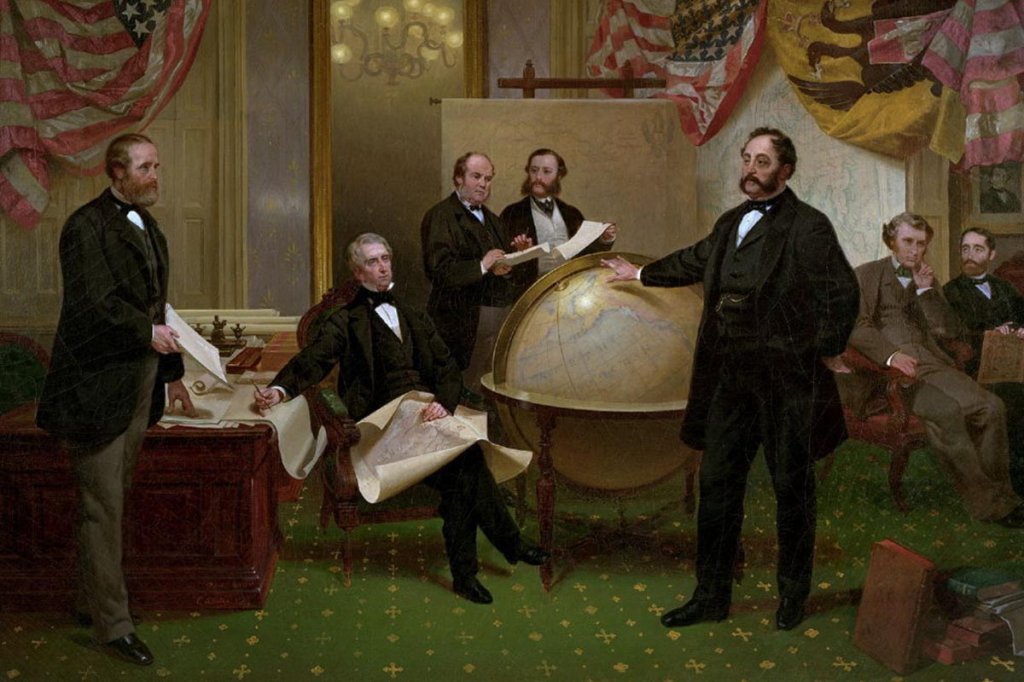
After the Civil War, Secretary of State William Seward was in a spending mood. He agreed to pay Russia $7.2 million (roughly $164 million today) to acquire Alaska in 1867; the transaction was ridiculed as “Seward’s Folly” at the time, but who’s laughing now?
Seward didn’t want to stop with the Pacific Northwest, either.
Enamored with Greenland’s vast natural resources, he turned the U.S. government’s checkbook toward purchasing it, along with Iceland, the following year. Seward reportedly had settled on a price ($5.5 million, or about $125 million today) but never got around to an official offer after Congress balked about acquiring more Arctic territory.
A Proposed Land Swap
The United States was at it again in 1910, but this time, it wasn’t offering cold, hard cash. American diplomats approached the Danes with a complicated trade, in which the Danes would hand over Greenland and the Danish West Indies to the U.S., and in return, the U.S. would relinquish some islands in the Philippines. Much like a deal involving three sports teams, the land exchange also would have involved Germany.
We’re not sure what the Germans thought of the deal, but the Danes’ answer was decisive. They responded with a hard no.
While the U.S. acquired the Danish West Indies–now known as the U.S. Virgin Islands–for $25 million in gold in 1917, Greenland remained out of reach.
Next, it was Truman’s turn to try.
Cold War Calculations
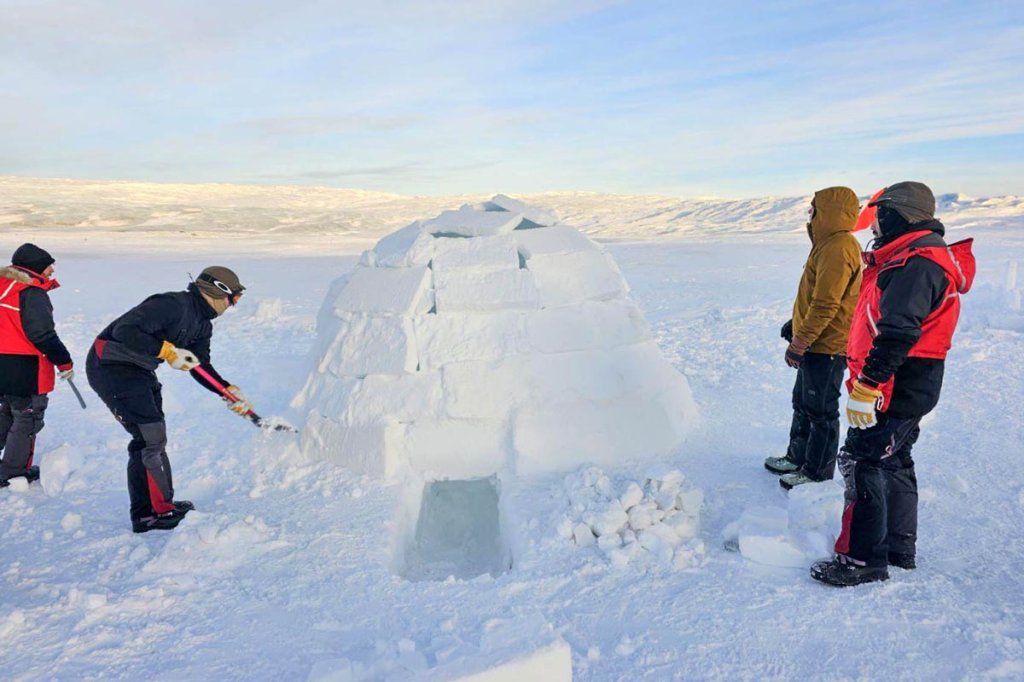
After the Allies defeated the Nazis in World War II, the Russians posed the biggest threat to the United States. The Cold War had barely begun when Truman tried to shore up America’s defense by making another pitch to Denmark.
Offering gold seemed to work once before with the Danes, so why not try it again? Just offer more of it, so that’s what the Truman administration did.
Valuing Greenland’s strategic importance, the Americans likely thought that $100 million in gold would lead at least to further negotiations. The Danes didn’t see it that way and, in reality, were aghast at the offer.
“The Danes were rather horrified that the U.S. thought it could gain a territory by putting that kind of a monetary value on it, and that Denmark would be willing to part with it,” historian Ron Doel, co-editor of “Exploring Greenland: Cold War Science and Technology on Ice,” said to History.com.
The 1951 Agreement
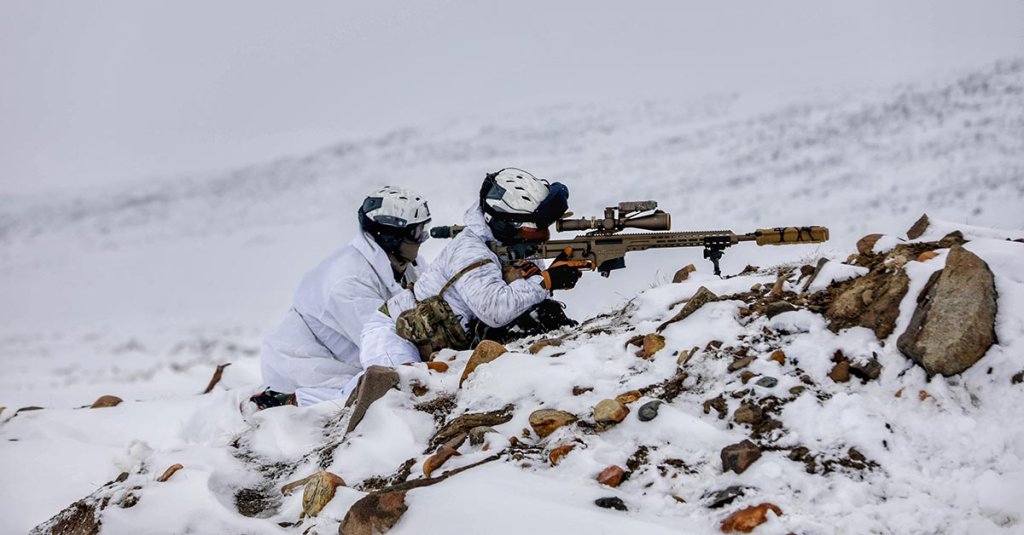
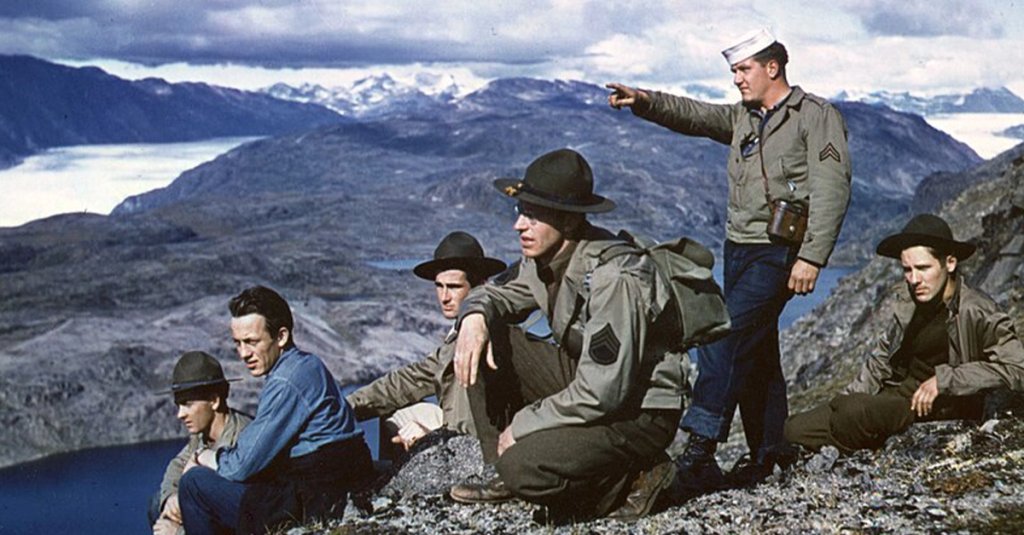
All is not lost, though, from the United States’ perspective. Since 1941, America has had a military presence on Greenland, but it became more robust a decade later.
After Soviet-backed communist revolutions toppled several countries in Europe in the late 1940s, NATO was established. The alliance initially included 12 countries, including the U.S. and Denmark. Greenland became a more pressing issue after the Russians detonated their first nuclear bomb and an omnipresent threat lingered that they could strike North America via the Arctic.
“The fear was that a Soviet plane with an atomic weapon strapped to its belly could zigzag its way across the high North Atlantic, pop over Eastern Canada, and drop a nuke on New York,” Barry Zellen, author of “Arctic Exceptionalism: Cooperation in a Contested World,” told History.com. “And so the U.S. wanted to have a presence in Greenland to conduct aerial surveillance of the horizon.”
Those concerns resulted in a revised agreement between the U.S. and Denmark in 1951, giving the Americans an expanded military presence on the island. It created Thule Air Base, which is now Pituffik Space Base, as well as redesignated Sondrestrom Air Base.
Pituffik is currently the only active U.S. military base on Greenland. While Trump announced last month the“framework of a future deal” regarding Greenland, few details have emerged.
Until the matter is settled, in Trump’s words, “one way or the other,” Greenlanders will be understandably anxious. They view their autonomy as priceless, and that’s not something that usually is for sale.
Don’t Miss the Best of We Are The Mighty
• How extremely cold weather can destroy the military’s best-laid plans
• The World War II commandos dedicated to Arctic operations
• This Civil War veteran nearly died while exploring the Arctic