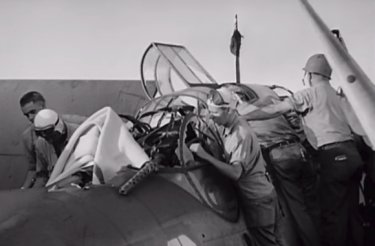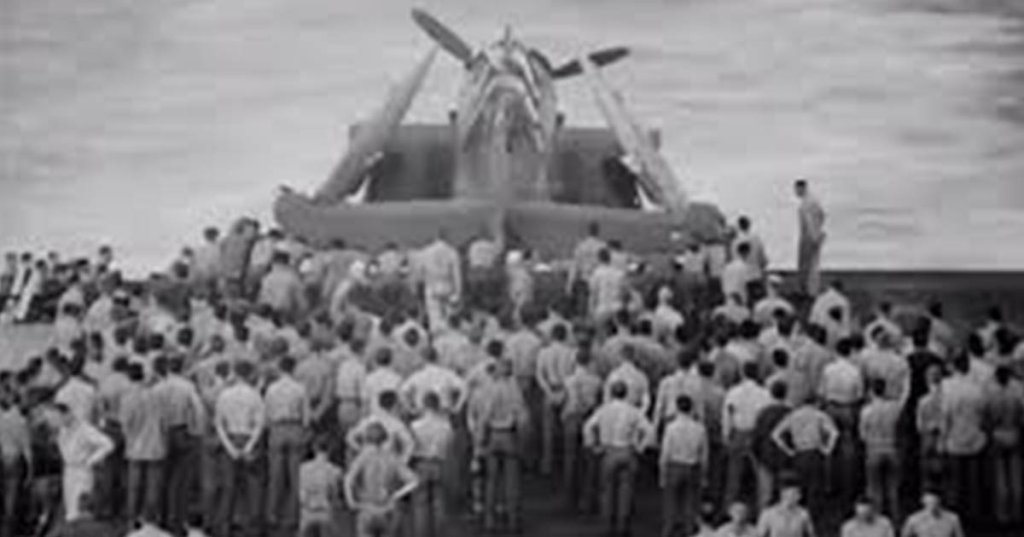
Only once in the history of the U.S. Navy was an aviator buried at sea inside his airplane. Loyce Edward Deen was so shot up by Japanese anti-aircraft fire that his shipmates decided to keep him forever in his TBM Avenger as they bid him fair winds and following seas.
An Oklahoma native, he spent most of his younger years caring for a little brother with Down Syndrome. After graduating from high school, he joined the Civilian Conservation Corps, but it was his time building A-26 Invader aircraft at the local Douglas Aircraft Company that inspired him to work with aircraft. He’d always wanted to join the Navy, so Aviation Machinist Mate (Gunner) 2nd Class Loyce Deen joined in 1942, less than a year after the attack on Pearl Harbor.
After completing basic training in San Diego, he attended gunner school to learn to shoot from the A-26 Invader. By 1944, he’d shipped out to the Pacific aboard the USS Hornet. His first combat duty station was aboard the USS Essex, the “Fightingest Ship in the Navy.”
Assigned to Air Group 15 aboard Essex, he saw intense combat in the October 1944 Battle of Leyte Gulf. He was wounded by shrapnel in the fighting, but instead of recovering on a hospital ship, he tied a bandage over the wound to stay with his crew, pilot Lt. Robert Cosgrove and radioman Digby Denzek.

Just after the Battle of Leyte Gulf, Deen became a turret gunner for a torpedo bomber just in time to see action at the November 1944 Battle of Manila Bay. Then just 23 years old, he took off with Lt. Cosgrove to make an attack run on Japanese cruisers in the bay. It would be his final flight.
While trying to hit the enemy ships, Deen was decapitated by Japanese anti-aircraft fire, killing him instantly. The plane was also heavily damaged.
Cosgrove flew the limping plane for two hours, all the way back to the Essex, through two thunderstorms. By the time they returned to the carrier, Cosgrove’s Avenger was damaged beyond repair. Considering his wounds and the damage to the aircraft, the decision was made to bury Aviation Machinist Mate 2nd Class Loyce Edward Deen in the aircraft rather than try to remove his remains.
At a time when scrap metal was in high demand, it was especially poignant that the Navy allowed the aircraft to remain intact, rather than stripping it for parts. Deen hadn’t even been in the Pacific Theater for a full year.
The U.S. Navy video below captured his burial ceremony:

Loyce Edward Deen
Deen’s name is inscribed on the Walls of the Missing at the Manila American Cemetery and Memorial in Manila, Metro Manila, National Capital Region, Philippines.