
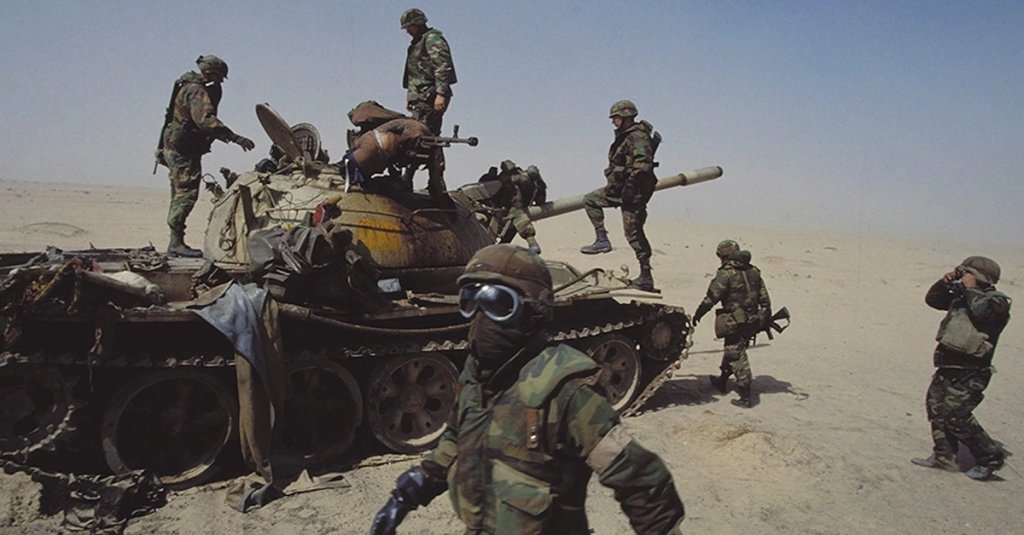
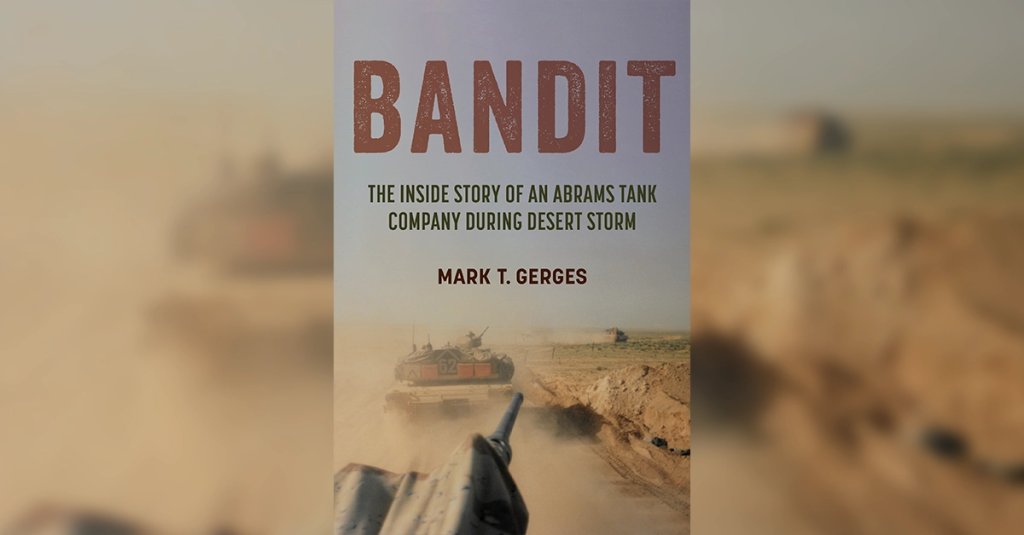
Mark T. Gerges commanded Bravo Company, 2nd Battalion, 70th Armor Regiment (call sign “Bandit”) in the 1st Armored Division’s 2nd “Iron” Brigade during Operation Desert Storm. In his new book, “Bandit: The Inside Story of an Abrams Tank Company during Desert Storm,” he delivers a grounded, human-centric account of armored warfare at his eye level.
Also Read: 21 Facts about the First Gulf War
Far from the high-level briefings and smart-bomb footage that defined public memory of the 1991 Gulf War, “Bandit” zooms in on the 63 soldiers of a single tank company, focusing on their training in Cold War Europe, unexpected deployment, and operations in the Iraqi desert.
The book opens with the intense training of the late-1980s U.S. Army in Europe—Grafenwöhr gunnery, Hohenfels maneuvers, REFORGER exercises—along with the cultural quirks of tankers, and the broader context of a U.S. Army still recovering from Vietnam while facing the end of the Cold War.
Gerges effectively contrasts the antiseptic “mother of all briefings” delivered by Gen. Norman Schwarzkopf with the reality inside an M1A1 Abrams: scanning for threats for 70-plus hours, the crack of sabot rounds, the smell of propellant, and the constant work of maintenance, fuel shortages, and sleep deprivation. Until he gets to the crux of the book: Medina Ridge.
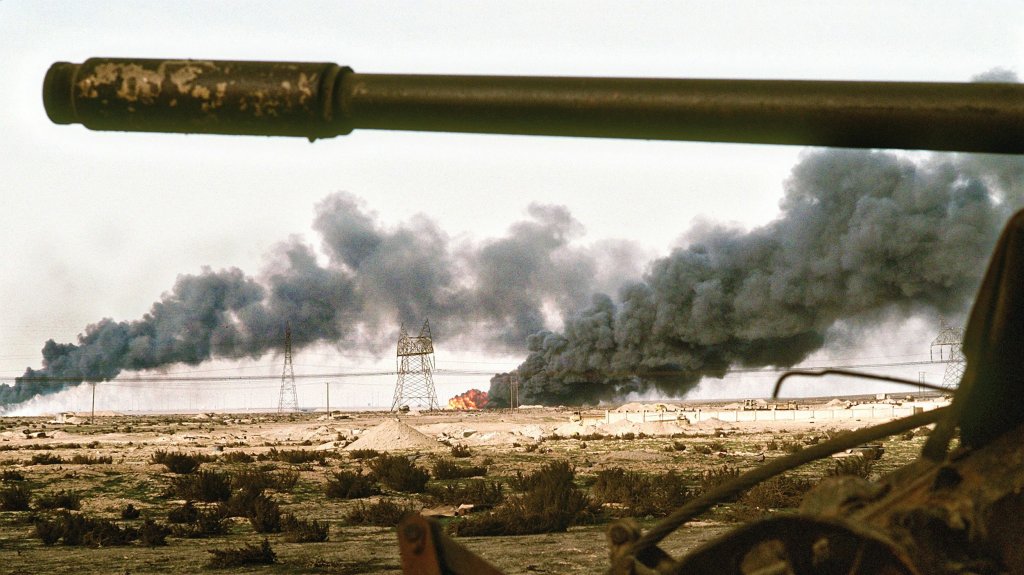
On Feb. 27, 1991, the fourth and final day of the ground phase of Desert Storm, 1st Armored engaged the Iraqi Republican Guard along a low-lying desert ridgeline southwest of Basra in what became the largest tank battle of the war, and the largest American tank battle since World War II.
The engagement took roughly two hours, and unfolded along what U.S. troops informally named Medina Ridge—a gradual slope around seven miles long. The Iraqi Medina Division, one of Saddam Hussein’s elite Republican Guard units, positioned elements of its 2nd Brigade in a reverse-slope defense along the ridgeline, a tactic designed to reduce their exposure to direct fire from American armor at long range.
1st Armored Division, supported by the 3rd Infantry Division, attacked with M1A1 Abrams main battle tanks in a driving rain and low visibility, conditions that might have otherwise favored the defenders. Instead, the thermal imaging systems and depleted-uranium armor of the Abrams proved decisive. Iraqi T-72 and T-62 tanks were outmatched at virtually every range, and the Medina Division’s reverse-slope position, while tactically sound in concept, was executed poorly and failed to blunt the American advance.
Within two hours, the U.S. destroyed 186 Iraqi tanks and 200 additional armored vehicles and artillery pieces. American losses amounted to four tanks along with an A-10 Thunderbolt II ground-attack aircraft and two attack helicopters. Two U.S. service members were killed and 33 were wounded.
To tell Bandit’s part of the battle, Gerges draws on his own journals, operations orders, letters, and contributions from former comrades (which includes interviews, photos, journals) to reconstruct events without romanticizing them.
This way, readers get a sense of the company’s personalities, small-unit dynamics, and how a tank company actually fought as part of a larger force. It humanizes both the excellence of American training and equipment amid the hardships that made the “100-hour war” far from bloodless or effortless for those on the ground.
Though it covers a lot of ground in a short time, the focus stays tightly on Bandit, which is a huge feature for those wanting granular insight rather than a 30,000-foot war overview. “Bandit” details what the arrows on Schwarzkopf’s maps actually meant for the soldiers executing them: movement, firepower, and the professionalism of Cold War tankers proving their mettle against a different enemy than they’d expected (or trained for).
For military history enthusiasts, armor veterans, or anyone interested in small-unit leadership and the human face of modern combat, “Bandit” is a thoughtful tribute to Gerges’ tankers in Bravo Company without any of the mythology that normally surrounds the Gulf War.

Loading comments…
Comments couldn’t be loaded. Please refresh the page.