
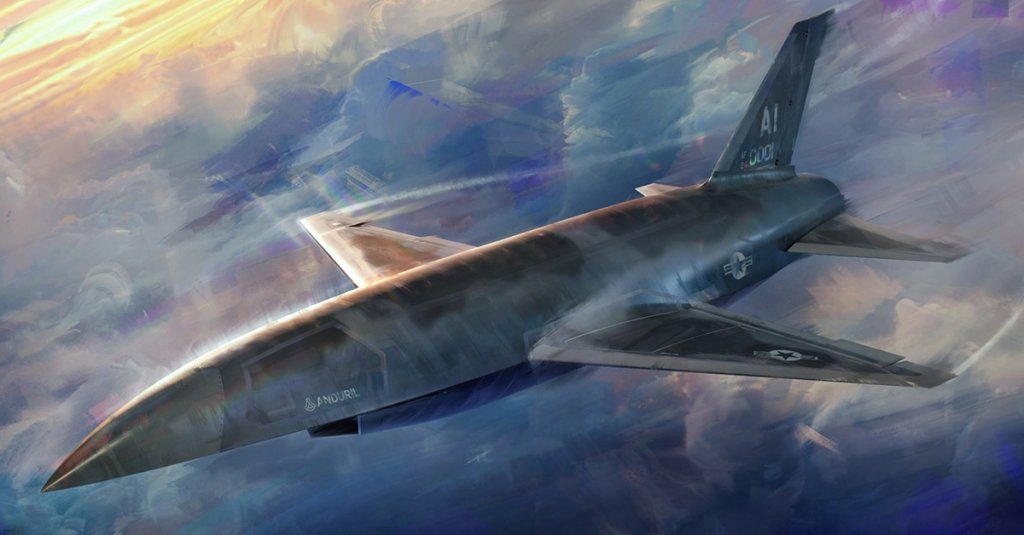
Inside a sprawling facility known as Arsenal-1, traditional rules of the defense industry are being dismantled one airframe at a time. April 2026 has arrived and technicians are proof-testing a $1 billion bet that America can still manufacture military power at a scale and speed that rivals the commercial sector. Standing at roughly half the size of an F-16, the Anduril YFQ-44A Fury is the centerpiece of this industrial experiment.
Also Read: China’s Atlas System: the future of AI swarm warfare
Solving the “more money, more power” mentality that has haunted the Pentagon for the past decades requires a radical departure from old-school procurement. Air superiority has long relied on a handful of billion-dollar platforms that are effectively too expensive to lose in a high-intensity conflict.
This machine represents an arrival of the “Affordable Mass” doctrine that appears to be sweeping the globe. A tactical shift where air dominance is maintained by thousands of capable systems rather than a few perfect ones. Representing the vanguard of this new era, the Fury is a jet-powered, semi-autonomous fighter designed for the messy reality of modern attrition.
Just a Prototype
Official military designations often tell the entire story for those who know the code. Deciphering the YFQ-44A reveals its specific mission. The “Y” stands for prototype, the “F” signals its dedicated fighter role, and the “Q” marks it as a fully unmanned system.
While it lacks a cockpit, it possesses the DNA of a high-performance interceptor designed specifically for the U.S. Air Force Collaborative Combat Aircraft (CCA) program. Jet-powered performance and a cost-effective, easily producible architecture allow it to act as a force multiplier rather than a simple propeller-driven surveillance tool.
Acting as a “Loyal Wingman,” the aircraft is built to fly alongside crewed fifth-generation fighters like the F-35.
Moving from concept to production occurred at a pace that has left traditional defense giants scrambling to keep up. Blue Force Technologies initiated the Fury concept in 2019 before the project was acquired by Anduril Industries in 2023. By 2024, the aircraft secured its spot in the Air Force competition, leading to ground testing in early 2025.
Following a successful first flight on October 31, 2025, the program entered a phase of intense autonomy integration. April 2026 finds the Fury proving its flight software can handle the rigors of combat as reliably as any human-piloted craft.
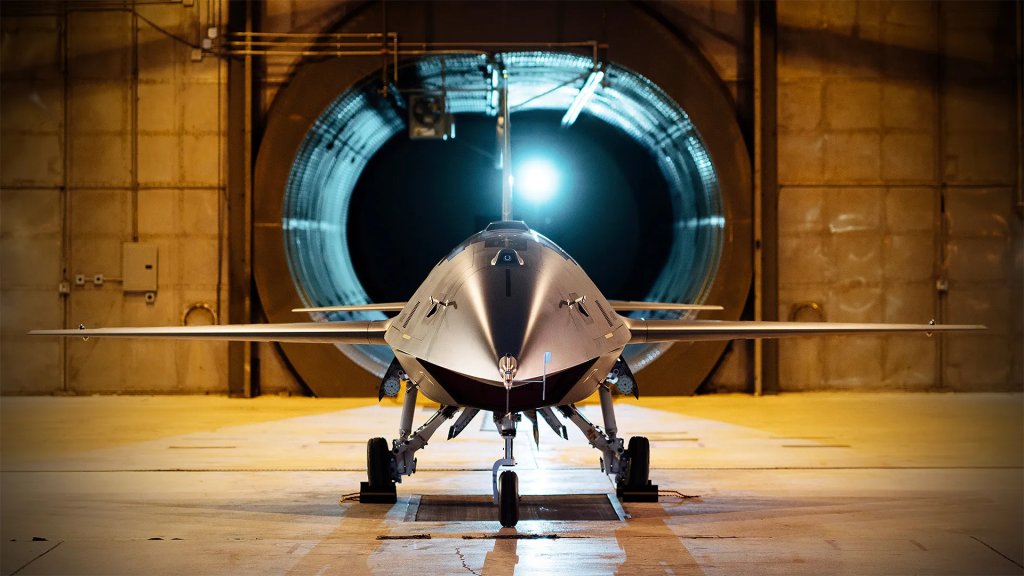
Autonomous Instincts
Anduril’s Lattice software serves as the prefrontal cortex for this robotic predator. Unlike traditional drones that require a pilot with a joystick for every bank and turn, the Fury operates with high levels of autonomy. Lattice integrates data from various payloads, allowing the Fury to act as a sensor node, an electronic warfare platform, or a decoy without constant human dragging.
February 2026 saw the YFQ-44A demonstrate its competence by completing captive-carry testing with weapons like the AIM-120 AMRAAM. Integrating these heavy-hitting missiles proves the aircraft can serve as a forward-deployed magazine, extending the reach of crewed fighters in contested airspaces.
Pairing a human pilot with several Furies creates a networked system where the drone takes the high-risk lead while the pilot can focus on intricate strategic decisions.
Industrial Reinvention
Taking the lead, and often unheralded, are those found on the factory floor in Columbus, Ohio. Boutique defense models typically rely on low volume, high cost, and timelines that stretch across decades.
Anduril’s “Arsenal” model flips this script by prioritizing high-rate production and commercial supply chain integration. Advanced manufacturing technicians and robotics operators make up the workforce here, replacing the traditional assembly line labor of previous years.
Technicians in Columbus are trained to treat an airframe like a piece of software-integrated hardware. By the end of 2026, the facility expects to have its initial workforce of 250 employees in place, with a long-term projection of over 4,000 jobs as the CCA program matures.
This multi-state footprint, including facilities in California, Mississippi, and Rhode Island, signals a targeted resurgence in American strategic manufacturing. Relearning how to build at scale and volume is a return to a mid-century manufacturing mindset, but it is driven by 21st-century automation.
The Wars of Attrition
Escalating tensions in the Middle East and the Strait of Hormuz have highlighted a cold reality. Advanced forces are frequently burning through millions of dollars in interceptor missiles to down drones that cost less than a used sedan. This “Patriot Problem” creates a paralyzing hesitation for commanders who do not want to fire a $4 million missile at a $20,000 threat.
Fury-type aircraft offer a third option that aligns with the brutal lessons of the war in Ukraine. Because it is built for affordable mass, the YFQ-44A can be deployed into contested zones where a commander would never risk a $100 million crewed jet.
Conflict winners in the near future will be the sides that can replenish their losses the fastest. Moving away from “exquisite systems that must survive” toward large numbers of systems that can be lost is the only logical insurance policy against saturation tactics.
Beyond 2027
April 2026 sees the Fury in a precipitous transition between prototype and fully operational system.
Decisions are expected later this year while the Air Force weighs the Fury against other potential options and competitors like the General Atomics YFQ-42A. National security incentives and guaranteed government demand are the primary drivers keeping this machine on its breakneck schedule.
Escalating pressures in the Gulf and the rapid iteration cycles seen on modern battlefields have made the need for a scalable force structure obvious. Fury is so much more than just another aircraft sitting in inventory. It is a prototype for a new way of building military power that prioritizes software and scale over traditional hardware cycles.
Don’t Miss the Best of We Are The Mighty
• Your standard rifle can now be an anti-drone weapon. Seriously.
• SMASH2000: Finally, an AI-powered optic that turns your AR-15 into a drone hunter
• Ukraine’s JEDI drone hunts Shaheds so your Patriot missiles don’t have to


Loading comments…
Comments couldn’t be loaded. Please refresh the page.