On a crisp autumn night in November, Henry Hascup, President of the New Jersey Boxing Hall of Fame, rose to the dais for the organization’s annual induction and awards banquet. With his booming Jersey-accented voice, often heard in the ring as an announcer, he delivered the opening remarks.
With Veterans Day approaching, he asked the veterans in attendance to stand and be recognized. As the former service members rose, few could miss the imposing 6-foot-5 figure among them.
That towering man was none other than Chuck Wepner, former world heavyweight title contender, two-time New Jersey State heavyweight champion, and the inspiration for the “Rocky” film franchise. At 86 years old, Wepner remains an imposing figure. But any initial intimidation is quickly disarmed by his warm smile and firm handshake.

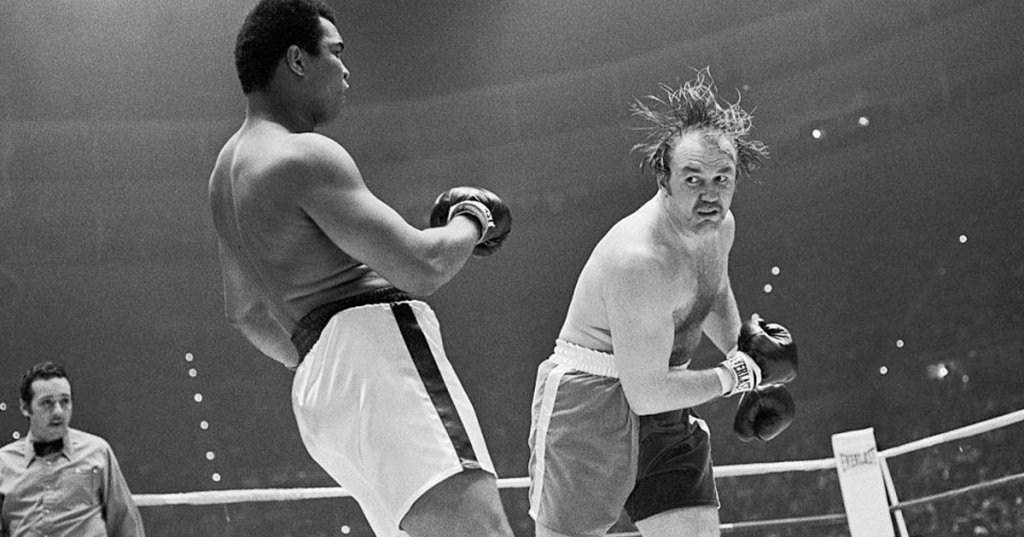
While most sports fans remember Wepner for his March 24, 1975 battle against Muhammad Ali, which famously inspired Sylvester Stallone to write “Rocky,” far fewer know of his earlier chapter: the former fighter’s service as a U.S. Marine.
Enlisting at 17, Wepner served from 1956 to 1959. At Marine Corps Air Station Cherry Point in North Carolina, he worked on the crash crew, extinguishing aircraft fires and rescuing pilots, a demanding and dangerous duty that helped harden the already tough kid from Bayonne, New Jersey. Wepner credited the discipline and structure of the Marine Corps with shaping both his toughness and his approach to life, both in and out of the ring.
Following his discharge, Wepner returned to Bayonne, where he worked as a bouncer in local bars while continuing his amateur boxing pursuits. Through his affiliation with the Bayonne Police Athletic League (PAL), he earned a spot in the 1964 New York Golden Gloves tournament. Competing in the heavyweight novice division, he captured the championship, laying the foundation for a professional career.
On August 5, 1964, Wepner made his pro debut at Veterans’ Stadium in Bayonne, knocking out fellow New Jersey native George Cooper in front of a hometown crowd. It was the first of 36 professional wins for the man who would become known as the “Bayonne Bleeder” due to frequent facial cuts suffered during fights.
Over a career that spanned from 1964 to 1978, Wepner fought many of the era’s most notable heavyweights. He shared the ring with contenders such as Buster Mathis, José Roman, Manuel Ramos, Joe Bugner, Randy Neumann, Duane Bobick, and Mike Schutte, as well as world champions including George Foreman, Sonny Liston, Ernie Terrell, and Muhammad Ali. From 1973 to 1976, Wepner was rated among the top 10 heavyweight boxers in the world by The Ring magazine for 40 consecutive months. He held a peak rating of number eight at the time of the Ali fight.

His legendary 1975 bout with Ali took place before 14,847 fans at the Richfield Coliseum near Cleveland and was broadcast via closed circuit to 150 locations worldwide. U.S. Army veteran and boxing historian Jerry Fitch, author of multiple books on Cleveland boxing, told WATM, “Although Cleveland had a great reputation as a boxing center during the 1920s and especially from 1937-1973, the one thing that didn’t happen was world championship bouts in the heavyweight division.”
Fitch recalled that before Ali-Wepner, the last heavyweight title fight in the area occurred on July 3, 1931, between Max Schmeling and Young Stribling.

In a pre-fight press conference, Wepner was asked whether he could survive in the ring with Ali. He responded, “I’ve been a survivor my whole life… if I survived the Marines, I can survive Ali.”
In the early rounds of their match, Ali toyed with Wepner, who was well behind on the scorecards. But in the ninth round, Wepner appeared to step on Ali’s foot while landing a right to the ribs that sent the champ to the canvas. Though Ali later claimed his foot was, in fact, stepped on, Wepner continues to point out that Ali never complained to referee Tony Perez during the contest. The knockdown changed Ali’s demeanor; he fought more seriously through the remaining rounds.
The champion controlled rounds 10 through 15, with the former Marine fighting to survive until the match’s final bell. In the 15th and final round, Ali unleashed a flurry of punches that sent Wepner crumpling into the ropes. As the challenger struggled to rise, Tony Perez stopped the fight.
Wepner, the part-time liquor salesman, earned $100,000 for the bout, while Ali, the 10-to-1 favorite, made $1.6 million.
Fitch, who covered the bout for Boxing Illustrated, had one of the best “seats” in the house thanks to a press credential that allowed him to move all around the ring area and see the fight from many angles.
When asked about his thoughts on Wepner’s performance against Ali, Fitch told We Are The Mighty, “All due respect to Chuck Wepner, who was as game as they come. But Muhammad Ali, who didn’t take Chuck seriously, was not going to be defeated by Chuck Wepner. Chuck fought hard and used all his roughhouse tactics, but he didn’t have the skills to beat a man like Muhammad Ali.”
Among the thousands of fans in attendance that evening was a young Hollywood hopeful, Sylvester Stallone. The spirit shown by Wepner at the Richfield Coliseum inspired the legendary actor and filmmaker to go home and write the first “Rocky” movie, a blockbuster film that would be released the following year in 1976. Despite Wepner’s defeat, he became the real-life inspiration for one of cinema’s most iconic underdogs. Rightfully so, as numerous longtime boxing insiders, including Jerry Fitch, consider the Ali fight a significant feather in Chuck’s cap.

After retiring in 1978, Wepner resumed work as a liquor salesman in New Jersey. His popularity grew, and he became a sought-after public speaker. Relations between Stallone and Wepner soured over time, however. In 2003, Wepner filed a lawsuit claiming Stallone used his story without proper compensation. The case was settled out of court in 2006.
Wepner has been the recipient of numerous honors and awards in his retirement, including induction into the New Jersey Boxing Hall of Fame. Most recently, he received the Jersey Joe Walcott Lifetime Achievement Award from the Atlantic City Boxing Hall of Fame on September 28, 2024. This honor was bestowed upon Wepner in special recognition of his 14-year professional career and lifelong dedication to the sport.
Wepner fought a significant bout in Atlantic City on June 23, 1973, when he defeated Ernie Terrell, former World Boxing Association (WBA) heavyweight champion, for the vacant National Americas heavyweight title. In this bout, referee Harold Valan served as the sole judge, awarding Wepner a seven-round to five decision victory.
Wepner first captured the minds of a more contemporary audience when ESPN released its film, “The Real Rocky,” in 2011. Since then, Hollywood also jumped on the popularity of the man who inspired one of film’s greatest franchises.
On May 5, 2017, the biographical film “Chuck” was released to audiences across the United States. Hollywood star Liev Schreiber, a boxing fanatic in his own right, co-wrote, co-produced, and starred in the movie. Just under two years later, on January 18, 2019, another Wepner-inspired project, “The Brawler,” hit theaters. This film stars Zach McGowan as the heavyweight contender.
Wepner hasn’t only been honored in films. Chuck was immortalized in bronze when his statue was unveiled in Bayonne’s Collins Park during a 2022 event. The unveiling ceremony was attended by a few hundred family, friends, and fans looking to honor Bayonne’s favorite son.
Reflecting on the dedication, Henry Hascup told WATM, “Chuck put Bayonne on the map when he fought Ali. Everyone had a great time taking photos and getting autographs from former boxing greats like Chuck, Larry Holmes, Gerry Cooney, and actor Liev Schreiber.”
Signifying what Wepner means to his hometown, Hascup went on to say, “It seems like most of the people from Bayonne were there. When they unveiled the statue, a loud roar went up.”
Much like Stallone’s character Rocky, Wepner remains a people’s champion. Loved across New Jersey and recognized worldwide, he is celebrated not just for his boxing legacy but also for his honorable service as a U.S. Marine.