
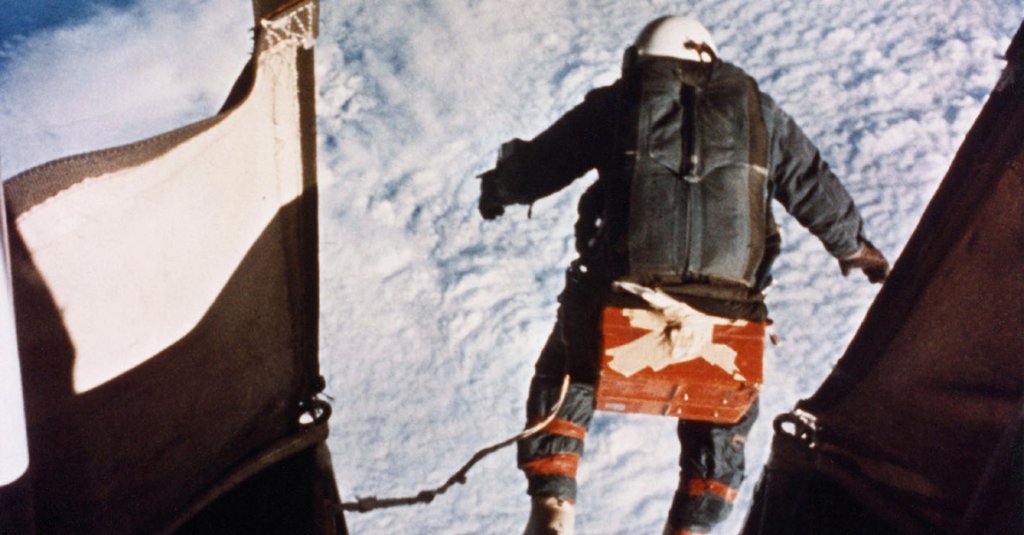
As Joe Kittinger fell more than 76,000 feet out of the sky, his parachute failed to deploy.
The mishap in late 1959 caused Kittinger to spin horizontally at about 90 revolutions per minute and lose consciousness. Without his reserve chute automatically activating, the U.S. Air Force pilot was going to die.
Also Read: How this Air Force spy plane traveled from coast to coast in record time
However spooked Kittinger was after the nearly tragic event, it didn’t dissuade him from free-falling again. In fact, Kittinger—who flew 483 combat missions during the Vietnam War—was back at it again a year later.
It was the right decision, because he soon set a record by surviving a descent from 102,800 feet out of the air.
How High Altitude Affects the Human Body
From a young age, Kittinger was laser-focused on becoming a military fighter pilot.
He never considered falling from such extreme heights until he met Col. John P. Stapp at Holloman Air Force Base in New Mexico. Per a 2023 article on the National Air and Space Museum’s website, Stapp was intent on learning more about how dangerously high altitudes affected the human body.
Keep in mind that this was before America sent a man into space. Stapp’s field of interest represented largely uncharted territory, so anything he discovered was regarded as new knowledge. Stapp began by strapping himself into a rocket sled on rails, and even though he incurred some injuries and other side effects as a result, those tests prepared him for the next step.
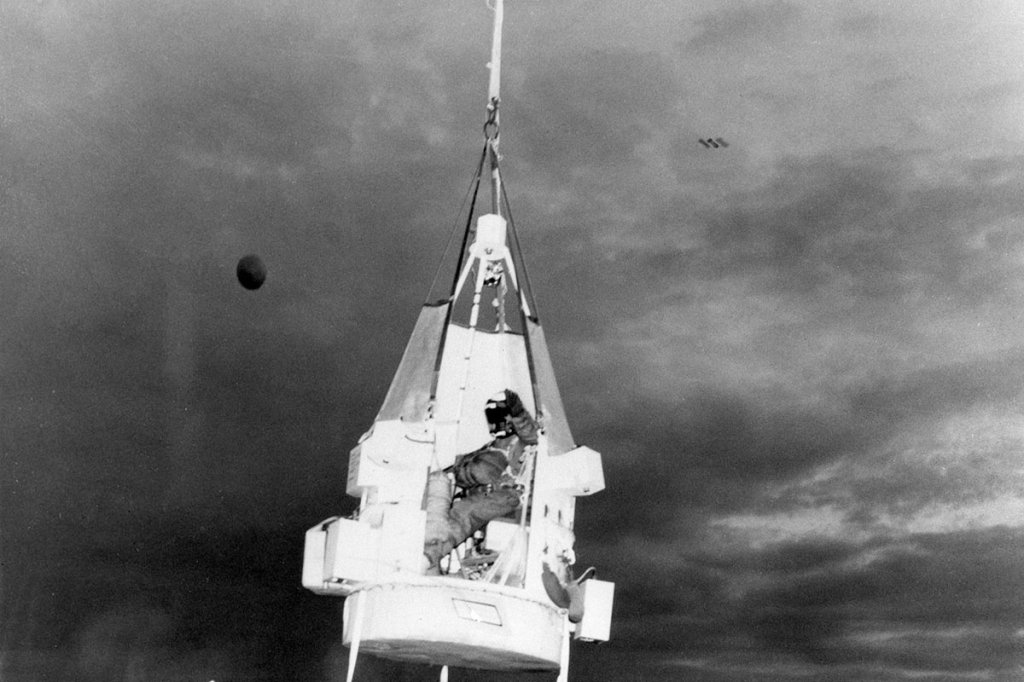
Kittinger, among others, helped him with that. After Kittinger rejoined Stapp at Wright-Patterson Air Force Base in Dayton, Ohio, he was involved in two high-altitude research initiatives. On the second, Project Excelsior, Kittinger performed all three of its free falls.
On the first attempt, he almost died because his parachute didn’t work properly. Unaffected after his brush with death, Kittinger returned to the heavens 3½ weeks later in the gondola of a 200-foot-high helium balloon. This time, he successfully descended from a height of 74,700 feet, according to the National Air and Space Museum.
For his third attempt, on August 16, 1960, Project Excelsior planned to go much higher.
Descending at More Than 625 MPH
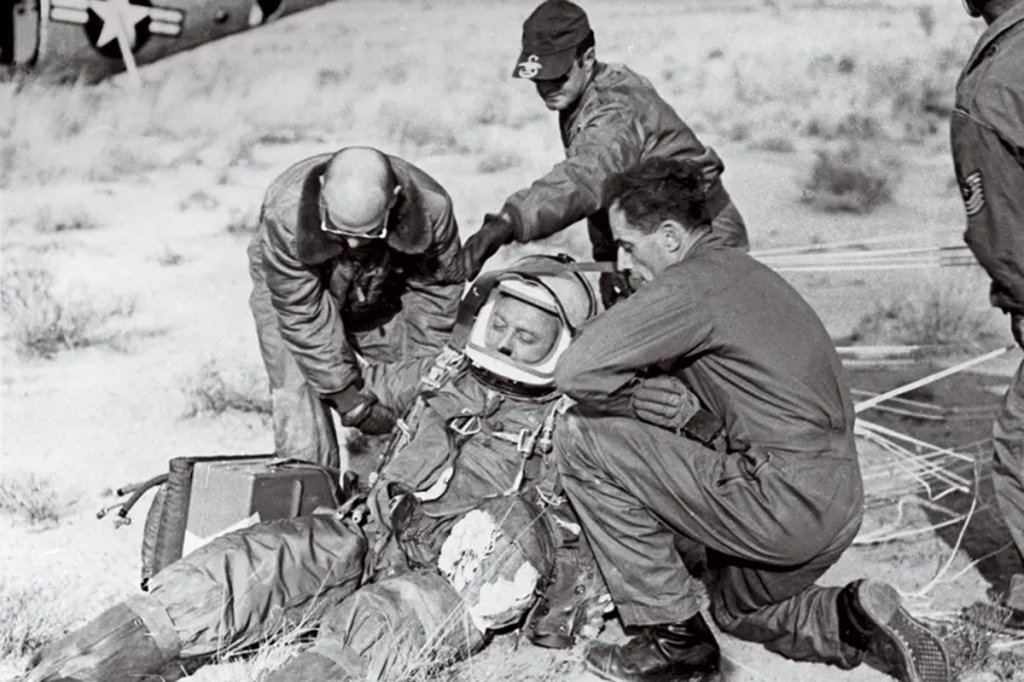
Kittinger, who previously served in the Korean War, was wearing a pressurized suit and gloves as the gondola ascended. One glove didn’t work properly, however, leaving his right hand painfully swollen as a result. As the museum’s article recounted, Kittinger was also perspiring despite the minus-35 degree temperature.
Moments before he stepped out of the gondola, Kittinger was overwhelmed as he saw a tremendous black void despite the time of day.
“It was morning!” Kittinger recalled in “Come Up and Get Me: An Autobiography of Colonel Joe Kittinger,” according to the Smithsonian Institution. “The sun was shining, but the sky surrounding it was the color of midnight.”
After reciting a short prayer, Kittinger began his fall. While his painful hand did not allow him to deploy his parachute manually, it automatically unfurled at roughly 18,000 feet.
During his 4½-minute descent, Kittinger took the opportunity to enjoy his unique view. The top speed during his descent was recorded as 625.2 mph—faster than the cruising speeds of most commercial airliners. Most importantly, Kittinger landed in one piece.
The moment was transformational.
“Nobody had ever been outside of a pressurized cabin at anything approaching 100,000 feet,” Kittinger reflected later, as stated in the National Air and Space Museum article. “We showed NASA that a spacewalk was possible.”
Less than a year before Alan Shepard became the first American in space on May 5, 1961, Kittinger traveled to unprecedented heights. It took five more years after Kittinger’s historic free fall for a NASA astronaut, Ed White, to walk in space.
Imprisoned in the Hanoi Hilton
After Kittinger’s record-setting mission, no one could blame him if he returned home to a life of leisure. After all, he earned the rest.
Instead, Kittinger continued his military career with three tours of duty in Vietnam. In May 1972, the North Vietnamese shot down Kittinger’s fighter jet, captured him, and detained him in Hoa Lo Prison—the so-called Hanoi Hilton. Kittinger was a prisoner of war for 11 months.
Kittinger remained the holder of the free-fall record for more than 50 years, until Felix Baumgartner of Austria broke it in 2012. At 135,889 feet, Alan Eustace possesses the current mark.
In some respects, though, Kittinger will always be the standard-bearer, because he showed what was possible. He established the bar for others who followed to reach.
Kittinger, who completed the first solo balloon flight across the Atlantic Ocean in 1984, died in 2022 at the age of 94. He is buried in Arlington National Cemetery.
Don’t Miss the Best of We Are The Mighty
• That time Neil Armstrong survived ejecting from his fighter jet in Korea
• The Artemis II crew made an 80s sitcom video as they flew to the moon
• Naval officer and Apollo 13 astronaut Jim Lovell dies at 97
Featured



Loading comments…
Comments couldn’t be loaded. Please refresh the page.