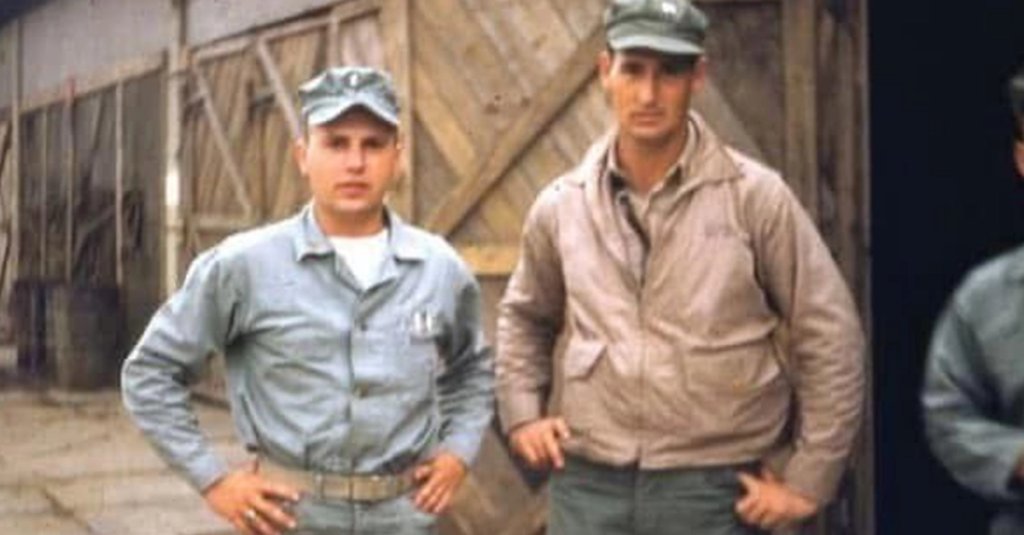
After Ted Williams served as a Marine Corps aviator during World War II, the military discharged him, and he returned to Major League Baseball.
While Williams continued his Hall of Fame career with the Boston Red Sox, he remained in the Marine Corps Reserve. There were some caveats, though, according to author Ben Bradlee Jr.’s book, “The Kid: The Immortal Life of Ted Williams.” The superstar outfielder would help with military recruiting and had a gentleman’s agreement with then-Cmdr. Alexander Vandegrift that he wouldn’t be recalled unless the United States got into another war.
Related: This is the little-known combat career of John Glenn
In 1952, the Marines recalled Williams as a fighter pilot. The move surprised the then-33-year-old ballplayer, but he left the Red Sox without complaint to serve his country for a second time.
Williams went on to fly 37 combat missions in Korea, about half of them as a wingman for future astronaut John Glenn. Forged during war, their friendship endured for the rest of their lives.
Developing a Friendship

Williams and Glenn were assigned to the same squadron in South Korea and developed an appreciation for each other over time. While Glenn was mild-mannered and soft-spoken and Williams could be abrasive and profane, they shared an intense desire to excel at what they did.
Glenn was not a household name during the early 1950s. Meanwhile, Williams could hardly go anywhere without being recognized. And yet Glenn respected Williams for selflessly accepting his place among other service members.
“He never mentioned baseball unless someone else brought it up,” Glenn once said, according to an MLB.com article in 2025. “He was there to do a job. We all were. He was just one of the guys.”
Their job was inherently dangerous. Williams’ F9F Panther fighter jet was struck a few times during combat, none more seriously than in mid-February 1953 in North Korea.
Glenn saved his life that day.
Williams’ Fighter Jet on Fire
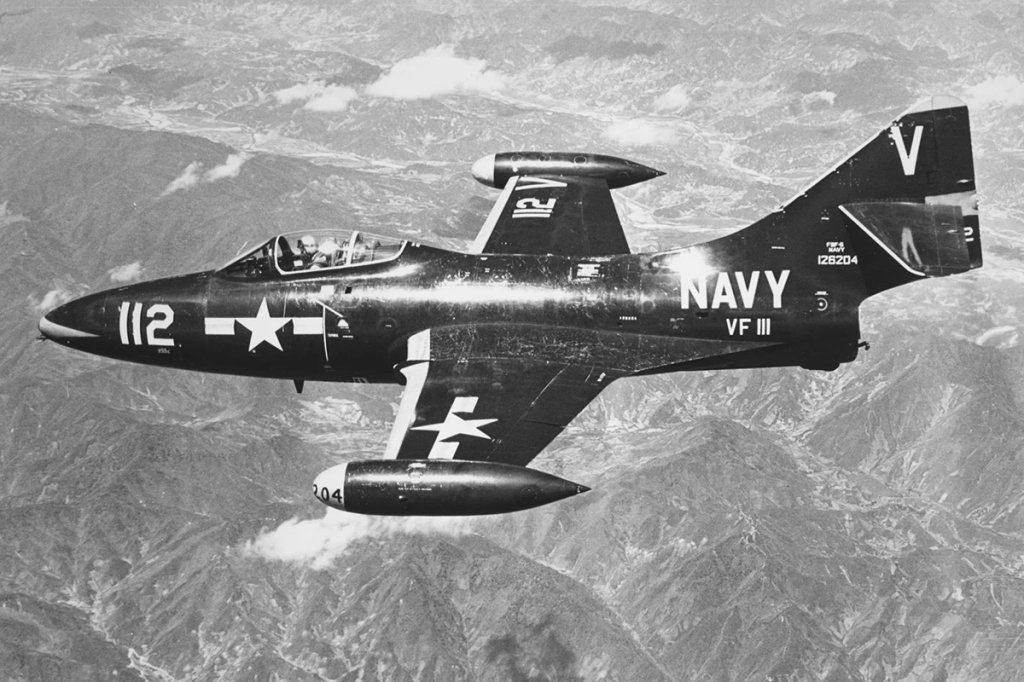
On that day, Williams again served as Glenn’s wingman as 22 jets from their squadron were tasked with destroying a grenade factory in Nampo, North Korea.
Once they reached their destination, Williams battled severely windy conditions and anti-aircraft fire as he dove his jet toward the factory. At some point, enemy fire left a sizable hole in one of the wingtips of Williams’ aircraft. The wing caught fire.
As Glenn recognized the peril that Williams faced, he pulled alongside the damaged aircraft and radioed Williams to eject immediately. At 6 feet, 3 inches tall and 205 pounds, Williams could not maneuver his large frame to allow himself to bail out.
Then in a clear voice, Glenn told Williams to follow him, per an account of the incident from the New England Historical Society. Recognizing in the moment that the lack of oxygen at higher altitude would extinguish the flames on Williams’ jet, Glenn began to ascend.
Despite the condition of his F9F Panther, Williams did as well. Glenn’s quick thinking worked, and both managed to return to base safely.
An Everlasting Bond Forged in War

John Glenn Sets Speed Record – 1957 | Today In History | 16 July 17
Five months after that harrowing incident, Williams was discharged from the Marines on July 28, 1953. He never lost contact with Glenn, not surprising considering they shared the same combat experience.
Williams even telegrammed Glenn to congratulate him after he completed the first supersonic transcontinental flight across the United States on July 16, 1957.
They stayed in touch as Williams resumed a baseball career that spanned 19 seasons and included two tours of military service. When Williams retired, he ranked third all time with 521 home runs. (Entering the 2026 Major League Baseball season, he is tied for 20th all time.)
As for Glenn, his celebrity rose considerably after the Korean War. As the first American to orbit the Earth in 1962, he became a famous astronaut. Glenn also served for 25 years in the U.S. Senate.
Through it all, he never lost track of Williams.
“Ted was a good friend,” Glenn once said. “When you fly in combat with somebody, there’s a bond that runs so deep, you can’t describe it.”
“That’s My Friend”
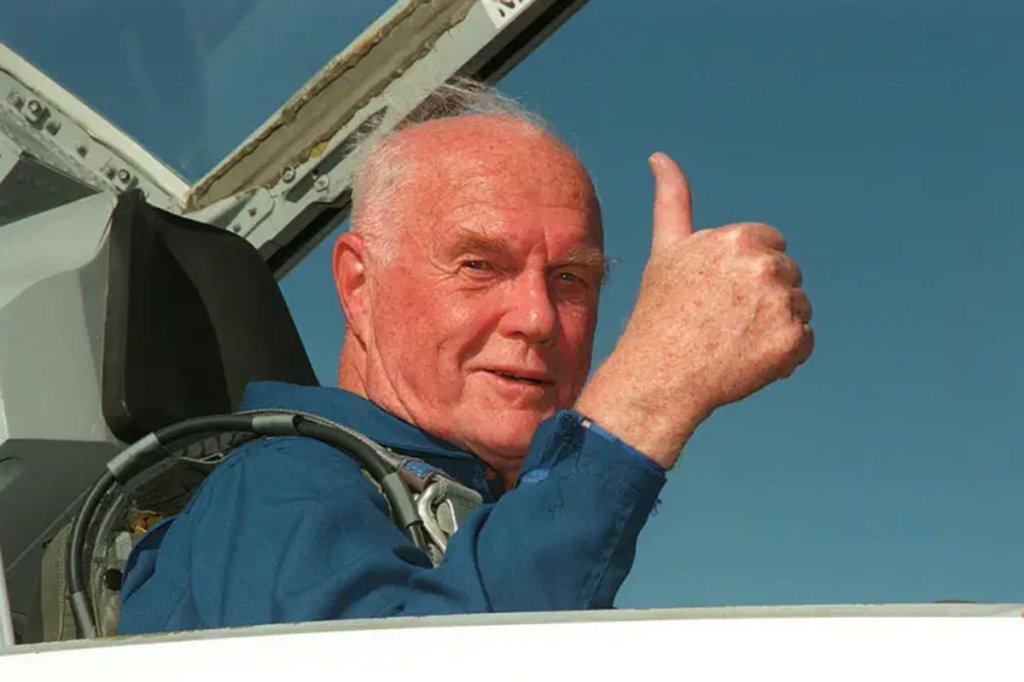
Glenn was 77 years old when he became the oldest person in space aboard the Space Shuttle Discovery on October 29, 1998.
Like a true wingman, Williams was there at Kennedy Space Center in Florida to watch the takeoff. Williams was 82 then, far removed from his youthful vitality, but he couldn’t help standing up and uttering the three words that said everything about what Glenn meant to him.
“That’s my friend!” Williams exclaimed.
Williams died on July 5, 2002, at the age of 83. Glenn was 95 when he died on December 8, 2016.