In December 1944, the United States was still very much in the middle of World War II. The June 6 landings in Normandy were fresh in the minds of troops on the ground and Americans back home, but setbacks throughout Europe and bloody battles in the Pacific Theater left a nation fatigued by the strains of war.
As the casualty counts increased and the war waged on, the air in America felt heavy. But for a moment in December, there was one thing taking everyone’s mind off the fighting: the Army-Navy game.
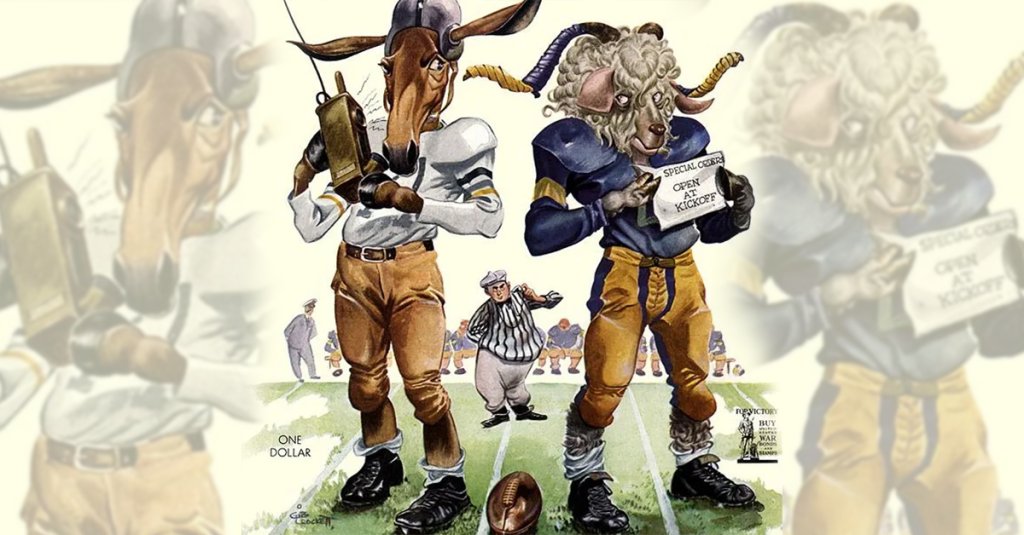
Army was ranked #1 and Navy, #2. The media declared the match-up the “National Championship” game.

1944 Newsreel: The annual Army-Navy football game
Well-known sportswriter Grantland Rice predicted it would be “one of the best and most important football games ever played.”
It was Navy’s turn to host, and the game was slated for Thompson Stadium in Annapolis. As global excitement around the matchup mounted, government officials considered moving it because Thompson’s capacity was only 19,000. On Nov. 17, the Associated Press announced Baltimore’s Municipal Stadium as the chosen venue.
There were 30,000 tickets available to the general public, but with a catch: you had to live within 8.3 miles of the stadium, and you had to purchase a $25 war bond through the Maryland State War Finance Committee in order to secure your seat. It was undoubtedly a cause Americans could get behind: all of the tickets were claimed within 24 hours, and the Army-Navy ticket drive raised over $58.6 million to support the war effort.
A sold-out crowd of 66,659 attended the Army-Navy game on Dec. 2, 1944, in frigid temperatures. The teams arrived in style: the Navy, by boats, sailed across the Chesapeake; the Army, accompanied by Navy destroyers, arrived on troopships.
The game didn’t disappoint. Entering the fourth quarter, Army led just 9-7. With two touchdowns in the 4th, Army won 23-7, snapping Navy’s five-year winning streak.
It was such a monumental victory that Gen. Douglas MacArthur sent a telegram to the Army’s head coach, Earl “Red” Blaik.
“The greatest of all Army teams—STOP—We have stopped the war to celebrate your magnificent success. MacArthur.”
And just like that, for a perfect moment in time, the war stopped to celebrate Army’s victory. Exactly two weeks after the game, Germany launched a surprise attack through the Ardennes Forest, later to be named the Battle of the Bulge, resulting in some 89,000 American casualties.
The Army-Navy game rivalry is one of the most storied in American history. But as we watch Saturday’s game, may we all remember that in the hearts of the players on the field and the cadets and the midshipmen in the stands, there is so much more than football.
Don’t Miss the Best of We Are The Mighty
• 7 of the coolest things to watch for during the Army-Navy Game
• A brief history of the Army-Navy Game’s special uniforms
• Previews and predictions for the 2025 Army-Navy Game