The movers finally leave. As the door closes, you are almost physically hit by the sound of sudden silence—you probably didn’t read about that on Reddit. Not the packout. Not the drive. Not delivery day. It’s the post-PCS moment when the adrenaline of the long haul finally drains, and you are standing in a strange kitchen holding a roll of packing tape.
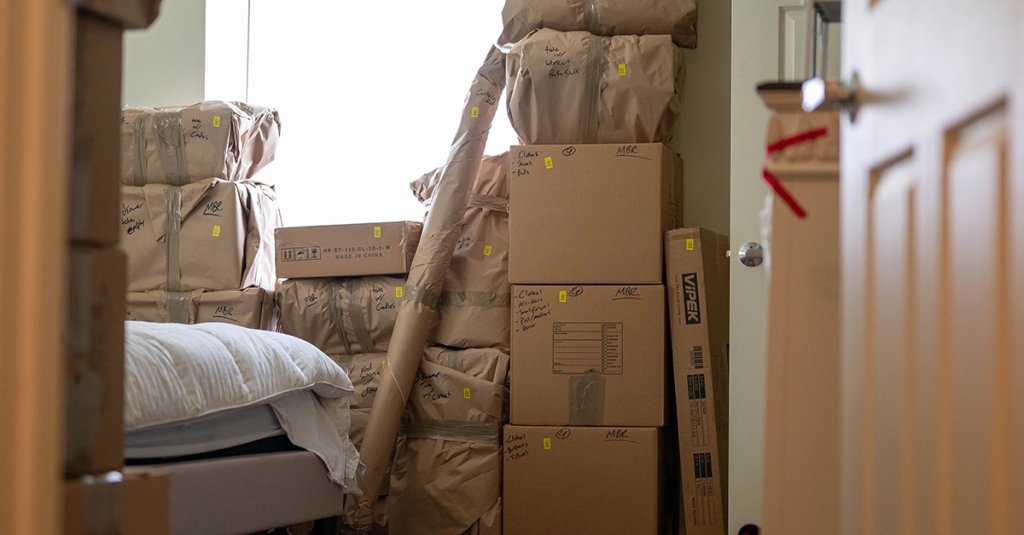
Boxes are stacked to the ceiling. Your service member is already counting down to report day. Kids are overstimulated or asleep in rooms that don’t smell right yet.
Also Read: 10 Things you only know if you’ve given birth on Tricare
One Army spouse laid it out quite succinctly: “The juggling act of household tasks, homeschooling, unpacking, parenting, and coming to terms with the fact that we were about to repeat the past year felt cripplingly overwhelming.”
Here is where some PCS guides come up short: the move doesn’t end when the truck pulls away. That’s where the real work starts. Blue Star Families‘ 2025 Military Family Lifestyle Survey, released in February 2026, found that many military families need more than a year to recover, financially and emotionally, from a single relocation.
With roughly 600,000 military families relocating each year and average out-of-pocket PCS costs hovering around $8,000, the stakes of that recovery period aren’t abstract. They shape morale, marriages, or whether a service member in-processes with a clear head.
What follows is a phased approach to unwind the first 72 hours in a new place, borrowed from the structure every service member already understands, built for one purpose: getting the household to “done enough” so the family can breathe.
A Quiet Place
Sometimes, as we enter this sacred post-PCS process, an emotional crater can open up after delivery day, a general malaise or “shell shock” that threatens to swallow you whole; it has nothing to do with laziness.
Military spouses spend weeks making hundreds of small decisions: what to ship, what to sell, which school, which route. By the time the movers drive away, the ol’ emotional fuel tank is on E.
Mix in the emotional drop-off that follows any major milestone, plus pets and kids who have lost every routine they’ve known, and you are operating, in military terms, under degraded conditions. Meanwhile, the service member is already being tracked by their chain of command. In-processing does not care that you cannot find the coffee maker.
Phase 1 (Hours 0–12)
Your first 12 hours post-PCS have exactly one objective: make the house sleepable. That means beds assembled, sheets on, a functional bathroom, and one corner of the kitchen that can produce coffee and a simple meal. Not the whole kitchen, or the whole bedroom. Just a place that is sleepable.
If there are kids in the household, add one more priority: a single “normal” corner per child. A familiar blanket. Three favorite toys. A night-light in the hall.
Children regulate off their parents, and parents regulate off any piece of evidence that their world still makes sense. First visible wins do more than reduce clutter. They tell the brain the mission is achievable. Everything else can wait.
Phase 2 (Hours 12–36): The Cardboard Has to Go
By the morning of day two, the enemy is largely visual. Psychologists studying cluttered environments describe an “ambient load,” that low-grade cognitive drain from walls of cardboard and surfaces that look like to-do lists. It is the reason nobody in that house can think straight.
Flatten empty boxes and stack them against one wall like sandbags. Identify two or three “anchor spaces” that will carry the family through the next week: kitchen, primary bedroom, and a kids’ zone or a living area. Unpack into those rooms. Leave the rest boxed.
This is also where overwhelm tends to peak. Novelty has worn off. Boxes feel infinite. Military Spouse (and mom), Jeri Gramegna, described hitting this exact wall and sending a vulnerable text to a friend that said, in essence, “I can’t today.”
Her friend, a fellow military spouse, understood immediately. Permission to pause is not a failure of the plan; it is part of the plan.
Phase 3 (Hours 36–72): Build Systems, Not Showrooms
The back half of the 72 hours is about workflow, not aesthetics. Your goal is a household that functions, not one that impresses.
Three systems matter more than anything else: a laundry workflow (where dirty clothes live, when a load gets run), a meal rhythm (a realistic plan for the week, even if that plan is “frozen pizza Monday, takeout Tuesday”), and functional storage for the things actually used every day.
A gallery wall, a color-coded linen closet, a perfectly sorted garage, all of it can wait 30 days. Maybe 60. Maybe forever.
By the end of day three, your household should also have an honest inventory of what is missing and what is extra. Military Family Advisory Network research has found that families typically absorb about $1,900 in unreimbursed costs and lose nearly $3,000 more in damaged or missing property during each move. That is certain to be much higher these days.
No need to start losing it yet, though. Just start the paperwork trail while the boxes are still fresh and the movers’ handwriting is still legible.
The Fight That Isn’t About the Spatula
Every PCS veteran knows the fight, the one that erupts on day two or day three over something absurd. A missing spatula. A misplaced box. A tone of voice at 9:47 p.m. That fight is never about the spatula.
Re-entry stress for your service member, role strain for you, and the sheer cognitive load of rebuilding a household from cardboard all collide in those first 72 hours.
Department of Defense Military and Family Life Counseling, administered through Military OneSource, offers confidential counseling to service members and spouses for issues related to PCS, stress management, and relationships.
Counselors are embedded on most installations and available virtually. A number worth saving before you need it is 800-342-9647, which is the Military OneSource line, open 24/7. Readiness is the key takeaway.
Be Prepared
The 72-hour post-PCS framework assumes, of course, that the truck will actually arrive at all. In 2025 and 2026, that has been an assumption rather than a guarantee. On Jun. 18, 2025, the Department of Defense terminated its Global Household Goods Contract with HomeSafe Alliance after widespread service failures, and families across the force have reported delayed shipments, missed pickups, and longer stays in temporary lodging.
If household goods have not arrived, our timeline compresses. Phase 1 becomes “make the hotel room livable for another week” rather than “unpack the kitchen.”
If your service member ships out solo or deploys the week after arrival, you become a one-person operation, and the plan has to drop a tier: fewer anchor spaces, longer timelines, more outsourcing.
Readiness
A 72-hour de-box detox is not about productivity. It is about post-PCS recovery. A spouse who has slept, eaten, and located the coffee maker is a spouse who can show up for a kid’s first day at a new school. A service member who walks into a house that works, not a cable reality show makeover, is a service member whose head is clear enough to report to duty. That is what readiness looks like, and it is built in those first 72 hours, one anchor space at a time.
Most PCS advice usually ends at your front door. Military families deserve more than that, because the days after the truck pulls away are not the end of the move; they are the beginning of everything else.
Don’t Miss the Best of We Are The Mighty
• Our huge list of year-round military freebies, discounts, and deals
• 5 Military tech breakthroughs of 2025 that are straight out of science fiction
• The infantry hates the XM7 rifle (and why the Army doesn’t care)