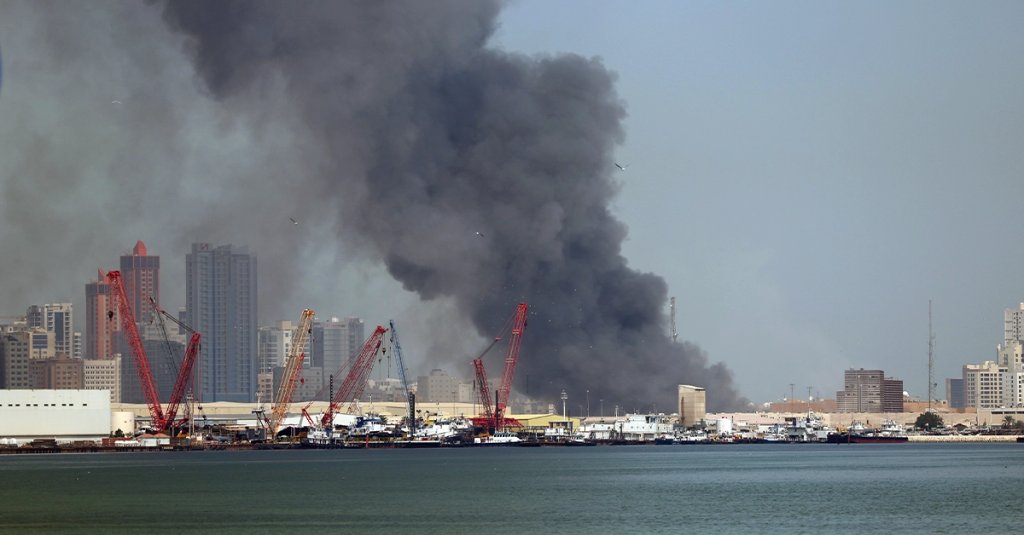
Smoke rises after Iran carried out a missile strike on the main headquarters of the U.S. Navy's 5th Fleet in Manama in retaliation against US-Israeli attacks February 28, 2026. (Stringer/Anadolu via Getty Images)
Get We Are The Mighty’s Weekly Newsletter
Military culture and entertainment direct to your inbox with zero chance of a ‘Reply All’ incident
Welcome to 2026. The sky over the Juffair district in Bahrain isn’t so blue; instead, it was a mosaic of gray-black plumes and the white-hot streaks of interception. For years, the armchair generals on social media have been salivating over Operation Truthful Promise 4, the supposed doomsday scenario where Iran’s missile rain finally drowns the U.S. 5th Fleet in its own home.
They told us the Persian Gulf was a kill box. They told us the headquarters at Naval Support Activity (NSA) Bahrain was a sitting duck. As the first Shahed-136 moped drones plodded over the Mina Salman port area over the weekend, it looked like they might finally be right.
However, while the world watched the smoke rise from the service center, our 5th Fleet was fine; the base that houses it took a black eye in the fracas, though.
Here is the after-action report on how we turned a potential Pearl Harbor moment into a dramatic piece of Iranian theater, and why the future of modern defense is about to become a bloodletting for our budgets.
Peaced Out
Before you start mourning the 5th Fleet, check the pier. In a stroke of intelligence foresight, or a well-timed leak perhaps, the U.S. Navy pulled its most valuable cards off the table well before the first siren wailed.
The USS Abraham Lincoln and USS Gerald R. Ford carrier strike groups vanished into the “blue water” like Homer Simpson into a wall of shrubbery, out into the Arabian Sea and Mediterranean, safely outside the immediate “kill zone” of Iran’s coastal batteries.
What Iran hit this weekend was, for all intents and purposes, a g-g-g-Ghost Port (If you know, you know). Millions of dollars’ worth of ordnance were spent splashing into static infrastructure, fuel depots, radar domes, and logistics hubs. No sugarcoating it, this was no bueno for our military in future conflicts.
On the other hand, it’s like blowing up an empty garage after the owner drove the Rolls-Royce to a different county. Don’t let the pirrhic victory of the carrier withdrawal fool you; the infrastructure left behind is a technical marvel, and it was being used for target practice.
Mopeds vs. Million-Dollar Missiles
When 71% of the planet is covered in high-quality H2O, the country that can rule it can rule the world. So when our Navy, a walking “FAFO” sign, isn’t a threat anymore, things need to change quickly. The Shahed-136 loitering munition is the one to cause an evolutionary change in American naval power… or else.
This little nugget is a $35,000 lawnmower engine with a warhead attached. It’s slow, it’s loud, and it’s arguably the most annoying weapon in modern history. But in a dense urban neighborhood like Juffair, annoying becomes lethal.
The problem isn’t that we can’t hit them, spoiler alert: we can, it just costs so much money. The Patriot PAC-3 and THAAD batteries protecting the base were screaming today, swatting at dozens of incoming threats in the air.
Unfortunately, here is the power of attrition: we are firing $4 million death sticks at $35,000 drones. Iran is counting on us to “win” every engagement until we run out of ammo or money. They want to deplete our magazine depth with junk drones before they send in the real hardware.
The Hypersonic “Fattah” and the Radar Horizon
Once the Shahed swarms softened the electronic bubble, the IRGC (Islamic Revolutionary Guard) sent in the heavy hitters: the Fattah-1 hypersonic missile. Iran calls it “The Conqueror,” and while Western analysts like to dismiss their Mach 13–15 speed claims as dubious at best, the picture on the ground today tells a different story.
Unlike traditional ballistic missiles, which are more predictable in their high-arcing paths (making them fairly easy targets for systems like THAAD), the Fattah-1 is designed for maneuverability within the atmosphere.
Today, that math resulted in at least one confirmed hit on a service center near the base’s command-and-control hub. We didn’t lose a ship, but we lost the untouchable aura our static bases once oozed.
Playing Defense in a Crowded Room
NSA Bahrain isn’t out in the desert like Al Udeid; it’s shoved into the middle of Manama’s Juffair district, surrounded by 20-story luxury apartments. This is a tactical nightmare. Every time a C-RAM (the land-based Phalanx) opens up with its signature wall of lead, thousands of 20mm high-explosive rounds are flying into the sky.
Reports are already filtering in of civilian high-rises shattered by “friendly” shrapnel and falling interceptor debris, thus introducing a major dilemma: the enemy doesn’t have to hit the base to win; they just have to force us to defend it so aggressively that we cause a diplomatic crisis with our Bahraini hosts. This one is simple: if too much damage is done to the civilian infrastructure from American weapons debris, the people will blame America.
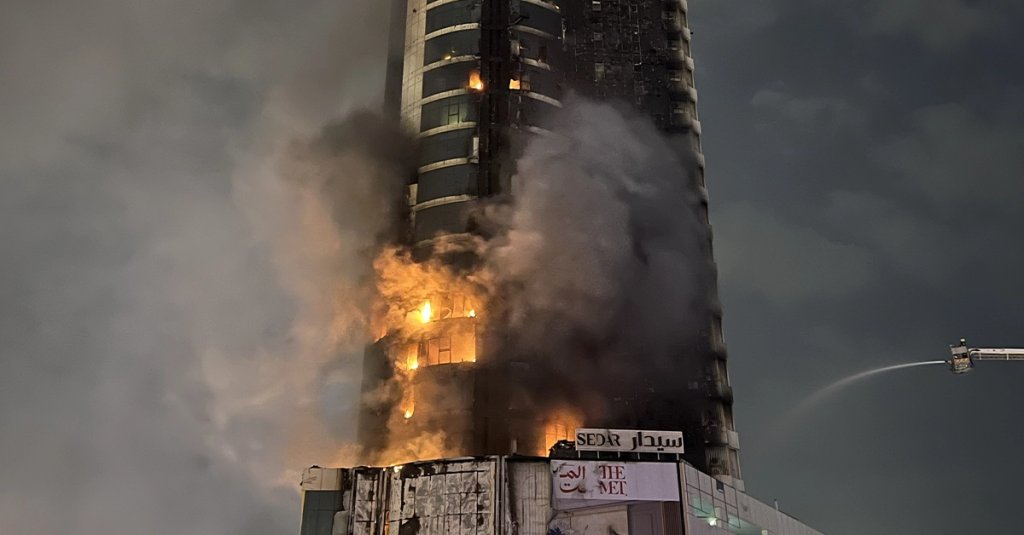
A fire broke out in a building targeted by Iranian unmanned aerial vehicles as Iran attacked several buildings in Manama, the capital of Bahrain, on February 28, 2026. (Stringer/Anadolu via Getty Images)
“LUCAS” Joins the Fray
Perhaps the grimmest part of today’s after-action report is the irony of Operation Epic Fury. While Iran was hitting us with Shaheds, the U.S. military was simultaneously debuting our new bestie, LUCAS (Low-cost Unmanned Combat Attack System).
What is the LUCAS? It’s a $35,000, American-made clone of the Iranian Shahed-136. We reverse-engineered their “moped” and started mass-producing it through Arizona-based SpektreWorks. Today, we saw a classic “Spider-Man pointing at Spider-Man” moment of 21st-century warfare: two powers using the exact same cheap tech to try and bankrupt each other’s air defenses.
We bought the airspace over the Persian Gulf for a trillion dollars, but today, Iran showed they could rent it for an afternoon with loose change. Operation Truthful Promise 4 never even sniffed the 5th Fleet because we were smart enough to move the ships, but it did leave the “Iron Dome” of the Gulf looking more like a well-worn pair of sweatpants.
Russia’s S-300s in Venezuela were nothing but paperweights because of corruption; the U.S. shield in Bahrain is under pressure because of attrition. We can win the sniper duel, but what happens when the enemy stops bringing a rifle and starts bringing ten thousand rocks?
The smoke is still clearing over Manama, and America’s naval dominance around the globe could be a lot less dominant unless serious attention is paid to defending against kids with toy choppers taking out our bases. Welcome to the era where small supplies of $4 million missiles are the only thing standing between a $30,000 drone and your mates.