
There was a lot of new technology brought to the battlefield during World War I. Two of those were used in tandem—and somehow managed to perfectly complement each other.
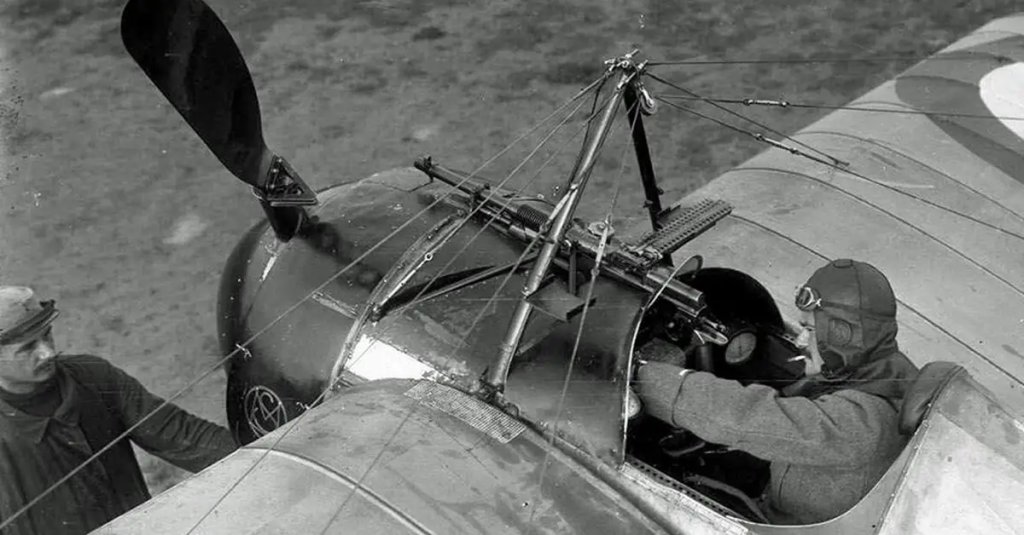
It was the fighter plane and the machine gun, mounted perfectly for the pilot’s use, without shooting up the propeller that kept the bird aloft. Was it the gun that was designed to fire through the propeller, or the propeller designed to be used with the biplane machine gun?
The answer is yes.
Also Read: A New York artist painted each of the Red Baron’s 80 aerial kills
The system worked because of synchronization gear which kept the gun from firing when the propeller would be hit by the bullet. While airborne, the prop would be spinning five times as fast as the weapon could fire, so there was little margin of error. The problem was solved by the addition of a gear-like disc on the propeller that would only allow the gun to fire in between the blades’ rotation.
Often called an “interrupter” the disc did not actually interrupt the firing of the weapon, it merely allowed it to fire semi-automatically instead of at an even pace. When the prop spun around to a certain position, it would allow the weapon’s firing mechanism to fully cycle and fire a round. Usually, when the round was supposed to be interrupted, the weapon was actually just in the process of cycling.

"The Interrupter" WW1 Machine guns on planes.
So pulling the trigger would essentially connect the weapon to the propeller, and the prop would actually be firing the gun. Letting the trigger go would disconnect the weapon from the propeller.
Later versions, such as the Kauper interrupter used on the Sopwith Camel, allowed for multiple machine guns at different rates of fire.
The interrupter was a welcome change from the early days of combat aviation, where props were sometimes metal plated just in case mechanically uncoordinated rounds hit the propeller, so the bullet would ricochet.

Don’t Miss the Best of We Are The Mighty
• Snoopy was much more than just a World War I flying ace
• Ukraine is using a World War I ‘creeping barrage’ tactic to turn the tide of the war
• Your battle buddy was originally supposed to check your feet in the trenches of World War I
Loading comments…
Comments couldn’t be loaded. Please refresh the page.