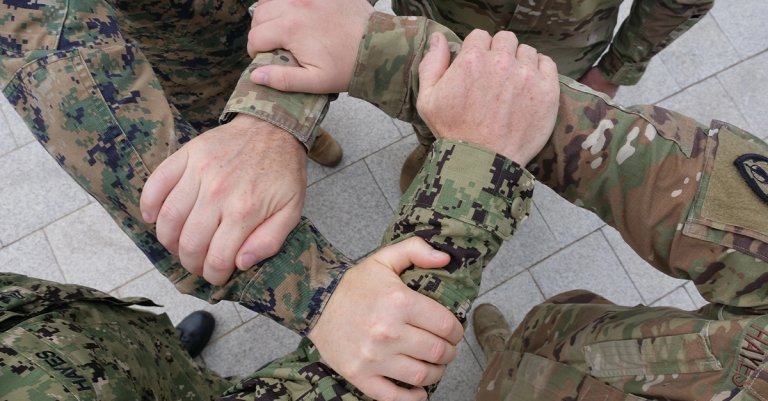
The 126th Army-Navy Game presented by USAA continued its legacy as one of sports’ greatest spectacles, marking the rivalry’s seventh appearance in Baltimore. During a weekend packed with notable figures from across the sports, entertainment, and military communities—including the President of the United States and Secretary of Defense—the Black Knights and Midshipmen put on a memorable show for the 70,936 fans in attendance at M&T Bank Stadium.
Read Next: These are the 5 presidential traditions around the Army-Navy Game
In what longtime Army play-by-play announcer Rich DeMarco aptly described as a game that means “everything” to both academies, the No. 22 Navy squad narrowly defeated Army, 17-16.
The buildup to Saturday’s matchup at the home of the NFL’s Baltimore Ravens has been months, and in many ways, years in the making.
Speaking to We Are The Mighty ahead of the rivalry, DeMarco, the longtime voice of Black Knights football, said, “When you walk in the football facility, I can’t even tell you how many signs say ‘Beat Navy.’”
The New Jersey-native and Army athletics fixture added that the modern intensity of the rivalry can be traced to 2014, when head coach Jeff Monken took over the program and helped elevate the annual matchup to its current level of significance.
“Coach Monken was hired in the midst of Navy’s 14-game winning streak in the series,” DeMarco explained. “People sometimes ask why there’s so much emphasis on ‘Beat Navy.’ The answer is simple: that’s the North Star for this program. Coach Monken measures success by beating Navy, and by how often Army is able to do it.”
Joe Miller, the voice of Navy football, echoed DeMarco’s sentiments on the significance of the rivalry.
“The last time we were in Baltimore was 2016, when Army snapped the streak,” Miller said. “That was a year when Navy played in the American Athletic Conference (AAC) championship game and had a great regular season. But it almost felt like none of it mattered, because they didn’t beat Army.”
Miller was referring to the last time Army and Navy met at M&T Bank Stadium in 2016, when the Black Knights edged their archrival 21-17 behind a physical performance from fullback Andy Davidson, who rushed for 87 yards and two touchdowns.
March-On
The pageantry and spectacle surrounding “America’s Game” began just after noon, when the Naval Academy Midshipmen and West Point Cadets conducted the traditional march-on to the field. One of the most powerful and enduring elements of the rivalry, the march-on has a rare ability to stir a deep sense of patriotism that transcends team loyalties. For sports fans and service members alike, it stands as one of college football’s most iconic traditions, an experience that must be witnessed at least once in a lifetime.
Related: 7 of the coolest things to watch for during the Army-Navy Game
For those lucky enough to experience this opening ceremony from field level, there is also a rare opportunity to hear some of the most creative trash-talking in sports. With Army entering the field second, the U.S. Corps of Cadets found themselves on the receiving end of a steady stream of heckling from the Brigade of Midshipmen, already situated in their section of seats.
Despite the partisan atmosphere and spirited back-and-forth during the pregame ceremonies, former Green Beret turned college and NFL football player Nate Boyer reminded everyone of the true meaning behind the Army-Navy Game in a pregame interview.
“Whoever wins or loses isn’t the most important thing. This game is so much more than that,” Boyer said. “Everyone watching knows that every person playing in the game is willing to die for them and for their freedom. This is a special day. We come together and recognize how important and impactful this game truly is, especially for the seniors who will soon take off the jersey, put on the camouflage, and be willing to make the ultimate sacrifice for our country and our beliefs.”

America’s Game
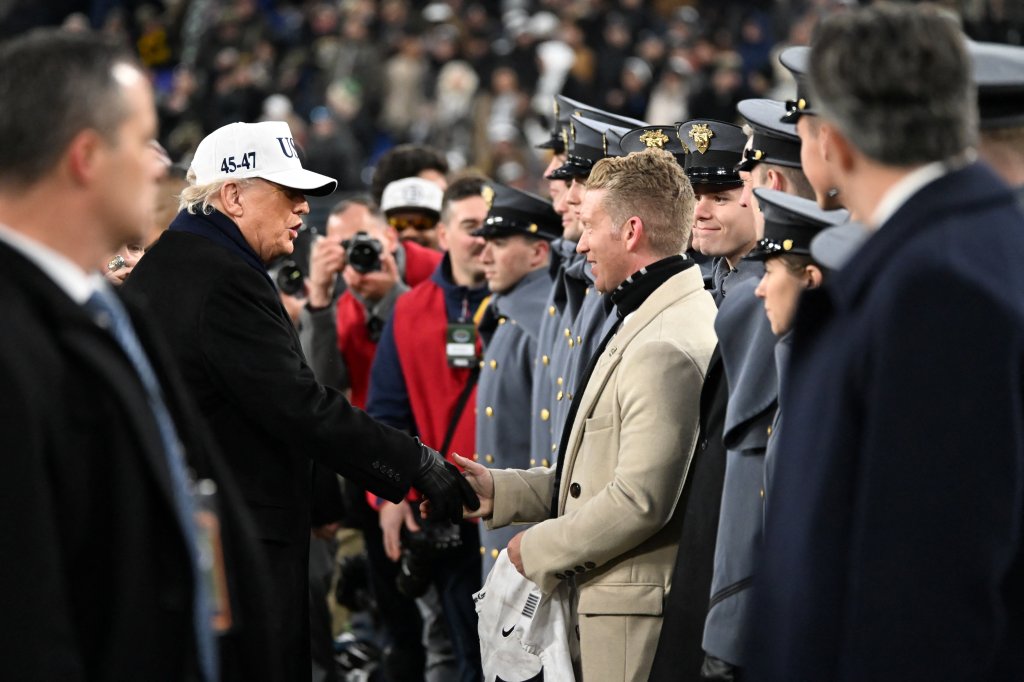
President Donald Trump accompanied the Mids and Black Knights, clad in their respective 250th anniversary uniforms, to midfield for the opening coin toss. Army picked tails and won the toss, deferring until the second half.
With bragging rights and the Commander-in-Chief Trophy on the line, Navy’s “terrific trio” of Blake Horvath, Eli Heidenreich, and Alex Tecza got the ball first. On the opening play, Horvath immediately energized the Navy faithful by handing the ball to Heidenreich, setting the tone for the run-heavy, clock-draining style that has defined service academy football this season. Nearly halfway through the opening quarter, Horvath drew first blood on a five-yard rushing touchdown at the 7:16 mark. Nathan Kirkwood’s extra point gave the Mids a 7-0 lead.
Army responded with a methodical drive of its own. A 7:21 possession that carried into the second quarter ended with Cale Hellums powering into the end zone on a two-yard rushing touchdown. Dawson Jones’ extra point evened the score at 7-7.
This exchange marked the first time since 2021 that both teams scored on their opening possessions.
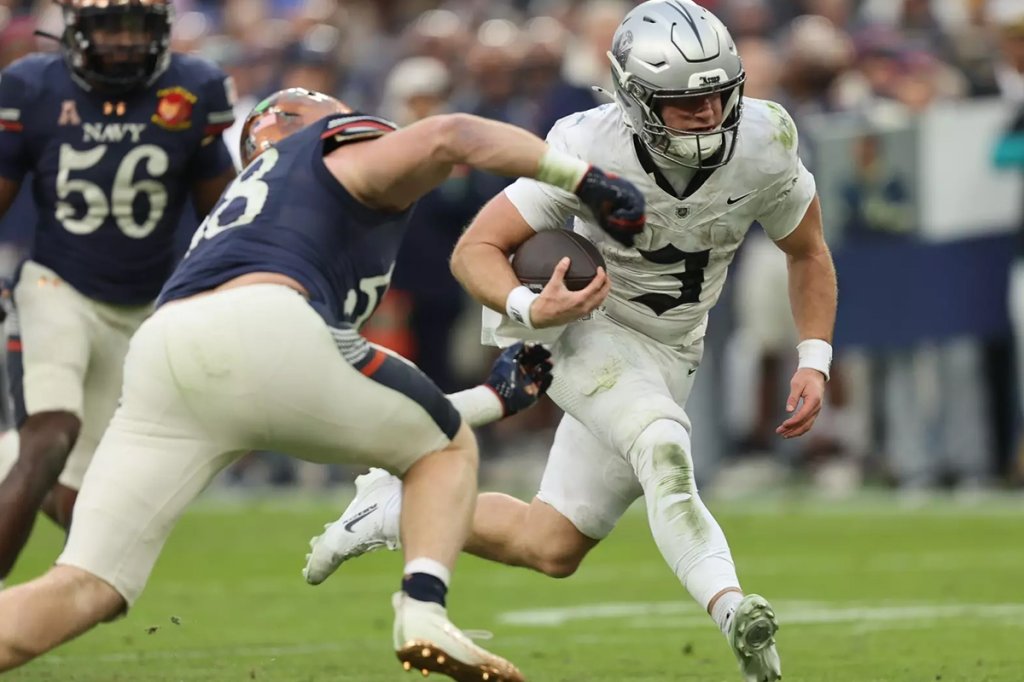
Navy went three-and-out on its next possession. With 12:37 remaining in the second quarter, the Black Knights started a drive at their own 34-yard line. The drive was dominated by the ground game, with the lone exception being a 21-yard completion from Hellums to slotback Noah Short. On 4th-and-2 at the Navy 11, Hellums kept the ball up the middle to move the chains. The Midshipmen defense stiffened in the red zone, forcing Army to settle for a 20-yard field goal by Jones at the 3:45 mark. After a 14-play, 8:52 march, the Black Knights led 10-7.
The Midshipmen answered with a 10-play drive that consumed 3:18 of game clock. Horvath briefly broke his tendencies by completing three consecutive passes, an uncommon stretch for the senior this season. However, on 2nd & 10 at the Army 27, Horvath appeared to attempt a pass but fumbled. Defensive lineman Jack Bousum recovered at the Army 45.
The turnover set up another Army scoring opportunity, which ended with Jones drilling a 45-yard field goal as time expired in the first half, extending the Black Knights’ lead to 13-7. The opening half lasted one hour and 18 minutes, and fans were treated to a halftime performance by the Army and Navy bands.
Army received the ball to open the second half. A 29-yard completion from Hellums to Short jump-started the drive, but the Midshipmen defense responded, shutting the door and forcing the Black Knights’ first punt of the afternoon.
On Navy’s ensuing possession, Horvath, operating out of the no-huddle shotgun, was intercepted by senior cornerback Justin Weaver. The 5-foot-11, 190-pound defender initially returned the interception into the end zone, but replay review ruled his knee down. Despite the short field, Army once again had to settle for three points, as Jones connected from 48 yards to push the lead to 16-7 at the 9:39 mark of the third quarter.
After a grueling 13-play possession that erased 6:40 from the game clock, Navy answered with a field goal of its own. Kirkwood’s kick from 21 yards out trimmed the deficit to 16-10 with 2:59 remaining in the third.
Army went three-and-out on its next possession, and Navy was also forced to punt after a defensive stand highlighted by Bousum’s sack of Horvath for a 10-yard loss.
Momentum swung early in the fourth quarter. After a one-yard run, Hellums was intercepted on 2nd & 9 at the Army 25 by sophomore cornerback Phillip Hamilton at the 11:19 mark. The Fort Worth-native’s third interception of the season proved to be his most consequential, setting up a go-ahead scoring drive for the Midshipmen.
A nine-play possession captured the best and worst of the Mids’ offense. Tecza broke loose for a 24-yard run, while Horvath fumbled on 2nd & Goal with the loose ball pounced on by Heidenreich. Two plays later, Horvath rewarded his slotback’s clutch recovery with a touchdown reception. Horvath hit the senior for an eight-yard touchdown pass down the middle. With Kirkwood’s extra point, Navy led 17-16 with 6:37 left to play.

2025 Army vs Navy Game Football Highlights (Dec 13, 2025)
Navy’s defense responded with pressure, forcing Army to go three-and-out and punt at the 4:50 mark.
This paved the way for the Navy’s biggest drive of the game. On the sixth running play of the possession, Horvath fumbled once again on a run up the middle, this time with the ball jarred loose by standout inside linebacker Kalib Fortner. Amid the chaos, Horvath managed to recover his own fumble, allowing Navy to keep the drive and the clock moving.
This set up a crucial fourth-down scenario with under two minutes remaining in regulation. During the timeout preceding the 4th & 1 play, Army Superintendent Lt. Gen. Steven Gilland and members of the West Point leadership team walked along the sideline, waving their covers in the air. The student section, located in the corner of the stadium overlooking the Black Knights’ sideline, erupted in boisterous cries of support as loud music blasted through the venue.
The stadium-shaking noise generated by the West Point cadets and fans, however, was not enough to stop a determined Navy offense. Tecza once again demonstrated why he has been one of the AAC’s most effective offensive players this season, bursting through the Army defense for a two-yard gain that secured the game-winning first down. Horvath then took a knee on the next three plays to officially seal the victory for the Midshipmen.
Horvath finished the game 7-of-14 through the air for 82 yards and a touchdown, while also leading Navy on the ground with 107 rushing yards on 34 carries and a score. Heidenreich served as his primary target, hauling in six receptions for 72 yards and a touchdown.
On the Army side, Hellums completed 5-of-10 passes for 82 yards and a touchdown. Like his counterpart across the field, he also paced his team in rushing, carrying the ball 25 times for 100 yards and a score. Short led the Black Knights in receiving with three catches for 51 yards, while sophomore wide receiver Brady Anderson added two receptions for 31 yards.
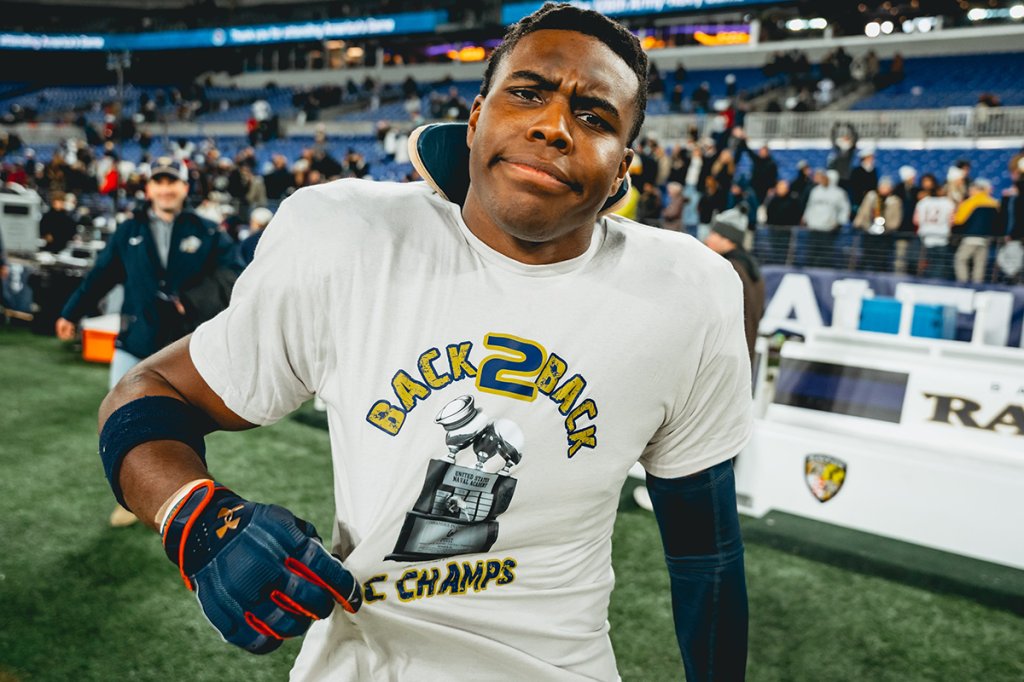
As a result of the win, head coach Brian Newberry and his Navy squad sang their Alma Mater in front of the student section second, a moment reserved for the victorious side in the rivalry. They also left Baltimore with another year of bragging rights and the coveted Commander-in-Chief’s Trophy, the annual award presented to the team with the best record among the three service academies. Prior to Saturday’s victory over Army, the Midshipmen had already secured a key win over Air Force, defeating the Falcons 34-31 on October 4th in Annapolis.
The 126th Army-Navy Game certainly lived up to AAC Commissioner Tim Pernetti’s view of the rivalry’s significance.
“It is a showcase for the conference,” Pernetti said. “We have a phenomenal brand of football, and a lot of it is built around a blue-collar, hard-nosed approach. I don’t think there are any two better examples of that than Army and Navy. While this is not a conference game, we embrace it as a showcase for our league, for the sport, and for what is important to the country.”
The Road Ahead
With the 126th Army-Navy Game in the books, the Midshipmen and Black Knights now turn their attention to bowl season.
Army will head to the historic home of MLB’s Boston Red Sox for the Wasabi Fenway Bowl on Saturday, Dec. 27, where the Black Knights will face independent UConn (9-3). Kickoff is scheduled for 2:15 p.m. ET, with coverage on ESPN.
Navy, meanwhile, is set for a Friday, January 2 showdown against Big 12 opponent Cincinnati (7-5, 5-4 Big 12) in the AutoZone Liberty Bowl. The matchup will kick off at 4:30 p.m. ET and air live on ESPN.