A sick soldier changed the trajectory of Dwight Hal Johnson’s life.
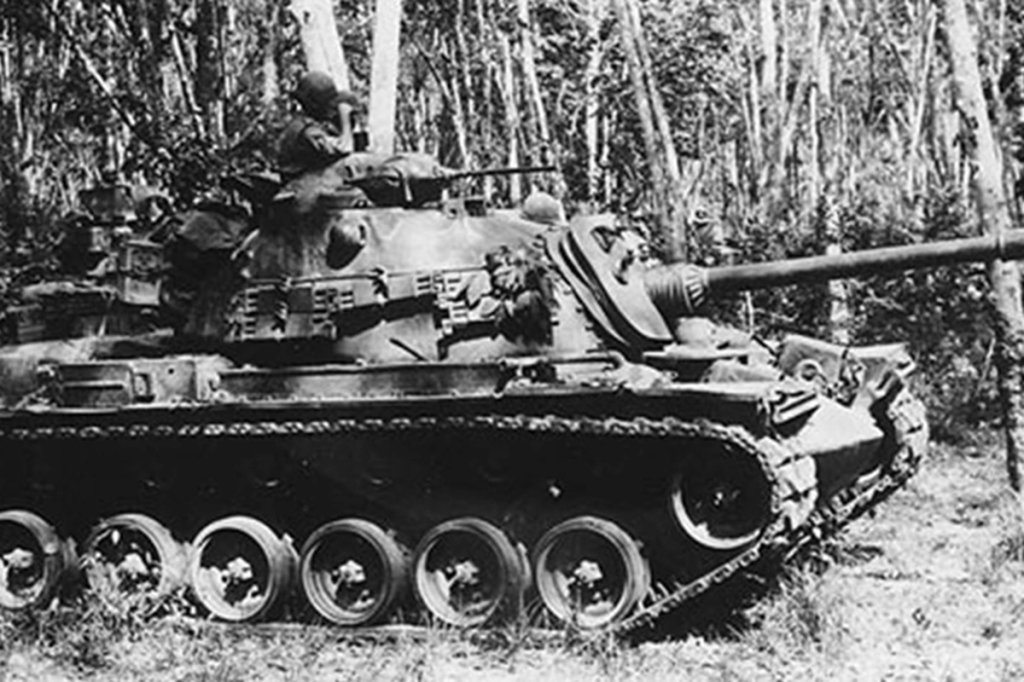
On January 13, 1968, Johnson believed he would be going home in less than two weeks after serving nearly a year as a U.S. Army tank driver in Vietnam. The next day, he learned he was being transferred to another M48 Patton tank because its driver was ill.
His homecoming would have to wait.
Related: The only time a Medal of Honor recipient killed another Medal of Honor recipient
One day after that, Johnson saw combat for the first time during an intense battle near Dak To in Kontum Province. The 20-year-old Detroit native’s heroism earned him the Medal of Honor, but the outcome could have been much different if not for that transfer.
During that intense skirmish, enemy rockets struck two tanks in Johnson’s platoon. One of them was the tank to which he was assigned only days before. As the hulk burned with his friends inside, Johnson raced to save them. He managed to pull one severely burned soldier to safety before the tank exploded, but the rest of the crew died.
Johnson never forgot the image of his dying brothers in arms. He survived the battle near the Cambodian border that day, although it came at a steep price. Along with his peace of mind, his innocence was irrevocably shattered that day.
Reaction Force Rushes to Aid of Platoon
Johnson never wanted to fight.
Growing up poor in Detroit, he was raised by a single mother. He made her proud, becoming an altar boy and a scout. Bullies targeted the slightly built Johnson, but his mother advised him not to respond with his fists and run away, and he listened.
Johnson couldn’t run away in Vietnam.
It all began when four M48 Patton tanks, including the one driven by Johnson, were assembled as part of a reaction force to assist other elements of the platoon as it engaged with a large contingent of North Vietnamese fighters, according to Johnson’s Medal of Honor citation.
Once Johnson got there, his tank became disabled, and that’s when raw courage, determination and adrenaline took over. He first emerged from his damaged military vehicle and fired its .50-caliber machine gun at the enemy as it seemingly converged from all angles.
Outnumbered and Outarmed

Johnson used whatever weapons he could: his tank’s externally mounted machine gun, a .45-caliber pistol and a submachine gun. The odds were heavily stacked against Johnson, but after watching his friends die, nothing was going to stop him.
He fired at the North Vietnamese, killing as many as he could until his ammunition ran out. When it did, he simply raced to his next weapon, all the while dodging hostile fire.
During the half-hour engagement, Johnson found himself in close contact with several enemy soldiers at various points. In one instance, Johnson looked straight into the eyes of an adversary wielding an AK-47. The U.S. soldier attempted to fire his pistol, only to realize he had no bullets left. Instead, Johnson used the stock end of his submachine gun (which also was out of ammunition) to kill the North Vietnamese soldier.
“Fighting his way through devastating fire and remounting his own immobilized tank, he remained fully exposed to the enemy as he bravely and skillfully engaged them with the tank’s externally mounted .50 caliber machine gun, where he remained until the situation was brought under control,” Johnson’s Medal of Honor citation read.
‘He Just Sort of Cracked Up’
By the time the engagement ended, Johnson is credited with killing up to 20 North Vietnamese soldiers. Despite running into the ambush multiple times, there is no evidence of Johnson sustaining any significant physical injuries.
After his former tank exploded, though, Johnson was so uncontrollable that he wanted to harm captured troops.
“He just sort of cracked up,” gunner Stan Enders recalled to The New York Times.
“When it was all over, it took three men and three shots of morphine to hold Dwight down. He was raving…. They took him away to a hospital in Pleiku in a straitjacket.”
Struggling on the Home Front
Johnson returned home to Michigan a changed man.
Like so many veterans, he was reluctant to talk about his experiences. If someone asked him about Vietnam, Johnson usually replied, “Aw, shucks, nothing happened,” sometimes punctuating his words with a laugh.
Outward appearances notwithstanding, Johnson’s transition back to civilian life was extremely difficult. No matter how hard he tried, he couldn’t cope. With a young family to support, he struggled to find work. Gripped by post-traumatic stress disorder, images of the horrors of war were a constant, unwelcome companion. Nightmares persisted.
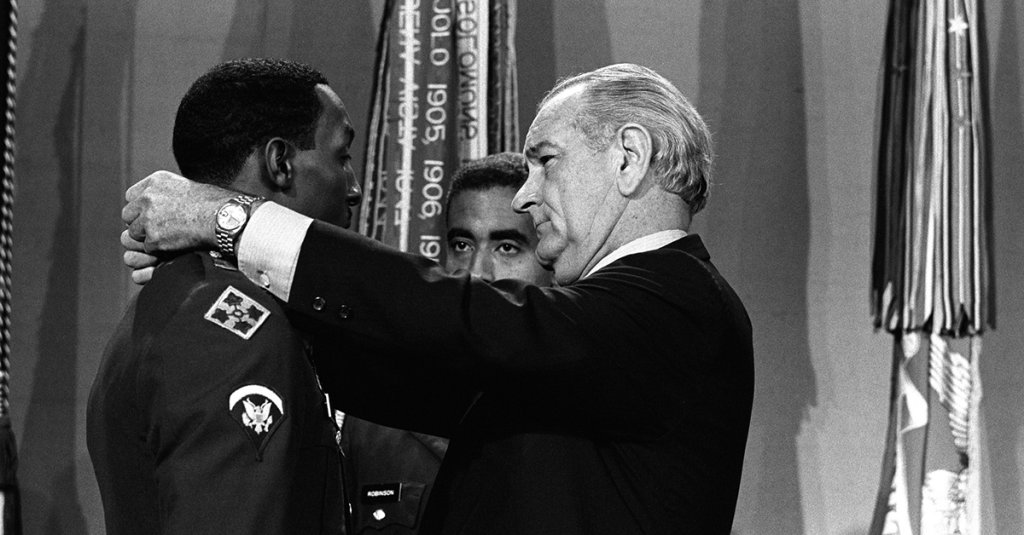
On Nov. 19, 1968, President Lyndon B. Johnson placed the Medal of Honor around Johnson’s neck. However, even receiving the U.S. military’s highest individual honor could not assuage Johnson’s survivor’s guilt.
After the ceremony, Johnson’s mother noticed him in tears. “Honey, what are you crying about,” she asked her son. “You’ve made it back.”
She didn’t understand. How could she? Outwardly, Johnson was presenting a brave front. Inside, the torment was relentless before it became too much.
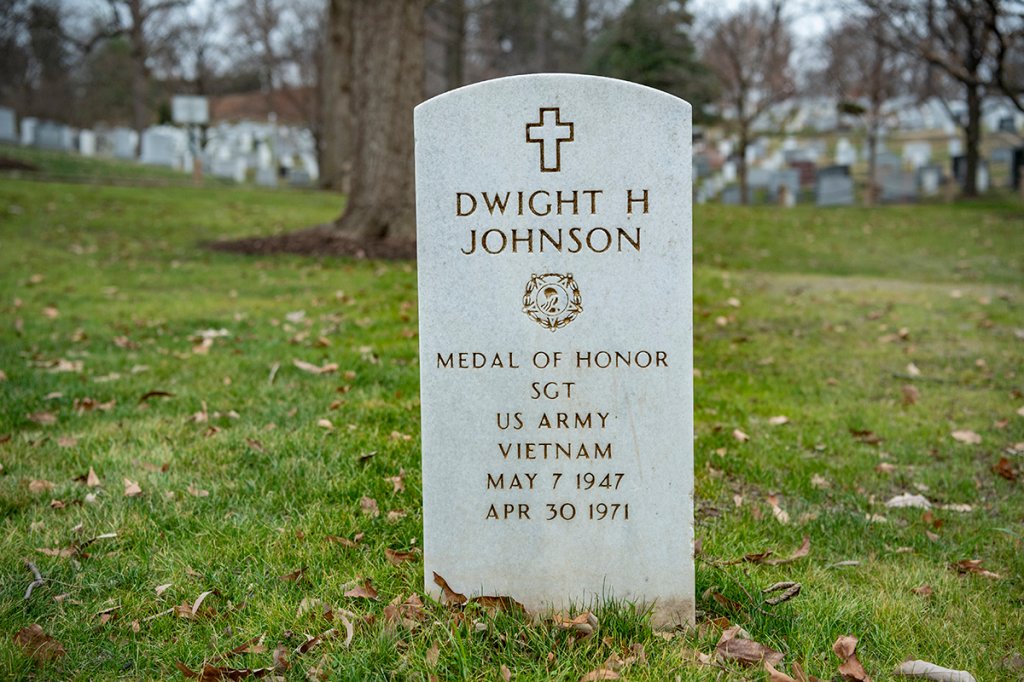
Johnson had been working as an Army recruiter when he was admitted for psychiatric care at Valley Forge Army Hospital near Philadelphia. While on convalescent leave, he attempted an armed robbery in his neighborhood in Detroit. During an exchange of gunfire, the store owner shot and killed Johnson a week shy of his 24th birthday.
When the detectives went through Johnson’s wallet for identification, they noticed his Congressional Medal of Honor Society card. Johnson’s suffering was finally over. A hero was dead.