If thousands of U.S. servicemen went missing in action over 10 years of combat, it would surely be the biggest political issue of our day.
And that’s how it was after the end of the Vietnam War.
Well into the 1980s, the status of Vietnam’s prisoners of war and missing in action was a sore point for politicians and everyday citizens from all walks of life. A few enterprising Americans took matters into their own hands – Dirty Harry himself even funded one daring rescue attempt.
Americans these days might have a hard time imagining 2,494 missing U.S. troops. But for Vietnam-era veterans, the idea is all too real. Years after the war ended and Saigon fell to the communists, the American public was still divided over the thought, and what to do about it.
As of 1983, the Pentagon was still telling reporters at the Boston Globe that it couldn’t rule out the possibility of Vietnam War POWs left behind in Southeast Asia. After a reported 480 firsthand sightings of POWs after the fall of Saigon in 1975, many prisoners’ families and members of the veteran community were convinced the American government was just “sweeping it under the rug.”
That’s when a former U.S. Army Special Forces soldier named Bo Gritz gained fame. Gritz is said to have made multiple incursions into Laos to find the alleged missing in action. He was also convinced there were American prisoners still being held in Southeast Asia. If there were, he was determined to take the issue out of the political arena and turn Indochina into a new battlefield if necessary – anything to get those troops back home.

According to the Boston Globe, the 44-year-old veteran soldier interviewed former prisoners held by the North Vietnamese who were repatriated at the end of U.S. involvement in Vietnam. He was even given access to American intelligence reports on the issue. His conclusion was to form a team of former Green Berets to go to Laos and locate these men.
Gritz’s plan was to link up with Laotian anti-Communist resistance fighters under the command of a Laotian general who sided with the Americans during the Vietnam War. That general also commanded 40,000 troops as part of a secret CIA army in Laos. According to the CIA, the effort was funded primarily through actor-director Clint Eastwood, who even informed President Reagan of Gritz’s plan (though the White House disputed the Reagan conversation).
The February 1983 rescue effort failed to return with any firsthand or photographic evidence of POWs or movement of POWs in Laos. By this time, the hunt for Vietnam War POWs became a “growth industry” in Thailand. Nothing was found of the 568 missing troops thought to be in Laos. Even worse, Gritz’s other missions became a publicity stunt.
In November 1982, Gritz led four ex-Green Berets and some Lao insurgents into Laos from Thailand, in what some described as a guerrilla invasion.
“It’s a good day to die,” the retiree said, according to the LA Times, as he started off across the Mekong River.
What was supposed to be a two-week incursion was halted after 72 hours when guerrillas from another faction ambushed the group. They retreated back into Thailand, where they were arrested for possessing advanced radio equipment. Two Lao soldiers were killed, and one American was captured.
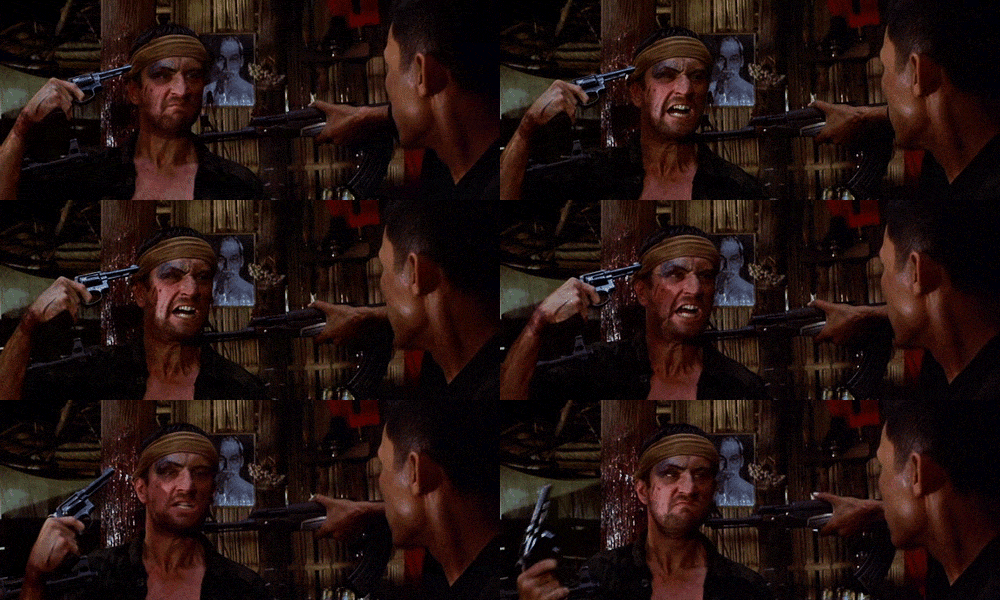
The end result was one more American captured in Indochina and the movie “Uncommon Valor,” starring Gene Hackman. The film was based on notes taken by Gritz during his “rescue mission” to Laos.

Uncommon Valor (1983) Official Trailer # 1 – Gene Hackman HD
It was probably embellished a little.