United States Marines have done some crazy things during deployments. We’re not even certain that becoming a Somali warlord takes the cake, because one Marine stole Princess Meriam al-Khalifa of Bahrain and another became the king of a Haitian voodoo island. So if you’re a Marine Corps NCO reading this, just ask yourself: Do you know where all your Marines are right now?
If the name Hussein Aidid kinda sounds familiar, it’s because his father, Mohamed Farrah Aidid, was a central figure in the 2001 film “Black Hawk Down.” Many will remember that the Battle of Mogadishu erupted because American forces were trying to capture some of his top lieutenants on his territory. But his history goes back well before Americans landed in Somalia.
Related: Operation Restore Hope was much bigger than ‘Black Hawk Down’
Mohamed Aidid was the leader of the Habr Gidr clan, who vied for power in the wake of the fall of dictator Mohamed Siad Barre’s Somali regime, which he and his United Somali Cogress helped to topple. The years that followed saw Somalia fall into famine and civil war, with the war helping exacerbate the country’s food insecurity.
Long story short: Aidid not only diverted food aid and relief supplies, his fighters ambushed the UN peacekeepers sent to protect the food. The United Nations offered a $25,000 reward for his capture, and he was personally targeted by American forces deplyed to the country. The U.S. hunt for Aidid led to the ill-fated Battle of Mogadishu that resulted in the death of 18 American troops.
But while Mohamed Farrah Aidid was busy overthrowing the government of Siad Barre, his son Hussein was in the United States Marine Corps, fighting in Desert Storm.
The elder Aidid had four wives. His first wife, Asli Dhubad, gave birth to five children. Hussein Mohamed Aidid was the first of those five. Hussein was born in a remote area of Somalia in 1962. When he was 17 years old, Somalia was still ruled by Barre whose authoritarian government was enjoying a brief thaw in relations with the United States. Hussein emigrated there in 1979, and graduated from high school in Covina, California two years later before enlisting in the U.S. Marine Corps in 1987.
Aidid was an artilleryman, assigned to Battery B, 14th Marines at the Marine Corps Reserve base in Pico Rivera, California. He actually deployed in support of Operation Restore Hope, the U.S.-led task force in Somalia whose aim was to disrupt the personal army of Mohamed Farrah Aidid. Mohamed Aidid controlled the strongest faction in the ongoing power struggle in the country.

The United Nations mandate was to “establish as soon as possible a secure environment for humanitarian relief operations in Somalia.” Essentially, Restore Hope aimed to protect the delivery of food and other humanitarian aid, keeping it from falling into the hands of Aidid’s personal army. The Marines deployed the younger Aidid because he was the only one in the ranks who could speak Somali. He served as a translator and liaison to his father in Mogadishu for a few weeks in late 1992 and early 1993.
”I always wanted to be a Marine,” he told The Associated Press. ”I’m proud of my background and military discipline. Once a Marine, always a Marine.”
He returned to the U.S. and became a naturalized citizen. In 1995, Aidid told his command he would miss drill for a while because he was traveling outside the U.S. He returned to Somalia and began preparing for his role in the Habr Gidr militia.
Mohamed Farrah Aidid continued his struggle for power, even declaring himself President of Somalia in 1995, a declaration no country recognized. He was shot in a battle against former allied warlords in July 1996 and died of a heart attack during surgery. Hussein, then age 33, was suddenly declared his father’s successor. The man who left the Marines as a corporal was suddenly a general.
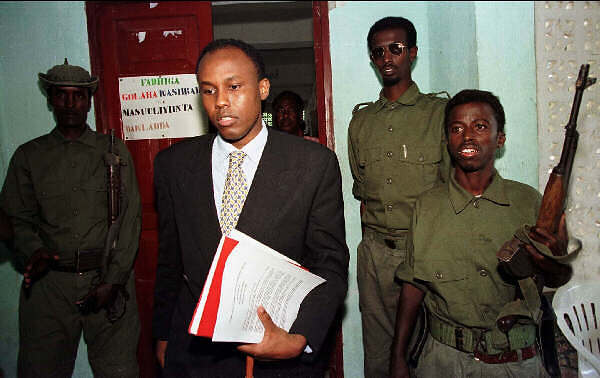
The younger Aidid’s personal and political views bounced back and forth between being more conciliatory than his father to being as warlike as his father. Initially, he vowed to crush and kill his enemies at home and overseas. He continued his father’s policies, especially the pacification of the countryside, which most saw as an authoritarian power grab. Forces loyal to Aidid were known to rob and kill civilians in their controlled territories. Other allied factions left the young leader’s camp because they did not see dedication to the peace process.
Hussein Aidid eventually softened, renouncing his claim to the presidency and agreeing to United Nationa-brokered peace agreements in 1997. An ardent anti-Islamist, he assisted the Bush Administration in tracking down the flow of arms and money through Mogadishu, gave up the sale and use of landmines, and helped Somali government forces capture the capital from the al-Qaeda-allied Islamic Courts Union in 2006. He was hired and fired as deputy Prime Minister, Minister of the Interior, and Minister of Public Works. He defected to Eritrea in 2007.

After his defection, he still had an interest in leading Somalia and even explored a run as the legally-elected president later that year. But the Aidid name remains incredibly devisive in his home country. The Somalis still vilify the family for the ruthless tactics they used to crush their opponents. Eventually, he returned to the United States and as recently as 2023, was active in the Somali expat community in Minnesota, urging Somalis in the U.S. to forgive each other and reject “evil” clan tribalism.