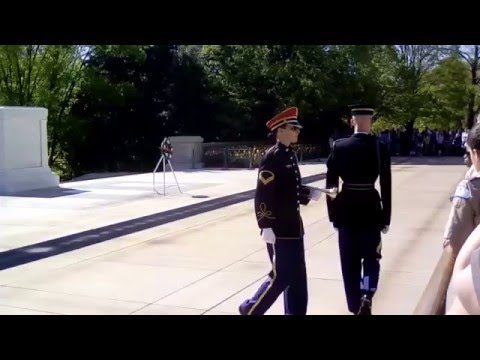
In April of 1948, the 3rd U.S. Infantry Regiment took on the unique responsibility of guarding the Tomb of the Unknown Soldier. Being a Tomb Sentinel isn’t as simple as walking back and forth while keeping a close eye out; it’s an extremely high honor that requires immense professionalism and commitment.
Each year, Arlington National Cemetery receives around four million visitors who come from across the globe to pay their respects to heroes who made the ultimate sacrifice for our nation. At the The Tomb of the Unknown Soldier, visitors watch solemn, powerful ceremonies that take place to honor the dead. If you plan on visiting this historic site, you’ll want to carefully read over the rules and regulations before stepping foot on those hallowed grounds. It is the job of Tomb Sentinels to protect this sacred place from all four million of those visitors — you don’t want to screw up and get yelled at like this unlucky visitor.
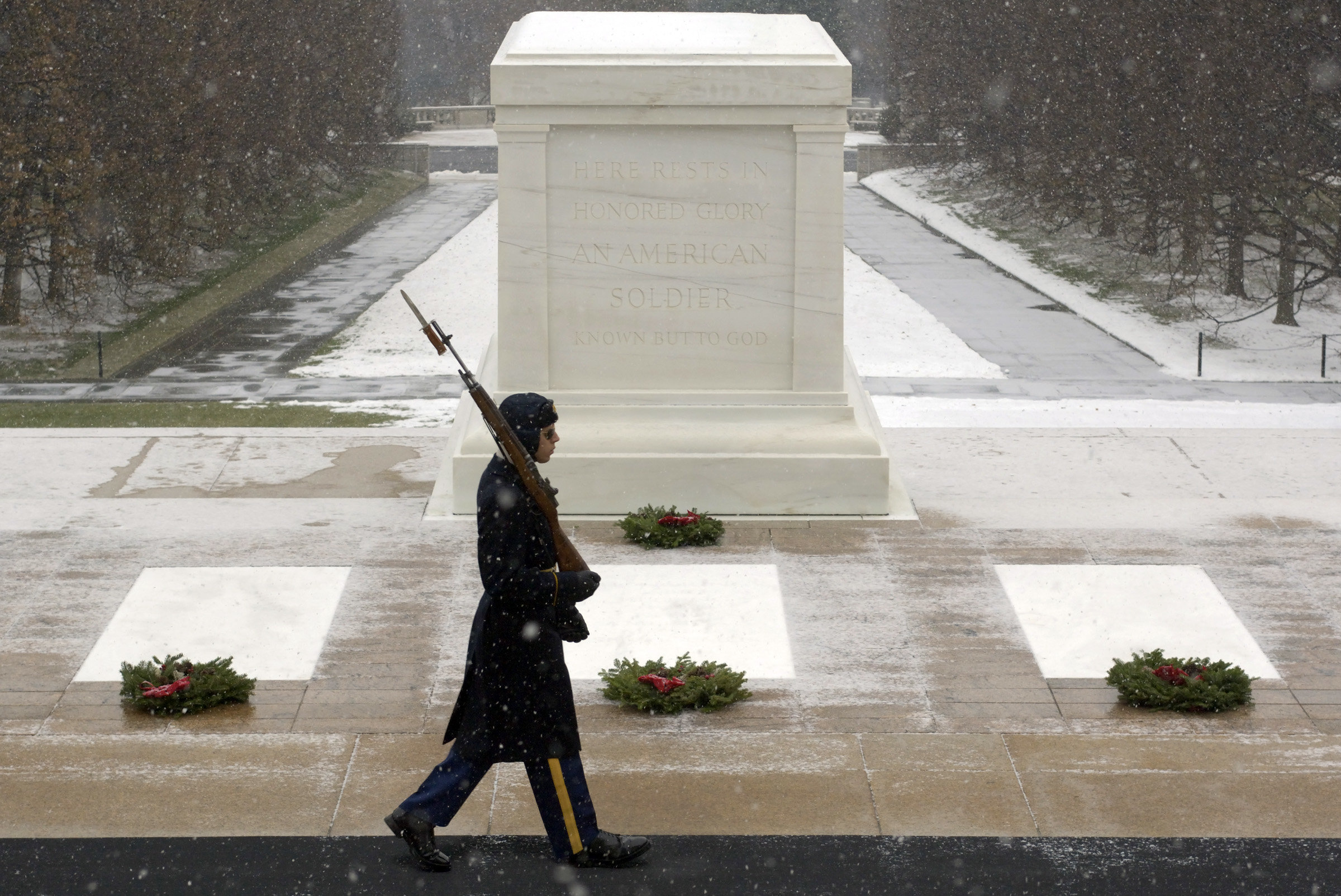
The Sentinel Guardsman never leaves their post at the Tomb of the Unknown Soldier.
(Photo by U.S. Air Force Master Sgt. Jim Varhegyi)
During a wreath-placing ceremony, a crowd gathers and two children are selected to lay the elegant decoration at the center of the tomb for all to see. The chosen children are assisted by a Sentinel in order to ensure the wreath is properly placed as the other soldiers render a perfect hand salute.
Once the wreath is laid, the Sentinels move to their assigned area as the Taps is played, showing ultimate respect.
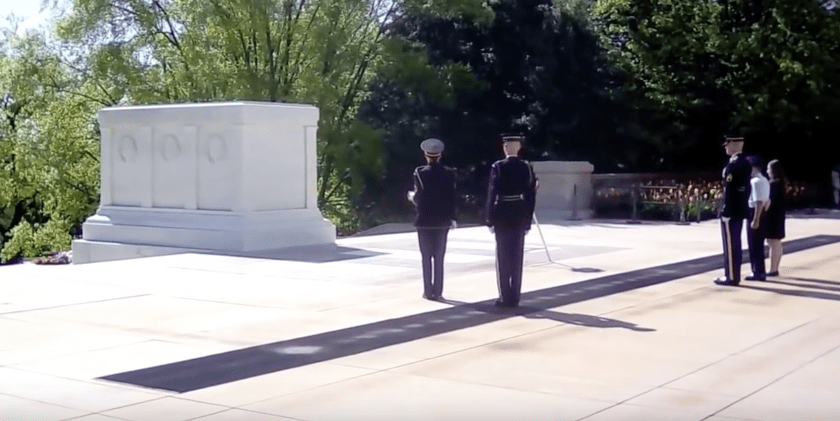
The participantsu00a0of the wreath laying ceremony.
(Tim Stampfly)
After the hymn ends, the participants march away with extreme military bearing. This time around, however, something interesting happened.
On the other side of the crowd, a woman wearing all white decided it was a good idea to walk up and slip past the barrier that keeps spectators from making physical contact with the tomb. As she made her way closer, the guard did precisely what he’s supposed to do — man his post.

“It is requested, that all visitors stay behind the chain rails at all times!” the guard sternly instructs.
Without thinking twice, the woman in white quickly squeezed her way back through the barrier and pretended like it never happened. Once she was secured in the designed visitors’ area, the ceremony resumed.
Check out the video below to watch a Tomb Sentinel protect the sacred ground from a curious trespasser.
Live-action roleplaying is popular among nerds the world over. But what they don’t realize is that the military hosts their own LARPing events to prepare for war.
While training for real-life combat, it’s important that the military runs simulations that get as close to the real thing as possible. But, when you start to really break it down, it becomes clear that the government is spending tons of money on opportunities for advanced LARPing — as they should be.
Here, we have a group of infantry LARPers attacking an enemy town.
(U.S. Marine Corps photo by Pfc. Rachel K. Porter)
You’re just pretending you’re at war
Make no mistake, there’s plenty of purpose behind it but, at the end of the day, your life is in very little real danger. A lot of times, you’re shooting pretend bullets at pretend targets in a pretend country.
Even when you get real bullets, you’re still fighting a made-up military in a made-up country.
Here, we have a berserker class clearing the way for the warriors.
(U.S. Marine Corps photo by Pfc. Rachel K. Porter)
You dress up as your selected class
Whether you chose to be a berserker (machine gunner), a warrior (rifleman), or a mage (mortarman), you get to dress up as your character and carry real equipment.
The bonus here is that the government spends tons of money training you in your selected class.
You get to fire real rockets!
(U.S. Marine Corps photo by Cpl. Aaron Henson)
You use real weapons
This is actually pretty cool considering that most LARPers don’t get to use real weapons. The government will spend lots of money for you to get a real weapon to use in your roleplay events, like Integrated Training Exercise (ITX). Meanwhile, not every LARPer is into live steel.
They’re there to create the most authentic of experiences.
(U.S. Army photo by Spc. Hubert D. Delany III)
Real props
You get to ride in helicopters to make the scenarios even more realistic. Sometimes, you’ll even get support from jets and tanks to truly sell an authentic experience.
Okay, so these props might be a tad cooler than getting to drink your own, real-life “health potion” that is probably just Sprite and grenadine…
They’re out there to help you… or hurt you.
(U.S Marine Corps photo by Lance Cpl. Juan A. Soto-Delgado)
Other roleplayers are involved
When you go to ITX, they’ll bring in a bunch of people to act as townspeople and enemies. This makes the experience a lot more authentic, which makes it a lot more interesting and fun.
You can talk with these NPCs for extra experience.
(U.S. Marine Corps photo by Lance Cpl. Alexis C. Schneider, 2d MARDIV Combat Camera)
There are non-player characters
The roleplayers that get brought in for the purpose of acting as the townspeople are very interactive NPCs. You’ll go on a patrol through the town and they’ll offer information or things to buy. Be careful, though, some might be working with the enemy!
The Coyotes even wear special items to specify they’re game masters.
(Marine Corps photo by Lance Cpl. Levi Schultz)
There’s usually a game master
In a lot of cases, there will be someone acting as the GM, there to make sure people aren’t cheating and everyone dies when they’re supposed to. They might come in the form of your company Gunny (or a Coyote in the case of ITX). They keep things fair and they’ll evaluate your performance after the event is over.
Here, we have two LARPers from different countries interacting in a dialogue.
(U.S. Marine Corps photo by Sgt. Tiffany Edwards)
You get to roleplay with other countries
On a peacetime deployment, you basically go to other countries to train with their military if your unit is trustworthy enough for that responsibility. This means that you travel and meet with other LARPers as you share an event together.
Republican Sen. John McCain, an internationally renowned Vietnam War hero who served for 30 years in the Senate representing Arizona, died Aug. 25, 2018, due to complications stemming from brain cancer.
His office said in a statement that his wife Cindy McCain and their family were alongside him when he died.
“At his death, he had served the United States of America faithfully for sixty years,” his office said.
McCain, 81, was a part of many of the past three decades’ most significant political moments. He was the 2008 Republican presidential nominee in a contest he lost to President Barack Obama. He also sought the presidency in 2000, mounting a primary campaign against President George W. Bush.
A graduate of the Naval Academy, the Arizona Republican followed both his father and grandfather, who were four-star admirals, into the US Navy, where he carried out airstrike missions.
During a 1967 bombing run over Hanoi, McCain’s plane was shot down, nearly killing him. He was captured by North Vietnamese forces and spent six years as a prisoner of war, suffering brutal beatings at the hands of his captors, which left him with lifelong physical ailments.
He quickly lost 50 pounds and saw his hair turn white. His captors did not treat his injuries from the plane crash.
Because his father was named commander of US forces in Vietnam that same year, the North Vietnamese offered to release McCain early. He refused unless every prisoner of war taken before him was also released. He was soon placed in solitary confinement, where he would remain for the next two years. He was not released until March of 1973.
Photograph of John McCain after his release from captivity.
(National Archives photo)
Upon returning to the US, McCain was awarded a number of military medals, including two Purple Hearts. He soon set his sights on politics and ran for an Arizona congressional seat in 1982, winning a tough primary and subsequently the general election.
In 1986, he ran for the Senate seat vacated by longtime Republican Sen. Barry Goldwater, who was the Republican presidential nominee in 1964. He won that election as well, and he has been reelected to the Senate for five additional terms — most recently in 2016.
Early in his Senate career, McCain became embroiled in the “Keating Five” scandal. McCain was one of five senators who received campaign contributions from Charles Keating Jr. and was later asked by Keating to prevent the government from seizing his Lincoln Savings and Loan Association.
McCain met twice with regulators to discuss the government investigation. He later returned the donations and admitted the appearance of it was wrong. The episode led McCain to become a leader on campaign finance reform, which included the passage of the McCain-Feingold Act.
During his 2000 campaign for president, the press became enthralled with the candidate who won over a reputation as a “maverick,” rebuffing his party’s conservative orthodoxy at the time. He famously traveled on a bus called the “Straight Talk Express” during his 2000 bid.
U.S. Sen. John McCain speaks to a group of Soldiers before re-enlisting them during an Independence Day celebration in Kabul, Afghanistan, July 4, 2013.
(U.S. Air Force photo by Staff Sgt. Dustin Payne)
In 2008, McCain fared far better. He won the Republican presidential nomination but ultimately was defeated by Obama in a year in which he faced defending an unpopular war in Iraq and a faltering economy under the Bush administration. McCain selected then-Alaska Gov. Sarah Palin as his running mate, a move criticized by some as having opened the floodgates for the Republican Party to be infiltrated by a number of far-right candidates who went on to be elected.
After the 2008 campaign, McCain returned to the Senate, his stature even more prominent, leading on national security and military issues.
He was diagnosed with brain cancer early in his sixth term. He battled through it, returning to Congress this past summer. In perhaps his last signature political moment, McCain cast a dramatic vote against his party to stop the repeal of Obamacare, coming to the floor in the middle of the vote before pausing and pointing his right thumb down. The moment highlighted a contentious relationship between the senator and President Donald Trump.
The type of brain tumor with which he was afflicted, glioblastoma, is particularly aggressive and difficult to treat. He had been receiving chemotherapy, but his family announced in August that he would no longer seek medical treatment.
McCain is survived by his seven children and his second wife, Cindy, whom he married in 1980 following a 15-year marriage to Carol Shepp.
Most famous among his children is Meghan, who is a prominent conservative pundit and cohost of ABC’s “The View.” During a December episode, former Vice President Joe Biden consoled her and said that if “anybody” could overcome that cancer, it was her father.
“Your dad is one of my best friends,” he said.
This article originally appeared on Business Insider. Follow @BusinessInsider on Twitter.
Throughout history, Native American warriors have given a wide mix of motives for joining the U.S. military. Those include patriotism, pride, rage, courage, practicality, and spirituality, all mingling with an abiding respect for tribal, familial, and national traditions.
This Veterans Day, explore the complicated ways the Native American culture and traditions have affected their participation in the United States military when The Warrior Tradition airs at 9 pm ET on PBS. The one-hour documentary, co-produced by WNED-TV and Florentine Films/Hott Productions, Inc., tells the stories of Native American warriors from their own points of view – stories of service and pain, of courage and fear.
What makes an air force good? Is it combat capability? Is it their track record? Much of that can stir up debates and cause one heck of a…disagreement among patrons at any watering hole or establishment.
Then again…life gets boring without such things.
F-35C Lightning IIs, attached to the Grim Reapers of Strike Fighter Squadron (VFA) 101, and an F/A-18E/F Super Hornets attached to the Naval Aviation Warfighter Development Center (NAWDC) fly over Naval Air Station Fallon’s (NASF) Range Training Complex. (U.S. Navy photo by Lt. Cmdr. Darin Russell)
So, here’s a look at the eleven best air forces in the world:
11. Russian Air Force
The Russians have been working on some new planes, but most of their very large force is old. Still, quantity can have a quality all on its own.
Russia also has long-range bombers and some tankers and airborne early warning planes. It’s just they are old, and maintenance levels have fallen off since the Cold War ended.
Russian Su-30 fighter (Wikimedia photo)
10. Republic of Korea Air Force
South Korea’s air force has come a long way in the same timeframe as China. F-5s and F-4s have been replaced by F-16s, and they developed the T-50 Golden Eagle, which is a very capable advanced trainer — so much so it has also been turned into a multi-role fighter as well.
A ROKAF T-50 at the Singapore Air Show. (Photo from Wikimedia Commons)
9. People’s Liberation Army Air Force (includes People’s Liberation Army Navy Air Force)
Twenty years ago, the bulk of China’s planes were copies of the MiG-21 Fishbed. Today, many of the planes are from the “Flanker family,” including home-grown versions like the J-11, J-11B, J-15, and J-16.
China also has the indigenous J-10 and JH-7, while also flying two fifth-generation designs.
Photo: Xinhuanet
8. Indian Air Force (including Indian Navy)
This country has won a few wars, and also has developed some of their own planes in the past and present. The only reason they are behind the Saudis is their reliance on Russian airframes, while the Saudis and Japanese have F-15s.
Having the second-best carrier aviation arm doesn’t hurt.
An Indian MiG-29K purchased from Russia. (Photo: Indian Navy CC BY 2.5 IN)
7. Japanese Air Self-Defense Force (including Japanese Maritime Self-Defense Force)
Japan could rank higher, but they have limited themselves due to Article 9 of their post-World War II constitution.
While they are stretching the boundaries, the lack of real ground-attack capabilities is very telling. But they have very good air-to-air, anti-surface ship, and anti-submarine capabilities.
With four “helicopter destroyers” that are really small carriers, Japan could vault up very quickly.
A Mitsubishi F-2A taxis during a 2009 exercise. Note the dumb bombs. (U.S. Air Force photo)
6. Royal Saudi Air Force
In 1990, the Royal Saudi Air Force had nice gear, but there was an open question of how well they could use them. Today, they’ve been upgrading the gear, and they have combat experience. This 1-2 combination is enough to vault them into the top air forces.
A Royal Saudi Air Force F-15S in its hangar. (Photo from Wikimedia Commons)
5. United States Marine Corps
The Marines really do close-air support well. Not that they haven’t had aces in their history, but the last air-to-air kill a Marine scored was during the Vietnam War.
Then there are the issues with their F/A-18s, and the need to pull airframes from the boneyard.
Capt. Jonathan Lewenthal and Capt. Eric Scheibe, AV-8B Harrier pilots with Marine Attack Squadron 231, Marine Aircraft Group 14, 3rd Marine Aircraft Wing (Forward), fly over southern Helmand province, Afghanistan. (U.S. Marine Corps photo by Cpl. Gregory Moore)
4. Royal Air Force (including the Fleet Air Arm)
This is a very capable, albeit small, force. The problem is “the Few” are becoming “fewer” — and there have been some uncomfortable gaps, including the early retirement of their Harrier force, which was a poor way to repay the airframe that won the Falklands War.
The fact that the Royal Navy’s new carrier will have to deploy with United States Marines says a lot.
A Royal Air Force Typhoon in 2012. (Peter Gronemann/Flickr photo)
3. Israeli Defense Force
The Israelis have had a good air force — much of it based on need. Yes, the airframes are American designs, but the Israelis have installed their own electronics on the F-15I and F-16I planes that are now the backbone of their military.
Plus, their pilots are very, very good.
F-16I Sufa (Photo from Wikimedia Commons)
1. United States Air Force and United States Navy (tie)
The Air Force and Navy have long been rivals – always trying to one-up each other. But in this case, the two are in a virtual tie. While the United States Air Force has strategic bombers the Navy doesn’t, the Navy, by virtue of its carrier fleet, is much more responsive.
The two services are complimentary and each are very good at what they do.
An F-15E Strike eagle conducts a mission over Afghanistan on Oct. 7, 2008. The F-15E Strike Eagle is a dual-role fighter designed to perform air-to-air and air-to-ground missions. (U.S. Air Force photo by Staff Sgt. Aaron Allmon)
We scraped through job reviews on Glassdoor.com, a site that lets employees rate their employers and their careers anonymously, to find out what the most loved jobs in the military are. Here are 12 of the highest rated careers in uniform:
12. Air Force Aircraft Mechanic (4.1)
Staff Sgt. Doug Miller and Master Sgt. Scott Dolese, aircraft structural maintenance technicians, work a jack support box repair from the inside and outside of a C-17 Globemaster III aircraft. (Photo: U.S. Air National Guard Senior Master Sgt. Emily Beightol-Deyerle)
Coast Guard Petty Officer 2nd Class Timothy Stratton, a storekeeper with the Eighth Coast Guard District, sifts through hundreds of procurement requests for different departments for the district, Oct. 31, 2011. (Photo: U.S. Coast Guard Petty Officer 3rd Class Casey J. Ranel)
Access to all of the ship or command’s goods while hanging out on ships (mostly) near the coasts. Sounds great. Storekeepers can go further out, serving primarily on icebreakers and cutters when they’re not on the shore. They specialize in inventory and supply. (Average rating is a 4.1.)
10. Marine Corps Aircraft Mechanic (4.1)
U.S. Marine Corps Sgt. Zachary Jackson, an airframe mechanic with Marine Fighter Attack Squadron (VMFA) 232, conducts maintenance on an F/A-18C Hornet. (Photo: U.S. Marine Corps Lance Cpl. Mason Roy)
Aircraft maintainers in the Marines Corps take care of the fleet of helicopters, fixed wing planes, and tilt-rotor aircraft that carry them and other Marines around the globe. They get a lot of first-hand knowledge of aircraft and are, for the most part, safely tucked away from the worst of the fighting. (Average review is a 4.1.)
9. Air Force Intelligence Analyst (4.2)
The 35th Operations Support Squadron intelligence analysts and Japan Air Self-Defense Force counterparts plot coordinates on a map in preparation for Red Flag-Alaska 17-2, at Misawa Air Base, Japan, May 26, 2017. (Photo: U.S. Air Force Staff Sgt. Melanie A. Hutto)
Collect all the signals, images, testimony, and other intel that’s coming from the field, and then think about it really hard. Of course, there’s tons of paperwork and your musings on the information determine whether other people live or die, so no pressure or anything. (Average rating is a 4.2.)
8. Coast Guard Information Systems Technician (4.2)
Chief Petty Officer Mark Bigsby, an information systems technician from Coast Guard Base Seattle, operates a deployable contingency communications system near Ellensburg, Washington. (Photo: U.S. Coast Guard Chief Petty Officer Marshall Wilson)
It’s an IT job, but with the Coast Guard. Keep computers properly hooked up and set up new networks when needed; you could even get called to keep all the computers on an ocean-going cutter working together. And odd note about the Glassdoor for this job though: the IT guys are less likely to recommend the Coast Guard to a friend (62 percent vs. 88 percent) than Coasties as a whole reported. (Average rating is a 4.2.)
7. Coast Guard Operations Specialist (4.2)
U.S. Coast Guard Rear Adm. Pat DeQuattro, deputy commander, Coast Guard Pacific Area, talks with Coast Guard Petty Officer 1st Class Stephen Perkins, an operations specialist, in Pohang, Republic of Korea, April 12, 2017. (Photo: U.S. Coast Guard Petty Officer 1st Class Rob Simpson)
Petty Officer 3rd Class Steven Martinez, left, a corpsman, and Staff Sgt. Joseph Quintanilla, a platoon sergeant, brace as a CH-53E Super Stallion takes off after inserting the company into a landing zone. (Photo: U.S. Marine Corps Sgt. Owen Kimbrel)
A combination of hospital nurses and field medics, Navy corpsmen give medical aid to sailors, Marines, and others both on ship and shore as well as in combat around the world. Obviously, this can result in a lot of stress but can also be very fulfilling. (Average rating is a 4.2.)
5. Army Human Resources Specialist (4.2)
(Photo: US Army Sgt. Jason Means)
It’s one of the more ridiculed jobs, an “uber-POG” position that rarely sees combat. But human resource specialists seem happy with their desk jobs, tracking personnel and making sure pay goes through properly. (Average rating is a 4.2, vs. an average of 3.4 for the infantry).
4. Army Logistics Manager (4.2)
Mine-resistant, ambush-protected, all-terrain vehicles line up for a convoy. (Photo: US Army Staff Sgt. Alex Manne)
The Glassdoor ratings for “Army Logistics Manager” cover a variety of jobs, mostly in the transportation branch. They drive trucks, plan routes, and send convoys through enemy territory. So, a little adventure on some days, but humdrum the rest of the time. A sweet life, unless we run into another era like the rise of the IED. Then it sucks. Horribly. (Average rating is a 4.2.)
3. Military officer (4.4)
Capt. Robert Duchaine, B Company Commander, 1st Squadron, 71st Cavalry Regiment, visits with children Oct. 31 at a Kindergarten school in the Khadamiyah area of western Baghdad. (Photo: U.S. Army 1st Lt. Bob Miller).
“Officer” is a wide catch-all that includes everything from the folks who manage door kickers to those who manage desk jockeys to those who manage truck drivers. (Glassdoor has a separate “Officer” category for each branch, but they all average ratings between 4.3 and 4.5.)
2. Army Operations Manager (4.5)
Master Sgt. Jeffrey Golden, the operations noncommissioned officer for the Regional Emergency Preparedness Liaison Officer, plans operations on May 7, 2017. (Photo: U.S. Army Reserve Spc. Christopher Hernandez)
This is another ratings category where the reviewers came from different jobs, but these are the folks who worked their way into an operations shop and are now in charge of planning missions and ensuring the teams have everything they need for success, from engineers building new roads to infantrymen slaying bodies. (Average rating is a 4.5.)
1. Coast Guard Machinery Technician (4.8)
Petty Officer 2nd Class Jeff Bernard, a machinery technician aboard Coast Guard Cutter Healy, cleans the block of one of Healy’s main diesel engines, Sept.18, 2016. (Photo: U.S. Coast Guard Petty Officer 3rd Class Lauren Steenson)
Chief of Naval Operations (CNO) Adm. Mike Gilday sent a message to the fleet to celebrate the 245th Navy Birthday.
Below is the text of his message:
Shipmates, this year we are celebrating our 245th Birthday virtually, around the world, together.
Although this birthday is different than in past years, what has not changed is how proud we can be of two and a half centuries of tradition, as well as our Sailors and civilians who continue to build our legacy with family members and loved ones at their side.
Today, Sailors stand the watch from the Western Atlantic to the South China Sea, and from the High North to the South Pacific. Your Navy enables prosperity 24/7/365 – at home and abroad – by helping keep the maritime commons free and open. And I promise you that our allies and partners – as well as your fellow Americans – all sleep better because you are there.
Our birthday is an important occasion because we celebrate our rich past, recognize the accomplishments of our shipmates today, and look to our bright future ahead.
The Navy needs you to be the best that you can be. Serve others. Be courageous. And always remember that America has a great Navy.
Happy 245th Birthday Navy Family. See you in the Fleet, Shipmates.
Three Iranian security personnel and three militants have been killed in a clash in the southeast of the country near the border with Pakistan, Iran’s state media report.
Reports said the fighting took place in the border city of Mirjaveh in Sistan-Baluchistan Province late on June 25, 2018.
Iran’s Islamic Revolutionary Guards Corps (IRGC) said its ground forces killed a “terrorist group” as it tried to enter Iran.
A Sunni militant group called Jaish al-Adl (Army of Justice) claimed that its fighters killed 11 Iranian security personnel. None of the casualty figures could be independently verified.
Iranian security forces frequently clash with militants and drug traffickers in Sistan-Baluchistan. The province lies on a major smuggling route for Afghan opium and heroin.
The population of the province is predominantly Sunni, while the majority of Iranians are Shi’a.
Saudi Arabia is seeking the death penalty for five suspects in the killing of the Saudi journalist Jamal Khashoggi.
In a Nov. 15, 2018 statement, the Saudi public prosecutor said that 11 suspects had been indicted in Khashoggi’s death and that he had requested the death penalty for five of them. None of the suspects were named.
The spokesman for the public prosecutor said Crown Prince Mohammed bin Salman had no knowledge of the killing, Agence France-Presse reported. Crown Prince Mohammed functions as an absolute monarch in Saudi Arabia with control over courts and legislation.
The Saudi foreign minister, Adel al-Jubeir, echoed that claim, telling a separate press conference on Nov. 15, 2018: “Absolutely, his royal highness the crown prince has nothing to do with this issue.” He added that “sometimes people exceed their authority,” without naming any names.
The five people who were recommended for the death penalty are charged with “ordering and committing the crime,” the public prosecutor said.
Saudi journalist Jamal Khashoggi
Khashoggi, a Saudi journalist who criticized the rule of Crown Prince Mohammed in articles for The Washington Post, died inside the Saudi Consulate in Istanbul on Oct. 2, 2018. He held a US green card and lived near Washington, DC, for at least a year before his death.
How Khashoggi died, according to Saudi Arabia
The Saudi deputy public prosecutor, Shaalan al-Shaalan, told reporters on Nov. 15, 2018, that Khashoggi died from a lethal injection after a struggle inside the Saudi Consulate and that his body was dismembered and taken out of the consulate, according to Reuters.
The agents killed Khashoggi after “negotiations” for the journalist’s return to the kingdom failed, Shaalan said.
He added that the person who ordered the killing was the head of the negotiating team that was dispatched to Istanbul to take Khashoggi home.
The whereabouts of Khashoggi’s body are not known, Shaalan added.
Riyadh has changed its narrative of the death multiple times, having initially claimed that Khashoggi safely left the consulate shortly after he entered and then said weeks later that Khashoggi died in a fistfight as part of a “rogue operation.”
Mevlut Cavusoglu, Turkey’s foreign minister, said that the prosecutor’s Nov. 15, 2018 statement was not “satisfactory” and called for “the real perpetrators need to be revealed.”
Minister of Foreign Affairs of Turkey Mevlut Cavusoglu.
Cavusoglu said, according to the Associated Press: “I want to say that we did not find some of his explanations to be satisfactory.”
He added: “Those who gave the order, the real perpetrators need to be revealed. This process cannot be closed down in this way.”
Saudi officials have repeatedly tried to distance its leadership, particularly Crown Prince Mohammed, from the killing. There is increasing evidence, however, suggesting that people with close ties to the crown prince were involved in Khashoggi’s death.
In his Nov. 15, 2018 statement, the Saudi prosecutor also said the country had detained 21 people over the killing. Riyadh said in October 2018 that it had detained 18 suspects and dismissed a top general.
That general has since been named by The New York Times as Gen. Ahmed al-Assiri, who was promoted to Saudi intelligence in 2017.
Riyadh wants the audio of Khashoggi’s last moments
The Saudi prosecutor on Nov. 15, 2018, added that the office had “submitted formal requests to brotherly authorities in Turkey” for evidence in Khashoggi’s death, including a purported audio recording of Khashoggi’s last moments that Turkish officials have repeatedly mentioned since October 2018.
The prosecutor added that Saudi Arabia was “still awaiting a response to these requests.”
Erdogan said in early November 2018 that he “passed on” the tape to the US, the UK, France, Germany, and Saudi Arabia.
Canadian Prime Minister Justin Trudeau said his country’s intelligence agents heard the recording, but France said it never received it. Britain and Germany declined to comment.
CIA Director Gina Haspel reportedly heard the recording during a visit to Ankara in October 2018 but was not allowed to bring it back to the US.
The audio features Khashoggi telling his killers “I’m suffocating” and “Take this bag off my head” right before he died, a journalist with Turkey’s state-run Daily Sabah newspaper told Al Jazeera.
This article originally appeared on Business Insider. Follow @BusinessInsider on Twitter.
The communist forces of Vietnam were largely successful, and for a lot of reasons. They were willing to undergo extreme discomfort and suffer extreme losses for their cause, they were resourceful, and they became more disciplined and well-trained over time. But there was a nightmare infrastructure that they created that also led to success: Those terrifying tunnels.
The fighting in Vietnam dated back to the 1940s when corrupt democratic officials turned the population largely against it. Communist forces preyed upon this, rallying support from the local population and building a guerrilla army, recruiting heavily from farming villages.
The ruling democratic regime patrolled mostly on the large roads and through cities because their heavy vehicles had trouble penetrating the jungles or making it up mountains.
By the time the U.S. deployed troops to directly intervene, regime forces had been overrun in multiple locations and had a firm foothold across large patches of the jungle, hills, and villages.
Viet Cong Tunnels and Traps – Platoon: The True Story
And while U.S. forces were establishing a foothold and then hunting down Viet Cong elements, the Viet Cong were digging literally hundreds of miles of tunnels that they could use to safely store supplies, move across the battlefield in secret, and even stage ambushes against U.S. troops.
The original Viet Cong tunnels were dug just after World War II as Vietnamese fighters attempted to throw off French colonial authority. But the tunnel digging exploded when the U.S. arrived and implemented a heavy campaign of airstrikes, making underground tunnels a much safer way to travel.
And with the increased size of the tunnel network, new amenities were added. Kitchens, living quarters, even weapon factories and hospitals were moved underground. The Viet Cong now had entire underground cities with hidden entrances. When the infantry came knocking, the tunnels were a defender’s dream.
The tight tunnels limited the use of most American weapons. These things were often dug just tall and wide enough for Viet Cong fighters, generally smaller than the average U.S. infantryman, to crawl through. When corn-fed Nebraskans tried to crawl through it, they were typically limited to pistols and knives.
Even worse for the Americans, the Viet Cong were great at building traps across the battlefield and in the tunnels. Poisoned bamboo shoots, nails, razor blades, and explosives could all greet an attacker moving too brashly through the tunnel networks.
This led to the reluctant rise of the “Tunnel Rats,” American warfighters who specialized in the terrible tasks of moving through the underground bases, collecting intelligence and eliminating resistance. Between the claustrophobia and the physical dangers, this could drive the Tunnel Rats insane.
Once a tunnel was cleared, it could be eliminated with the use of fire or C4. Collapsing a tunnel did eliminate that problem, and it usually stayed closed.
But, again, there were hundreds of miles of tunnels, and most of them were nearly impossible to find. Meanwhile, many tunnel networks had hidden chambers and pathways within them. So, even if you found a tunnel network and began to destroy it, there was always a chance that you missed a branch or two and the insurgents will keep using the rest of it after you leave.
And the tunnels even existed near some major cities. Attacks on Saigon were launched from the Cu Chi Tunnels complex. When U.S. and South Vietnamese troops went to clear them, they faced all the typical traps as well as boxes of poisonous snakes and scorpions.
And the clearance operation wasn’t successful in finding and eliminating the bulk of the tunnels. The Cu Chi Tunnels were the ones used as staging points a weapons caches for the Tet Offensive.
The Gary Sinise Foundation, a non-profit that focuses on veterans, first responders, and their families, has helped send almost 2,000 people from Gold Star families to Walt Disney World near Orlando, Florida, as part of Snowball Express, a holiday season program that aims to help families of fallen service members.
Snowball Express started in 2006 and aims to create a five-day experience for the families that is fun, inspiring, and therapeutic. In 2017, Snowball Express became an official Gary Sinise Foundation program.
The program may be young, but through the tireless work of its supporters and members, it has quickly made an impact on participants. A tweet from Fallen Patriots, a non-profit that focuses on helping Gold Star family members get to college, said that participant Dale Mundell now wants to fly for American Air, the airline sponsoring the event, in order to help other family members take part in such events in the future.
I witnessed an international airport come to a complete stop today …
Airports got in on the festivities as well. The Killeen Airport, a familiar location for any service members who have activated or deployed through Fort Hood, Texas, welcomed Snowball Express participants and a man in a Santa costume met with the families.
In Nashville, other travelers stopped what they were doing and held a rendition of the Star-Spangled Banner. U.S. troops in the terminal stood at attention and saluted as the song was performed, and you can see bystanders drying their eyes in a Facebook video of the event.
Meanwhile, airport employees seem amped about the Snowball Express as well. The National Air Traffic Controllers Association sent tote bags to participants to help them get all their goods from location to location, and the controllers themselves posted photos on social media celebrating as flights took off from airfields under their control.
And around the Disney parks, other park goers and local residents have chimed in on social media as they ran into the crowds of Gold Star family members and were affected by the experience. For some, it was simply a great experience to see all the happy families, but for others, it was also a somber reminder that service members and first responders are still in harm’s way every day.
After all, some participants are as young as 2 or 3 years old, as Snowball Express participant Ramonda Anderson pointed out in a tweet.
If you’re interested in supporting the Gary Sinise Foundation, which also builds adaptive homes for disabled veterans, hosts free theater nights for veterans, and helps pay for training and equipment for first responders, they are always accepting donations on their website and are part of the Combined Federal Campaign. Use CFC number 27963.
The AR rifle platform is popular among gun enthusiasts because of its customization. The modular platform allows gun owners the freedom to accessorize or even create their own build from the comfort of their own homes — the epitome of user friendly in the rifle world. Now, thanks to Daniel Defense, that modularity has spread to the much-loved bolt gun with the Delta 5 long-range precision rifle.
Daniel Defense is known for their AR rifles, parts, and accessories, so the Delta 5 is a first for them in the realm of precision rifles. The modular bolt gun features out-of-the-box customization that would typically require professional gunsmithing. From the user-configurable stock to the interchangeable cold-hammer forged barrel, the user can tailor this rifle to fit their personal preferences without the wait.
Daniel Defense didn’t just “manufacture” a rifle, they designed this gun with the user in mind. Except for the Timney trigger, the entire rifle — from the buttstock to the barrel — was carefully designed and engineered in-house by Daniel Defense.
The author takes aim with the first bolt-gun offering from Daniel Defense, the Delta 5.
(Photo by Karen Hunter/Coffee or Die)
The rifle I tested was chambered in 6.5 Creedmoor, but it’s also available in .308 Winchester and 7mm-08 Remington. After firing more than 500 rounds through the Delta 5, ringing steal at 1,000 yards and beyond, it’s evident that this gun is a fast-cycling tack driver.
The mechanically bedded stainless steel action of the Delta 5 is unique, and the design plays a huge part in the rifle’s accuracy. The three-lug bolt with 60-degree bolt throw and floating bolt head provides excellent lock-up and enables the shooter to get shots off faster. Combined with the integral recoil lug, this enables consistent performance for the shooter. A 20 MOA/5.8 MRAD Picatinny scope base requires fewer adjustments for long-distance shots.
However, where the Delta 5 really changes the game is the barrel, which is interchangeable at the user’s level. The fact that changing the barrel does not require a gunsmith makes moving between calibers dramatically easier and something the user can do at home. The barrels are made from stainless CHF steel, which provides longer life and requires no break-in time. These exceptional barrels are cold-hammered forged, providing a greater potential for accuracy compared to others, and the heavy Palma contour reduces the weight to 64 percent of that of other precision barrels.
The length of pull of the Delta 5 is adjustable by inserting or removing quarter- and half-inch spacers between the stock and the buttpad.
(Photo courtesy of Daniel Defense)
During my range session, the feature that stood out to me the most was the Timney Elite Hunter trigger. This is a single-stage trigger with a two-position safety and is adjustable from 1.5 to 4 pounds, enabling a smooth pull and crisp reset.
Running the bolt is an easy and smooth pull, and if the bolt knob isn’t a good fit for your hand, the threaded bolt handle makes it easy for the user to install an aftermarket knob. What took some getting used to was the long stroke required when running the bolt. If you run it by memory, you’ll come up short, resulting in an empty chamber click. After spending some time with the gun, you start to become accustomed to the longer stroke, making it much easier and a little more automatic.
The stock of the Delta 5 brings more to the table than aesthetics alone. The eye-catching design is not only ergonomic, but also the carbon-fiber-reinforced polymer construction aids in longer life and lighter weight. The Delta 5 is also configurable for length of pull, shipping with quarter-inch and half-inch spacers, and the cheek riser is adjustable for preferred height, yaw, and drift. There is a total of 14 M-LOK points along the forend, one at the bottom of the stock and three M-LOK QD sling points.
I paired the Delta 5 with the Bushnell Forge Optic. Together, this duo has the power to make anyone feel like a sharpshooter with minimal effort. If you’re a fan of long-range precision shooting, the Delta 5 is worth testing. Daniel Defense didn’t enter the precision rifle game with a cookie-cutter product — they combined cutting-edge technology with in-house manufacturing, and wrapped it in a user-friendly, modular package.
A Coast Guard member became the second woman in its history to receive the Silver Lifesaving Medal.
Petty Officer 2nd Class Victoria Vanderhaden, a boatswain’s mate at Coast Guard Sector Mobile, received the medal for saving two swimmers off the coast of Long Island Sound, New York.
Vanderhaden received the medal in July. Photo courtesy of Facebook.
“It was 2018 and I had just moved to New York and was trying to hit every beach in the area. I hadn’t been to Fire Island yet but heard the sunset there was amazing. I have the surf report app on my phone and it said it was going to be six feet. There were people and beach deer everywhere. … But I saw two guys pretty far out in the water and it was like a washing machine out there [with the waves],” Vanderhaden said.
She says she slowly grew more alarmed as she watched and heard someone on the shore yelling “ayúdenme.” Although she couldn’t understand the Spanish word, Vanderhaden sensed something was wrong. Turning to the couple next to her, she asked if they knew what that word meant. They did: Help me.
Turning to the couple next to her, she asked if they knew what that word meant. They did: Help me.
Vanderhaden immediately headed to the water, instructing people to call the police and the nearby Coast Guard station. She took off her shoes, sweater and started swimming. The rip current was so strong, it pulled her to the first man pretty quickly. Since the other man in the water was in more trouble being further out, she let the first know she’d be back for him and to try to stay afloat.
“When I got to the next guy, he was freaking out and climbing on me a lot. I was propping him up on my knee, holding him and telling him it was going to be okay. I don’t even know if he could understand me. Finally, he calmed down and I started swimming with him, pulling and pushing him. Then, we got to the second guy and that’s when things got hard,” Vanderhaden said.
When she reached the second man in the water, he began grabbing at her in obvious terror. Managing him while also keeping the other man and herself above water was a struggle. It took about 10 minutes just to calm them down.
“I started pushing one and pulling the other. I couldn’t see the beach because it had gotten dark and the waves were so high. We finally made it to shore and then the guys were hugging me and thanking me,” Vanderhaden said.
She found out later they were in the water almost 45 minutes.
Once she finished giving her statement to the police, she called her senior chief who was the OIC of her assigned duty station. Vanderhaden just briefly told them she had to talk to police but didn’t go into detail of what happened.
The police thought she was assigned to Coast Guard Station Fire Island but she was actually part of Coast Guard Station Eatons Neck. For about a week, they couldn’t figure out who she was and the sector jokingly started referring to her as the “Ghost Coastie.” It wasn’t until her mom happened to overhear some of the story that the dots finally got connected back to Vanderhaden.
“It was about a week before anyone knew it was me,” Vanderhaden said with a laugh.
Roughly two years later, she received the Silver Lifesaving Medal, with the presenting officer being a familiar face: her father. Vanderhaden’s father, Master Chief Petty Officer of the Coast Guard Jason M. Vanderhaden, is the top senior enlisted leader for the Coast Guard. Her brother currently serves too.
“For me, the other military branches making fun of us is one thing but I feel people [the public] think we are just police officers on the water. But it’s so much more than that,” she said.
Petty Officer 2nd Class Victoria Vanderhaden with her parents. Courtesy photo.
Vanderhaden’s father has served since 1988, making the culture of the Coast Guard all she’s ever known. She was asked if she thinks she would have jumped in to rescue the men if she hadn’t been a coastie.
“That’s a difficult question, because I don’t know anything but the Coast Guard. In my world and for all of people I live with and work around — all of us would do the same thing,” she said.
Then she added a recent conversation she had with a retired Coast Guard master chief who told her that some people think and some people do. He then said, the people who join the Coast Guard do.