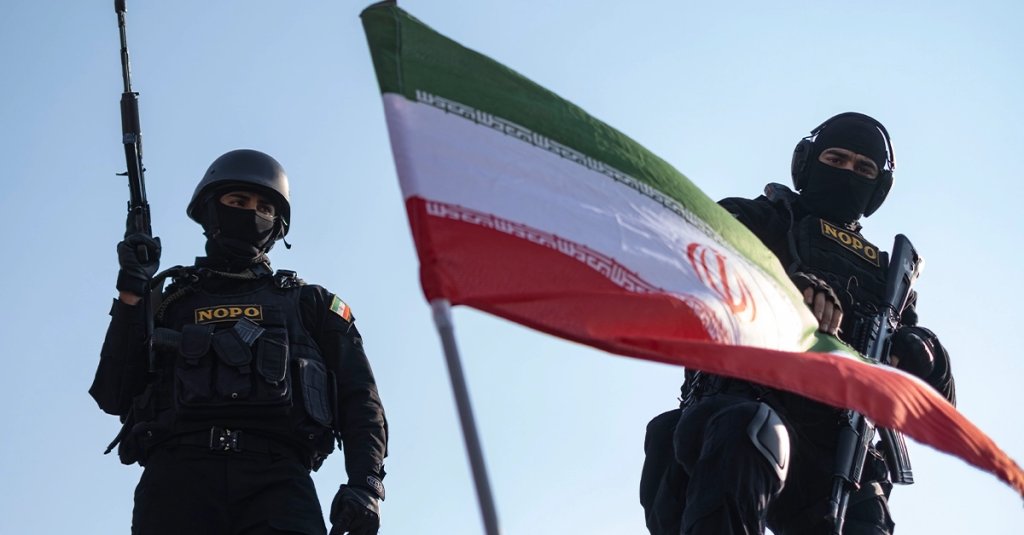
This article originally appeared on Radio Free Europe/Radio Liberty.
Even as U.S. President Donald Trump threatens to strike Iran, he has repeatedly called on Tehran to “make a deal.”
Trump’s demands for an agreement are clear: Iran must end its nuclear program, limit its ballistic missile capabilities, and sever ties with armed proxies in the Middle East. In return, the United States will not attack Iran and remove crippling sanctions.
If the Islamic republic does not accept those terms, Trump has warned that the country will suffer consequences “far worse” than last year, when the United States joined Israel in bombing Iran’s nuclear sites.
Related: The military options the US has to use against Iran
Experts say it is unlikely that Iran will accept Trump’s maximalist demands, which would mark a reversal of decades of policy and amount to capitulation in the eyes of Tehran.
The United States has deployed key military assets, including an air carrier and additional bombers, to the Middle East in recent days.
Trump has also ratcheted up economic pressure on Tehran by announcing a 25 percent tariff on any country doing business with Iran and imposing new sanctions.
The U.S. president has threatened to carry out a military strike on Iran since nationwide protests erupted in late December 2025 and the authorities launched a violent crackdown that killed thousands of demonstrators.
U.S. Military Action Is ‘Likely’
Trump on Jan. 28 said he wanted a “fair and equitable deal” that ensured Iran will have “no nuclear weapons.” Tehran has long claimed that its nuclear program is peaceful.
But the nuclear file is only one of several U.S. demands. Trump, according to reports, has also insisted that Iran must accept caps on its ballistic missile program and end its support for pro-Iranian armed groups in Lebanon, Iraq, Yemen, and the Palestinian territories.
Tehran possesses short-range missiles that threaten U.S. military bases and commercial interests in the Persian Gulf and advanced medium-range missiles that can reach Israel, a key US ally.
Experts say Trump is seeking to exploit the unprecedented weakness of Iran’s clerical establishment to force Tehran into making wide-ranging concessions.
Iran’s rulers have been weakened by a worsening economic crisis and weeks of nationwide protests that posed the biggest threat to their power in years. Israel has also degraded the military capabilities of Tehran’s allies, including Lebanon’s Hezbollah, Yemen’s Huthi rebels, and US-designated Palestinian terrorist group Hamas.
“Some U.S. officials see this moment as an opportunity to pressure Tehran into concessions on nuclear limits, regional behavior, and missile capabilities,” said Alex Vatanka, Iran program director at the Washington-based Middle East Institute.
“Collapse Of The Islamic Republic”
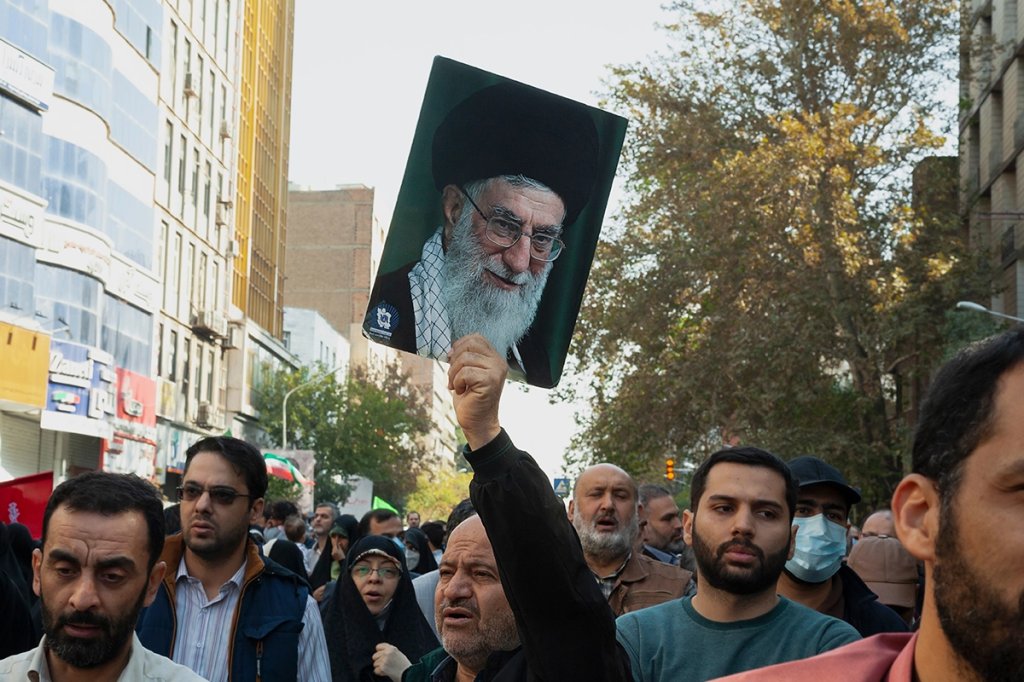
Iranian officials, including Foreign Minister Abbas Araqchi and parliament speaker Mohammad Baqer Qalibaf, have said Tehran is open to talks but alleged Washington is not interested in a fair agreement.
Iran’s Supreme Leader Ayatollah Ali Khamenei would be “very skeptical and resistant to accept” Trump’s demands “as he would perceive acceding to them as paving the way for the collapse of the Islamic republic,” said Jason Brodsky, policy director at the Washington-based United Against Nuclear Iran.
In the absence of a deal, Trump is “very likely” to authorize military action against Iran, said Brodsky, pointing to the president’s rhetoric and the U.S. military buildup in the region.
“This is a very similar pattern of statements and actions that resulted in the 12-day war in June and the US seizure of Nicolas Maduro in Venezuela,” he said. “President Trump alternates between confrontational and conciliatory statements to throw the Iranian regime off.”
Brodsky said the objectives of military action would be to hold Iran accountable for its bloody crackdown on protesters, deter its behavior in the region, and erode its military capabilities.
He added Trump could view “further military action as the prelude to an eventual deal down the line.”
Vatanka offered a more cautious assessment, arguing there are “still reasons for the United States to think twice.”
He emphasized that “the Pentagon knows any strike could trigger a regional chain reaction” involving Iran’s allied armed groups and proxies.
The “This is a very similar pattern of statements and actions that resulted in the 12-day war in June and the US seizure of Nicolas Maduro in Venezuela,” he said. “President Trump alternates between confrontational and conciliatory statements to throw the Iranian regime off.”
Brodsky said the objectives of military action would be to hold Iran accountable for its bloody crackdown on protesters, deter its behavior in the region, and erode its military capabilities.
He added Trump could view “further military action as the prelude to an eventual deal down the line.”
Vatanka offered a more cautious assessment, arguing there are “still reasons for the United States to think twice.”
He emphasized that “the Pentagon knows any strike could trigger a regional chain reaction” involving Iran’s allied armed groups and proxies.
The US military buildup in the Middle East, he suggested, could be “mostly defensive or aimed to pressure Tehran on the diplomatic track, rather than [bring about] regime change.” military buildup in the Middle East, he suggested, could be “mostly defensive or aimed to pressure Tehran on the diplomatic track, rather than [bring about] regime change.”
Kian Sharifi is a feature writer specializing in Iranian affairs in RFE/RL’s Central Newsroom in Prague. He got his start in journalism at the Financial Tribune, an English-language newspaper published in Tehran, where he worked as an editor. He then moved to BBC Monitoring, where he led a team of journalists who closely watched media trends and analyzed key developments in Iran and the wider region.
Copyright (c) 2026. RFE/RL, Inc. Reprinted with the permission of Radio Free Europe/Radio Liberty, 1201 Connecticut Ave NW, Ste 400, Washington, DC 20036.