
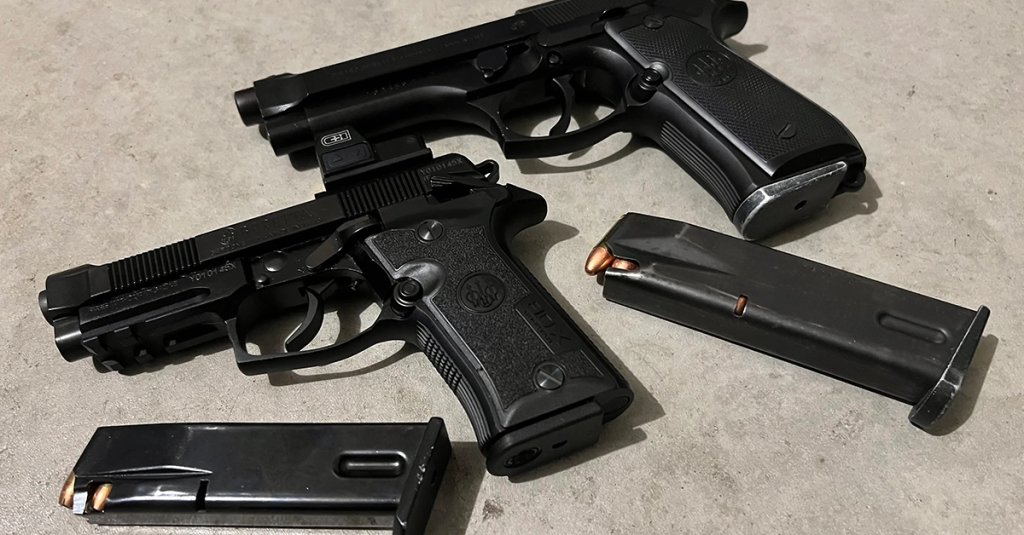
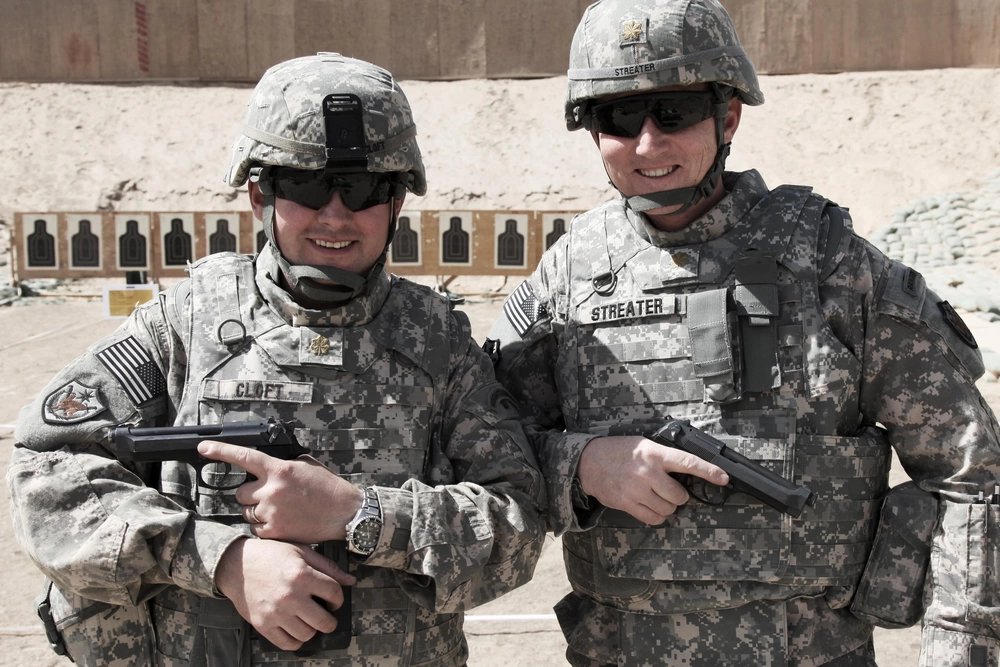
Veterans who served from the mid-1980s up to today will likely be familiar with the iconic 9mm Beretta M9. Despite the formal adoption of the SIG Sauer M17/M18 handgun as the official U.S. military sidearm in 2017, the M9 remains in some active duty arms rooms and, as of 2026, service members are still qualifying with the weapon.
Also Read: America’s last combat revolver served from World War I to Vietnam
Although the M9 has proven itself to be extremely robust and reliable, the platform has its drawbacks. The weapon’s size and weight can both be issues for shooters with smaller hands and it can be difficult to carry concealed (at least, comfortably).
That’s why the military adopted the SIG Sauer P229 (as the M11), the compact version of the P226 that went up against the Beretta in the XM9 trials for troops whose duties required a concealed sidearm. But for some service members and veterans, the M9 is the only pistol they’ve ever learned to operate.
Not all veterans are firearm enthusiasts and choosing a single firearm to put in a bedside safe and carry in a holster can be difficult. If you’re wanting to make use of that formal military training off duty or after you get your DD-214, the M9 makes a good home defense gun, but might not be the best choice for everyday concealed carry (even if you tape it to your back “Die Hard” style like John McClane).
Luckily, Beretta has an alternative that provides the familiarity of the M9 in a more compact package.
If the M9 is Dr. Evil, the 80X Cheetah is its Mini-Me. An evolution of the 80 Series of Beretta pistols, the 80X takes the same form and function of the M9 and delivers them in a more ergonomic and concealable pistol.
Of course, as Marine veteran and firearms instructor Clint Smith famously said, when it comes to handguns “For carrying, none are too small; for fighting, none are too big.”
The 80X works itself into a sort of Goldilocks spot between the full-size M9 and a micro-compact pistol that disappears into a pocket, but tries to jump out of your hands when you pull the trigger.
Unlike the M9 with its falling block mechanism, the 80X uses a straight blowback design. Chambered in .380 ACP or convertible to .32 ACP, the slide is easy to rack and recoil is very controllable, even without a delayed recoil system. Integrating Beretta’s Vertec design, the 80X uses a slimmer grip that allows even small-handed shooters to control the weapon with confidence.
Moreover, the magazine release, slide stop/release, and frame-mounted, ambidextrous safety-decocker are all reachable without breaking your grip.
The safety-decocker is the one feature that troops trained on the M9 will find different on the 80X. Although the M9’s slide-mounted safety was designed to allow the same downward sweep as the 1911 to disengage it, the actual forward and clockwise rotation could confuse some shooters. Moreover, manipulating the slide from the rear could inadvertently sweep the safety on and decock the pistol.
The frame-mounted safety-decocker of the 80X provides a more ergonomic and intuitive control carried over from legacy 80 Series pistols. It also gives the shooter a thumb ledge when using a modern shooting grip.
Despite the best efforts of fudds, red dot sights on pistols are here to stay. Even huge bureaucratic agencies like the military and large metropolitan police departments are getting with the times and issuing red dots on sidearms. While the 80X comes with a familiar and solid set of iron sights, the rear sight can be removed for an optic plate.
Natively, Beretta offers a plate to allow the mounting of red dots that utilize the Holosun 407K footprint.
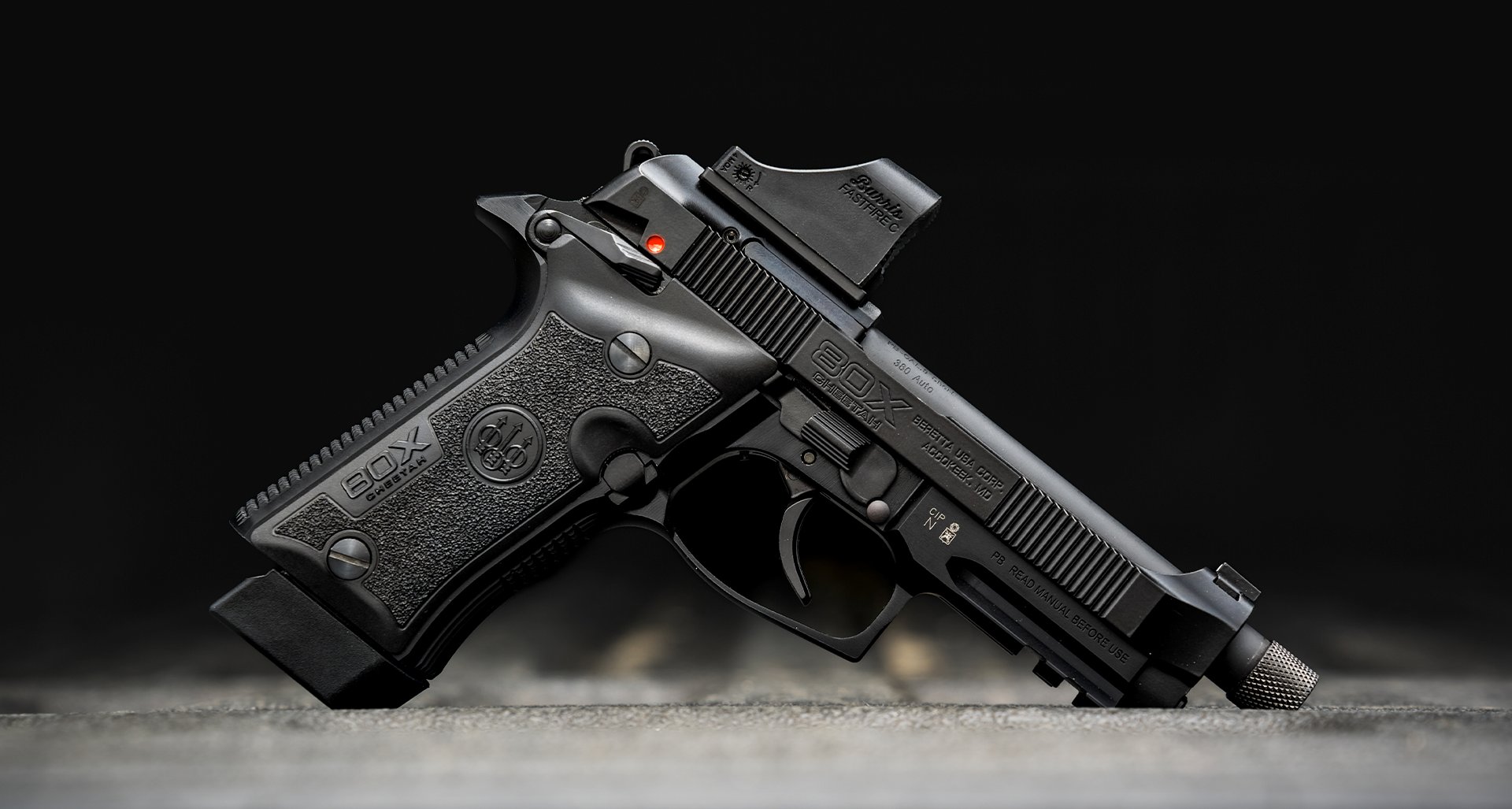
Similar to the Shield RMSC footprint, this has quickly become the industry standard for handguns with thin slides that can’t accommodate the larger Trijicon RMR footprint. The plate secures to the slide with two screws while another two screws and two recoil bosses hold the red dot to the plate.
While not as optimal as a direct mount to the slide, proper application of blue Loctite and prescribed torque kept the optic in place and zeroed for over 500 rounds, including hollowpoints. A red dot also provides another manipulation point to work the slide, as long as you let that Loctite cure and torqued the screws correctly.
While the Holosun 407K offers good value for its price, the 6 MOA dot can make precise shots difficult and the 507K with the smaller dot and selectable outer ring drives the cost up. At the same price point as the 407K, C&H Precision offers their EDC red dot with RMSC footprint.
Notably, C&H’s EDC comes with 50,000 hours of battery life at its lowest setting, automatic shutoff after 5 minutes of no movement to preserve its CR1632 battery, automatic on when it detects movement, and a slightly larger window than the Holosun. Most importantly, the EDC’s multi-reticle system allows the user to select a more precise 3 MOA dot, a 26 MOA outer circle for a flash sight picture, or both the dot and circle for new dot users.
While .380 is deemed anemic by some modern shooters, consider that it was a standard concealed carry cartridge for much of the 20th century. Moreover, FBI ballistic testing revealed that today’s .380 ACP self-defense loads from Federal, Hornady, and Speer can consistently meet the Bureau’s requirements for bullet penetration and expansion.
While the 80X can be converted to .32, maybe stick with .380 if the 80X is going to be your one-and-done handgun.
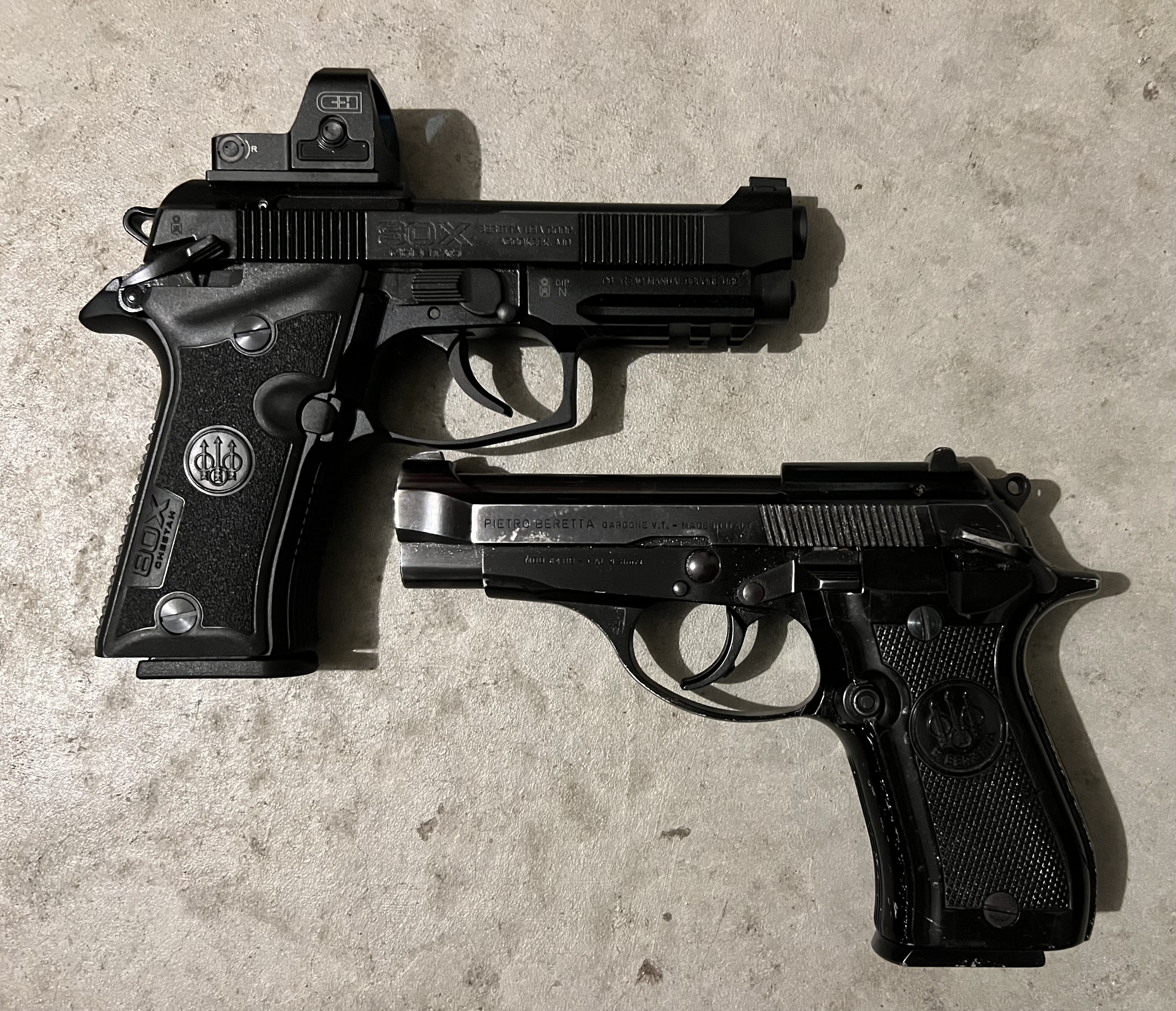
The 80 Series that the 80X evolved from was popular with European law enforcement, especially in its home country of Italy. Many of these pistols have been surplussed and continue to be imported into the U.S. providing plenty of Italian-made, 13-round magazines.
While Beretta notes that the 80X is not mechanically interchangeable with the older .380 ACP 84 Series, my testing found that Beretta 84 double-stack .380 magazines worked perfectly in the 80X. The modern Cheetah is available with standard 13-round or 15-round magazines, or state-compliant 10-round magazines.
Further bringing the Cheetah into the 21st century, the 80X comes with a MIL-STD 1913 rail to mount light and/or laser and can be had with a threaded barrel. With most factory .380 ACP loads being naturally subsonic and the 80X using direct blowback, it’s a perfect suppressor host.
Not only does this reduce the concussion that the shooter is exposed to, but the reduction of the suppressor tax stamp to $0 makes it even easier to obtain an affordable 9mm can (which has the same bore diameter as .380) for training on the range or to avoid hearing damage in a home defense situation. With an optic plate raising the red dot on the slide, you can still acquire a sight picture over a modestly sized suppressor.
Shooting is a perishable skill; even if you qualified with the M9 in the military, it’s important to remain proficient with a personal weapon that you trust with your life. Most people who carry a micro-compact pocket pistol likely don’t train with it much. The 80X provides a full grip for most shooters’ hands and, at 25 ounces unloaded, is easy to shoot for a full day of training without being too heavy to carry comfortably.
It’s even available in multiple colors from FDE for Tactical Timmys to legally-different-from-Tiffany Blue to match your knockoff Rolex. If you carried an M9 in the military and are looking for a single handgun for home defense, concealed carry, and target shooting, consider the 80X.
Don’t Miss the Best of We Are The Mighty
• Stormin’ Norman’s Beretta M9 from Desert Storm is going up for auction
• The Colt Detective Special was America’s concealed carry through Vietnam
• Beretta’s Marine Corps 250th birthday shotgun is a vibe


Loading comments…
Comments couldn’t be loaded. Please refresh the page.