
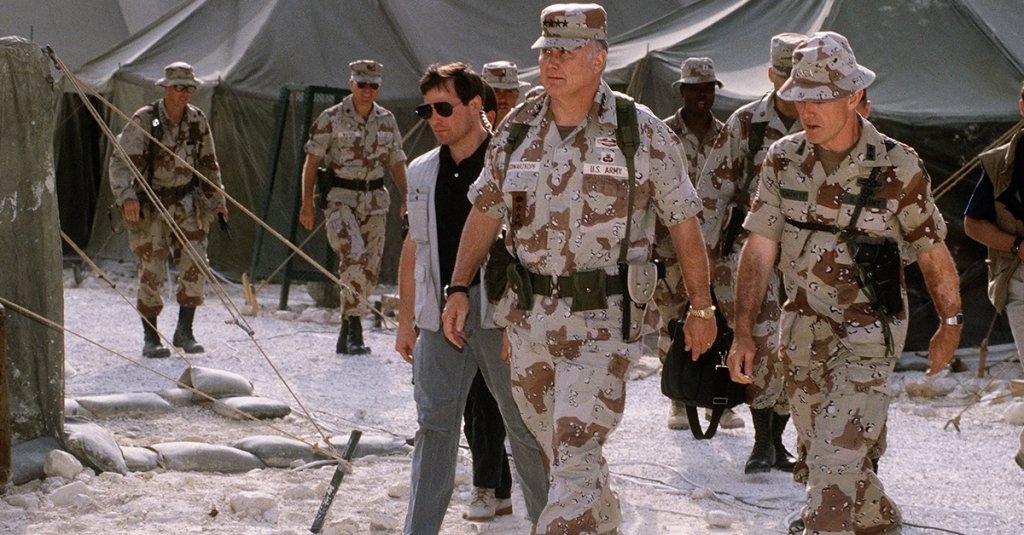
Yes, you read that right: Norman Schwarzkopf’s Beretta. The handgun that was on the hip of one of America’s most famous generals during one of the nation’s most significant modern military operations could soon be yours.
Imagine having the opportunity to bid on Andrew Jackson’s sword from the Battle of New Orleans or Teddy Roosevelt’s Colt 1892 revolver from his assault on Kettle Hill. Going straight from his family’s possession to the auction block, the sale of Gen. Schwarzkopf’s Desert Storm M9 is unprecedented.
Also Read: Gen. Norman Schwarzkopf wore two watches and it’s still a vibe
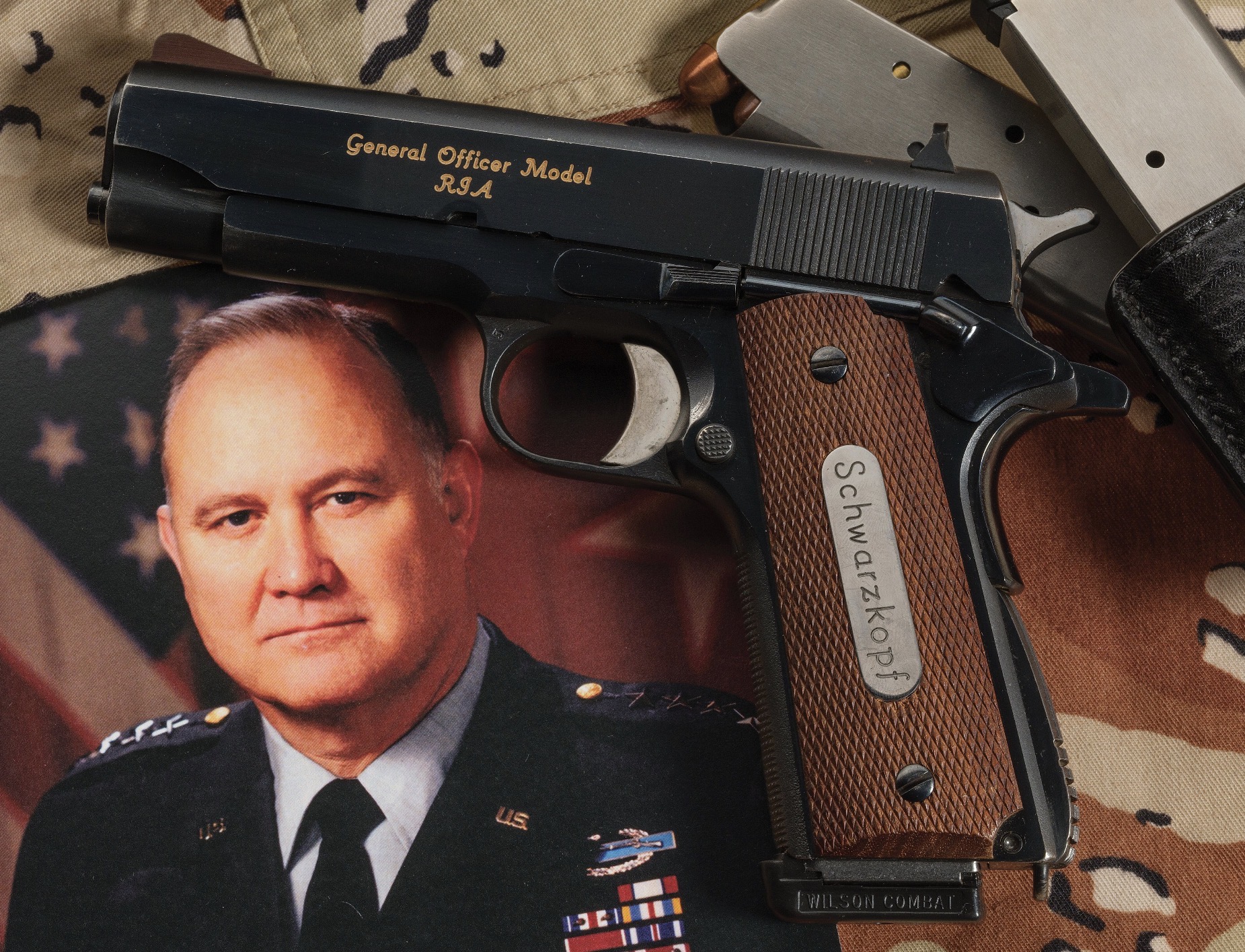
A West Point graduate, Schwarzkopf had a truly distinguished career that took him from the jungles of Vietnam to the invasion of Grenada. During that time, the U.S. military went through an evolution that saw Hueys replaced with Black Hawks and the .45 ACP 1911 replaced with the 9mm M9.
Schwarzkopf was originally issued an M15 General Officer’s Pistol, a shortened version of the standard issue 1911, when he earned his first star in 1978; that pistol was carried by Schwarzkopf in Grenada. Following the adoption of the M9 as the military’s new sidearm, he was also issued a General Officer’s version of the Beretta.
First adopted in 1911, the 1911 pistol was a revolutionary military weapon. At the time, many world powers were still issuing revolvers, if not black powder revolvers. With seven rounds of horse-killing (remember, cavalry still rode horses back then) .45 ACP on tap and easily reloaded with a detachable box magazine, the 1911 gave American troops a handy and powerful sidearm in the Philippines, on the Pancho Villa Expedition, and the trenches of World War I.
Although the 1911 continued to stack bodies during World War II, 9mm handguns and their ability to carry more ammo became more popular with militaries. Despite the NATO standardization on 9mm in 1955, the U.S. military continued to issue the 1911 and its .45 ACP ammo. That is, until 1985.
With its World War II-era (and even some World War I) 1911s getting long in the tooth and the nagging of NATO standardization, the U.S. military held the XM9 trials to adopt a new 9mm handgun. The winner was the Beretta 92F, later updated to the 92FS, which was adopted as the M9. With 15 rounds of 9mm, the Beretta offered increased capacity over the 1911’s seven rounds. Saving the argument of power versus capacity, the M9 did bring the U.S. military into compliance with NATO.
Although initial M9 deliveries came from Beretta’s factory in Italy, the awarding of the U.S. contract required eventual manufacturing in the states and production was spun up in Maryland. Over 600,000 M9s were delivered to the U.S. military, but only a reported 555 were General Officer’s Pistols bearing a “GO” prefix. Of those 555, only one was issued to Stormin’ Norman and carried by him during the Gulf War.
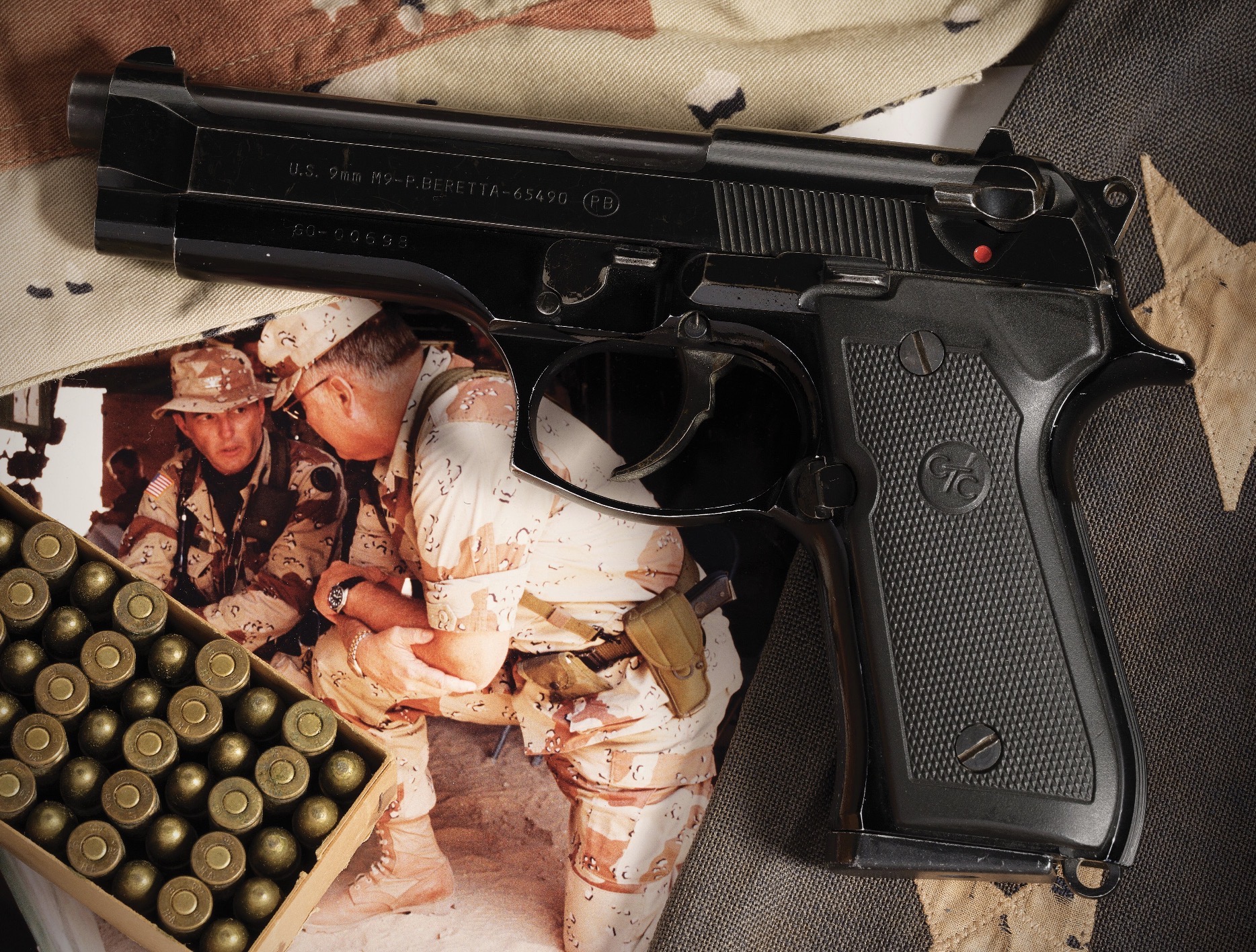
As the Commander of U.S. Central Command, Schwarzkopf led U.S. and Coalition forces during Operations Desert Shield and Desert Storm. With increased military media coverage, Schwarzkopf was famously photographed wearing one watch on each wrist and carrying his M9 on his left hip (yes, Stormin’ Norman was a lefty and his M9 has its magazine release on the right side of the frame). Notably, Schwarzkopf carried his M9 in a standard OD green or “chocolate chip” M12 holster rather than the black leatherette Officer Model holster.
This historic sale is being conducted by Rock Island Auction. Despite being carried in the desert, RIA curators note that Schwarzkopf’s M9 has 90% of its original phosphate and anodized finishes. The listing also includes a Beretta-marked magazine, the black leatherette General Officer belt rig, holster, and dual magazine pouch with an extra magazine. Securing the M9’s provenance, a letter from Schwarzkopf’s daughter is including attesting that the pistol was carried by her father during the Gulf War.
What’s not original to the gun are its Crimson Trace laser grips. Replacing the standard plastic Beretta grips, these must have been added by Schwarzkopf after he retired in 1991 since Crimson Trace didn’t release laser grips for the Beretta 92 until the late 1990s. The fact that Schwarzkopf added these may suggest that he continued to carry, or at least use, his M9 into retirement.
Unsurprisingly, RIA estimates that Norman Schwarzkopf’s Beretta will hammer between $60,000-90,000. His M15 was estimated to sell for between $9,500-15,000… it sold for $70,500.
Don’t Miss the Best of We Are The Mighty
• 21 facts about the First Gulf War
• Why the US government had to pay Beretta after awarding them the M9 contract
• What the Soviet Union thought as it watched Operation Desert Storm
Loading comments…
Comments couldn’t be loaded. Please refresh the page.