
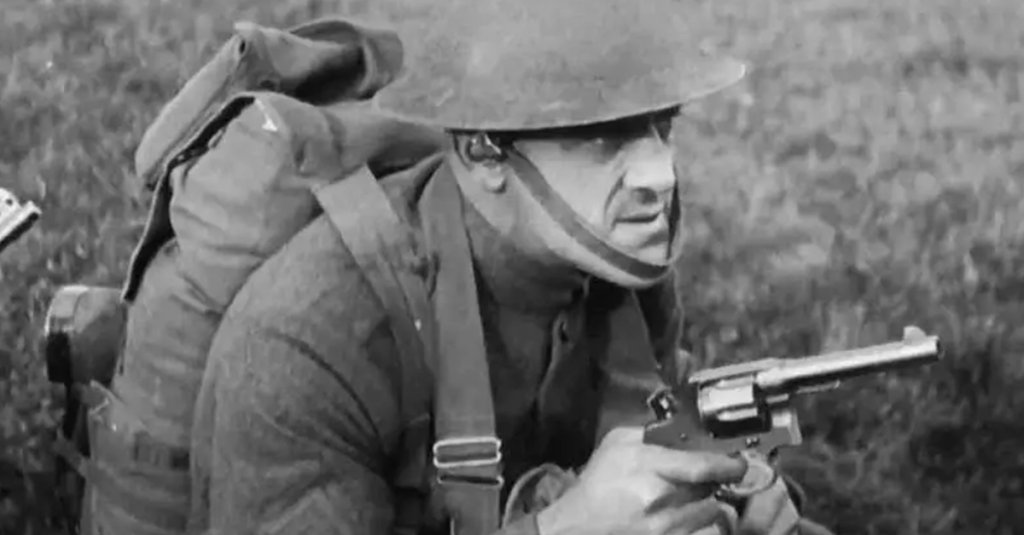
Americans tend to be thought of as gun-toting cowboys with a “big iron” on their hips. This might stem from the nostalgia of the “Wild West” that led to a boom of 1950s and 1960s Westerns in American pop culture. It might also stem from a romanticized version of the actual Wild West of the late 19th century.
Also Read: The Colt Detective Special was America’s concealed carry of choice through Vietnam
In fairness, the U.S. military has had a long-standing relationship with the classic six-shot revolver. From the Colt 1848 Dragoon to the Single Action Army, the American soldier’s sidearm for latter half of the 19th century was a big-bore wheel gun.
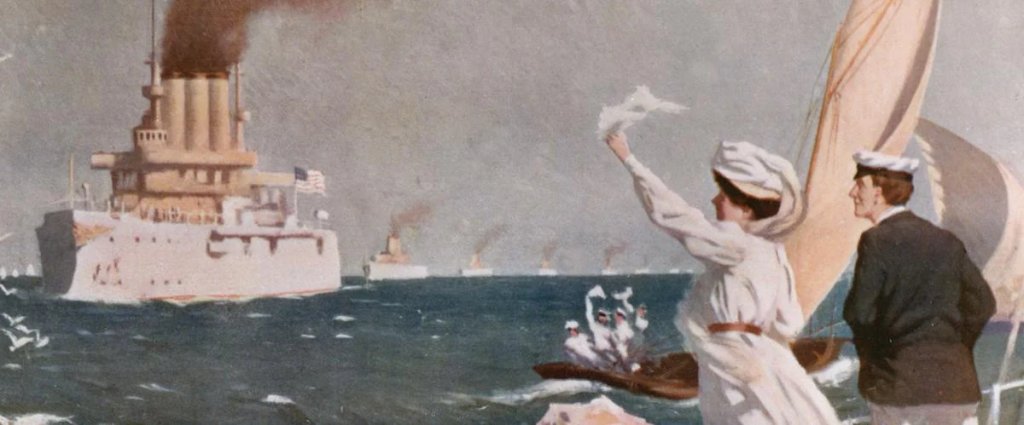
At the turn of the 20th century, the United States was evolving from an emerging nation to a real player on the world stage. It acquired colonies following the Spanish-American War of 1898 and the U.S. Navy’s Great White Fleet was on a world tour of power projection from 1907 to 1909.
As part of the military’s modernization, the M1911 automatic (now known as semi-automatic) pistol was adopted. At a time when revolvers were the standard and self-loading pistols were brand new, this was a revolutionary change for the U.S. military. Additionally, the new .45 ACP bullet that the pistol chambered meant a huge logistical shift away from revolver ammo. This became a problem when war were declared.
On April 6, 1917, following the sinking of a civilian passenger ship (don’t touch our boats) and publication of Germany’s Zimmerman Telegram that offered Mexico an alliance to attack the U.S., America entered World War I to kick German butt. But, despite having been adopted in 1911, the military didn’t have enough M1911s to arm the millions of draftees and volunteers that quickly entered the ranks to fight the Hun.
The reason they didn’t have enough was that Gen. John J. “Blackjack” Pershing wanted to equip every soldier in the American Expeditionary Forces with a sidearm in addition to their primary weapon. Luckily, the American war industry was already spooled up.
Prior to America’s entry into the war, companies like Colt and Smith & Wesson were already producing weapons for Entente Powers like the British and Russian Empires. These production lines were simply switched to supply the U.S. military.
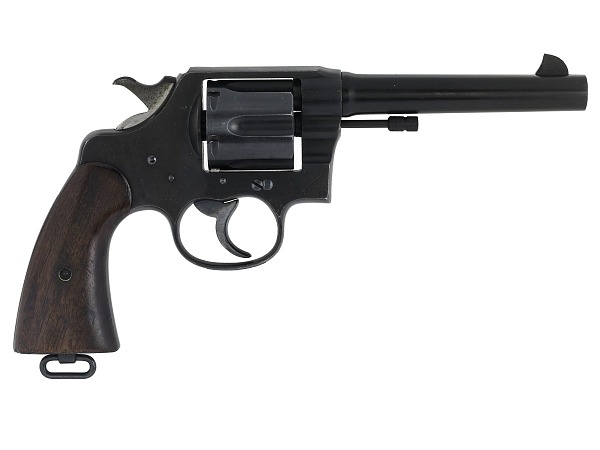
Notably, America fielded more M1917 Enfield rifles, based on the British 1913 Enfield, than M1903 Springfield rifles. Colt’s New Service and Smith & Wesson’s 2nd Model Hand Ejector revolvers were already in production and could augment M1911 pistols in U.S. service. There was just one problem.
Remember that new .45 ACP handgun cartridge? It’s rimless so that it can easily feed a self-loading pistol from a magazine. While the large-frame Colt and Smith revolvers could handle the pressure of the .45 ACP, there needed to be a way to hold the cartridge at the back of the cylinder like traditional rimmed revolver cartridges.
Joseph Wesson is credited with the solution: the patented half-moon clip which allows the use of non-rimmed cartridges in a revolver’s cylinder.
The ejector could now actuate on the clips to eject spent cartridges and loading two clips of three rounds each was easier than loading six rounds individually. A shoulder was also machined into the cylinder for the case of the .45 ACP to sit in the correct position for firing, but relying on the shoulder without clips this meant that spent cases had to be pried or poked out one at a time.
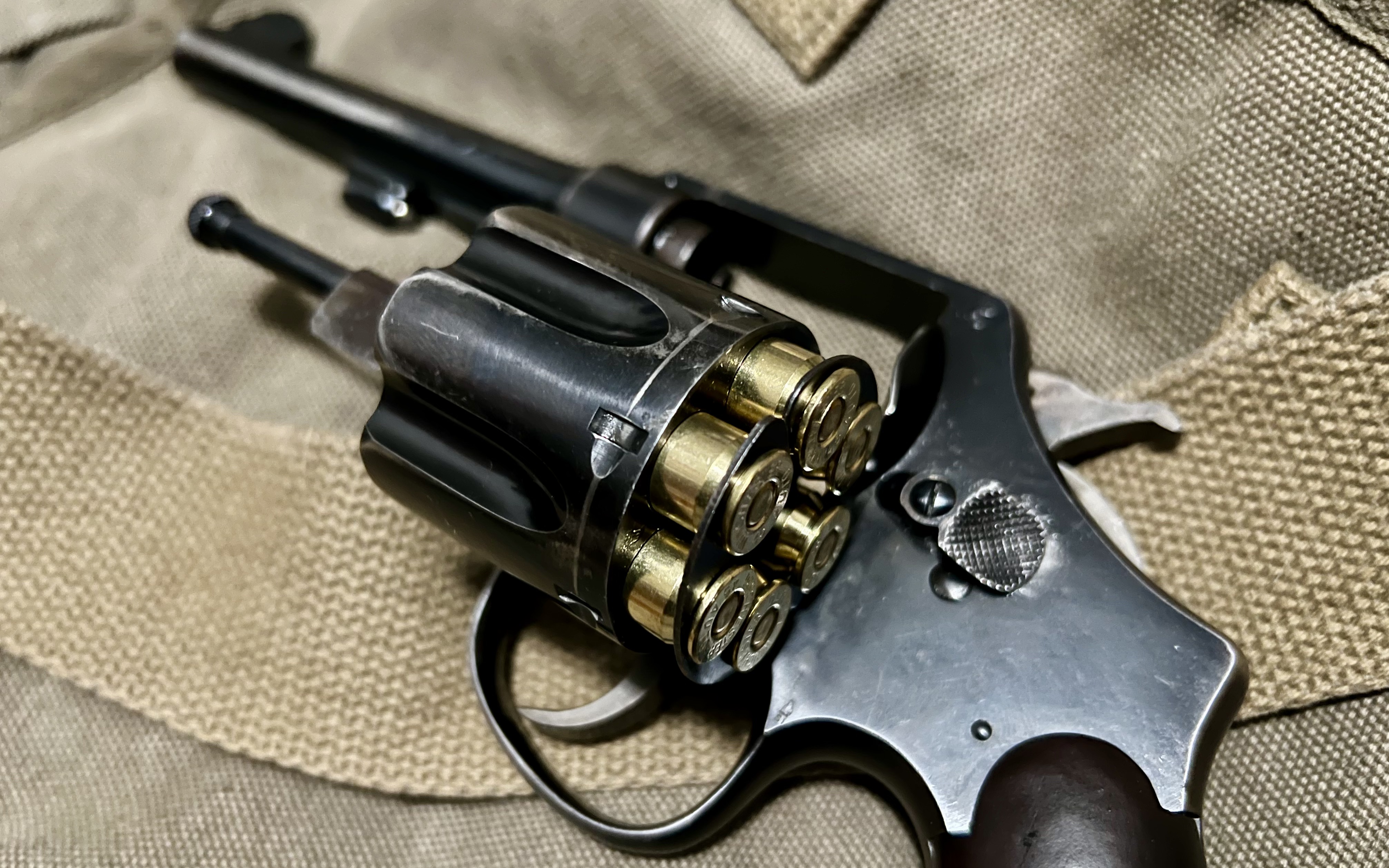
The U.S. military awarded Smith & Wesson a contract for its Hand Ejector revolver and moon clip on the condition that Colt be allowed to use the clip patent for its New Service. Other companies also produced the stamped steel clips for the military. With ammunition logistics solved, the U.S. military adopted both the Smith and the Colt as the M1917 revolver.
Though visually similar to a casual observer, the two pistols were mechanically different and were separately recorded and tracked by armorers and property book holders. Notably, the Colt cylinder turns clockwise and its release is pulled back while the Smith cylinder turns counterclockwise and its release is pushed forward.
During World War I, M1917s saw limited frontline use, instead intended to free up M1911s to go to the trenches. Those that were sent to the front were often carried by machine gun crews. Interestingly, future-president Harry Truman was issued both an M1917 and M1911 while serving as an artillery officer.
In total, about 300,000 M1917s were built, split roughly in half between Colt and Smith. Most of these were produced in the latter half of 1918 in anticipation of the Spring Offensive of 1919 that never occurred. Orders continued to be filled after the Armistice to prevent the collapse of the American firearm industry that had expanded to support the planned offensive.
Though some M1917s were surplussed out of the military after World War I or snuck home in duffel bags, nearly 200,000 were still in armories when America entered World War II. Again, they were mostly issued to rear echelon or stateside troops, but were chosen over M1911s by some who preferred a revolver to a semi-auto.
Those M1917s that did see frontline service were often carried by vehicle and artillery crews. Perhaps the most notable depiction of this in media is the use of a Smith & Wesson M1917 by Sherman tank commander Staff Sgt. Don “Wardaddy” Collier (who would later be immortalized by Brad Pitt in “Fury”).
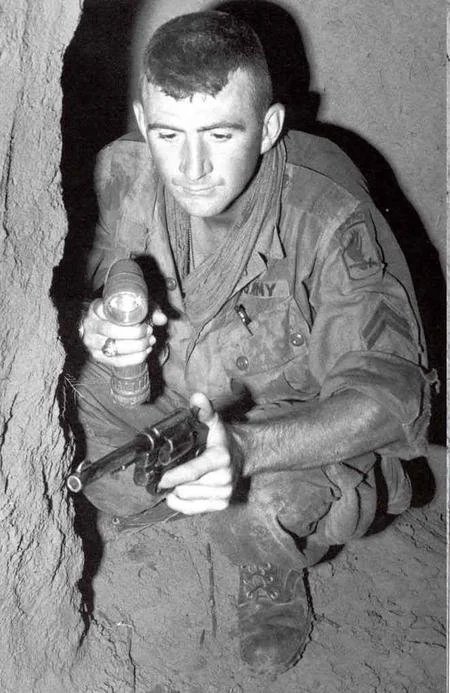
Remaining in U.S. military inventory, the M1917 saw its final and perhaps most intense action in Vietnam. Some helicopter crew members were issued M1917s with moon clips, but tunnel rats specifically sought out the vintage six-shooters. While clearing Viet Cong tunnels, the close-quarters fighting introduced the risk of the M1911’s slide being pushed back and out of battery.
“If you stick a revolver in Charlie’s gut, it’ll go bang when you pull the trigger,” a veteran tunnel rat told We Are The Mighty.
Outside of the military, surplus M1917s were used by law enforcement during the interwar gang era. In the 2019 film “The Highwaymen,” former Texas Ranger Frank Hamer (Kevin Costner) is depicted picking up a Smith & Wesson M1917 before hunting down Bonnie & Clyde.
Still not cool enough?
“Raiders of the Lost Ark” is one of the greatest films ever made, securing a spot in the Library of Congress’ National Film Registry. Indiana Jones (Harrison Ford), everyone’s favorite globetrotting archaeologist, famously fights with his whip and fists, but does pack a big iron when the situation calls for it (like when Ford has dysentery ahead of a scripted fight with a swordsman).
That iconic revolver was a shortened Smith & Wesson M1917/Mk II Hand Ejector.
Don’t Miss the Best of We Are The Mighty
• You could be the next owner of Darth Vader’s revolver
• Stormin’ Norman Schwarzkopf’s Beretta M9 from Desert Storm is going up for auction
• This classic carry pistol was used by gangsters, generals, SWAT, and spies
Loading comments…
Comments couldn’t be loaded. Please refresh the page.