

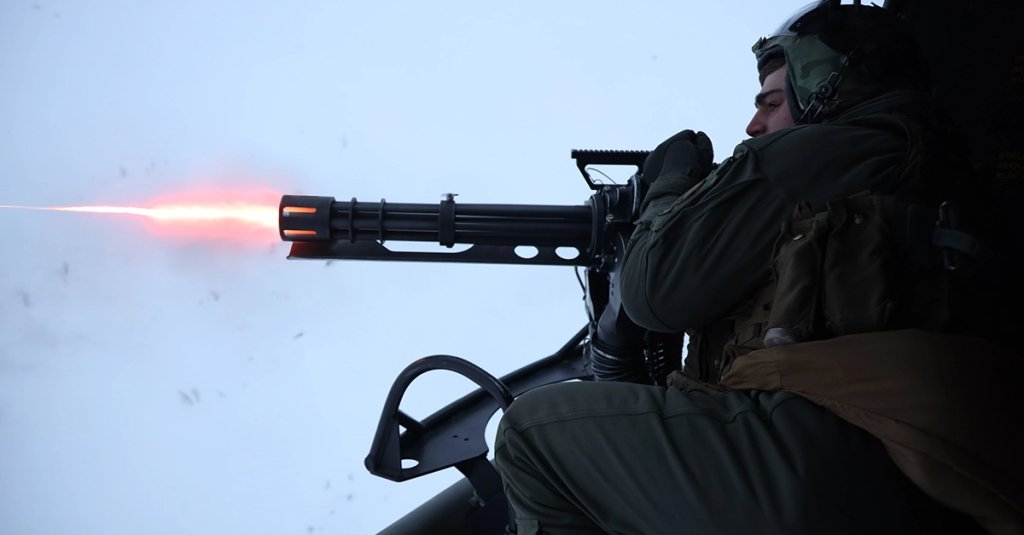
The M-134 “minigun” does not sound like a gun, really. A rifle pops and a machine gun thumps, but the thing rips. One long, flat, ripping note with no gaps in it; like reality being unzipped, ending in a solid rope of tracer where a target used to be. Its report lands in your sternum before your ears catch up. If you have ever stood near one, you did not hear shots as much as feel them.
Read Next: Your standard rifle can now be an anti-drone weapon. Seriously.
Humans have been arguing this question for longer than 160 years; why fire from one barrel when you can fire six? It’s an excellent question, too; a similar question was probably grunted by our legendary ancestors, who instead asked why throw one rock at that creature’s head when you can throw six? Or 6,000.
Some will say this is simply a story about a gun; however, it is a story about family, a bloodline of spinning-barrel weapons across three centuries, and the trait that runs through all of them. They refuse to quit. They refuse, specifically, to do the thing every other gun on earth can do at the worst possible moment.
They refuse to jam.
Dr. Gatling’s Rapid-Firing Invention
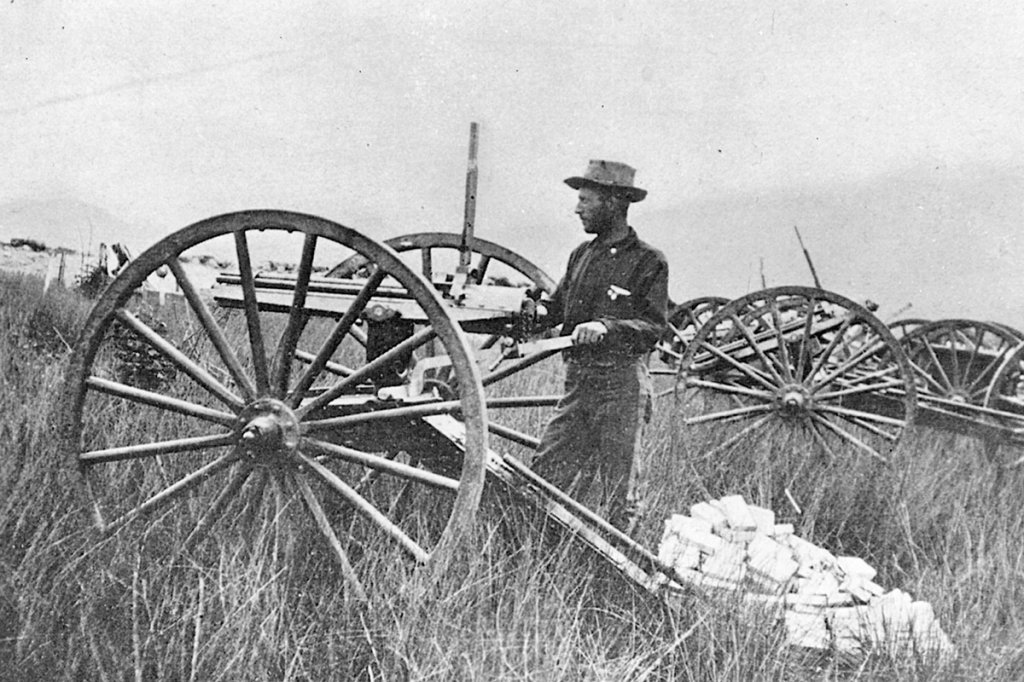
It starts, like so many of these stories, with a man who thought he was saving lives. Dr. Richard Gatling patented his gun on Nov. 4, 1862, in the middle of the Civil War, after watching trainloads of soldiers die, most of them not from bullets but from disease, infection, and exposure on the way to the fight.
His logic, written down years later, was dark, but almost tender: if one man with the right machine could do the battle duty of a hundred, armies could shrink, and fewer men would have to die. He was wise, but unbelievably wrong about the dying part.
What he built was six barrels around a central shaft, fed by gravity from a hopper and spun by a hand crank, throwing around 200 rounds a minute when a good soldier managed five. The hand-crank era faded once single-barreled guns like the Maxim did the same job on their own. It didn’t really make a difference in the Civil War, but the idea didn’t die.
It would slumber for half a century.
Project Vulcan
By the time the United States entered the war in Vietnam, machine guns had already made their mark on modern warfare and jet engines changed the tempo of combat. Aircraft had gotten so fast that a single-barrel cannon could not fling bullets quickly enough to catch them in the half-second they stayed in your sights.
By June 1946, the Army had handed General Electric a contract for Project Vulcan, Gatling’s old idea rebuilt for the jet age. GE soldered an electric motor where the hand crank used to be and let it run.
After years of prototypes in ridiculous calibers, the 20mm version was standardized in 1956 as the M61 Vulcan, a six-barrel cannon firing up to 6,000 rounds a minute.
It first went to war in April 1965 in the nose of an F-105 Thunderchief over Vietnam, and some version still rides in the F-15, the F-16, the F-22, and the Navy’s F/A-18. This is the weapon that owns the name. When you hear the word”Vulcan,” they’re either talking about “Star Trek” or this 20mm cannon.
Putting the “Mini” in “Minigun”
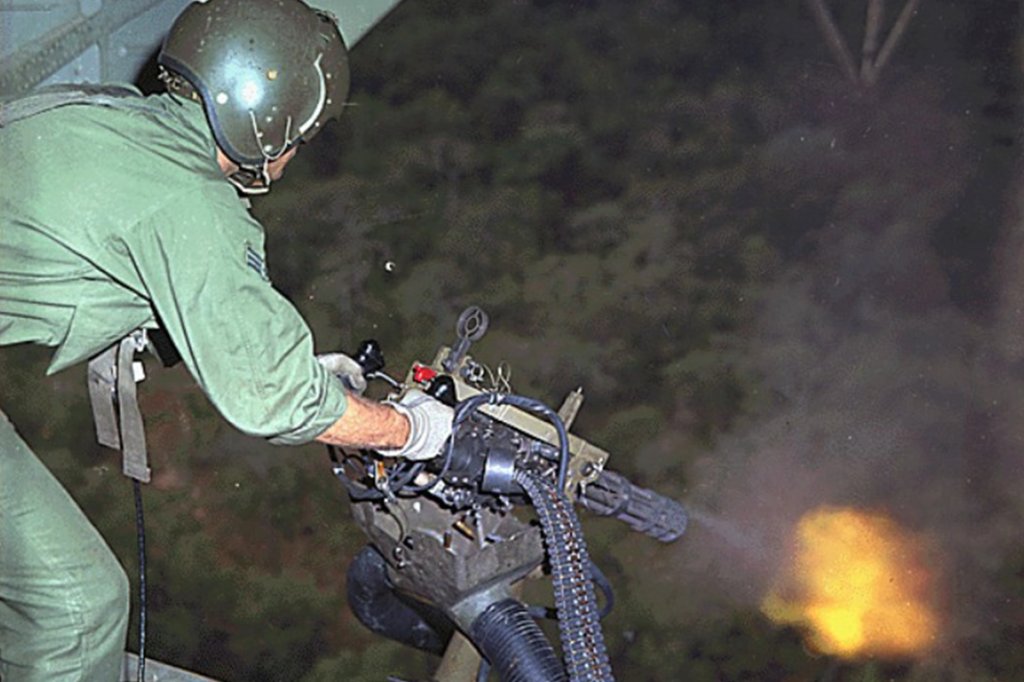
GE would go on to build a smaller one, accidentally creating a masterpiece. When helicopters started getting shot down over Vietnam, the military needed a gun light enough to hang in a door and fast enough to saturate a treeline. GE took the 20mm Vulcan and shrank it to fire the 7.62mm rifle round.
They called it the Minigun, “mini” because it was the little brother of the 20mm cannon and “gun” because it fired rifle bullets instead of cannon shells. Designated the M134 and the GAU-17/A in Navy and special operations hands, it ended up on Huey door mounts, on the AC-47 gunships nicknamed “Spooky” and “Puff the Magic Dragon,” and on the riverine boats.
To the men underneath it, the minigun was that tearing sound and the rope of red light. It never really retired either. Dillon Aero builds a modern titanium version today.
The Big Boys
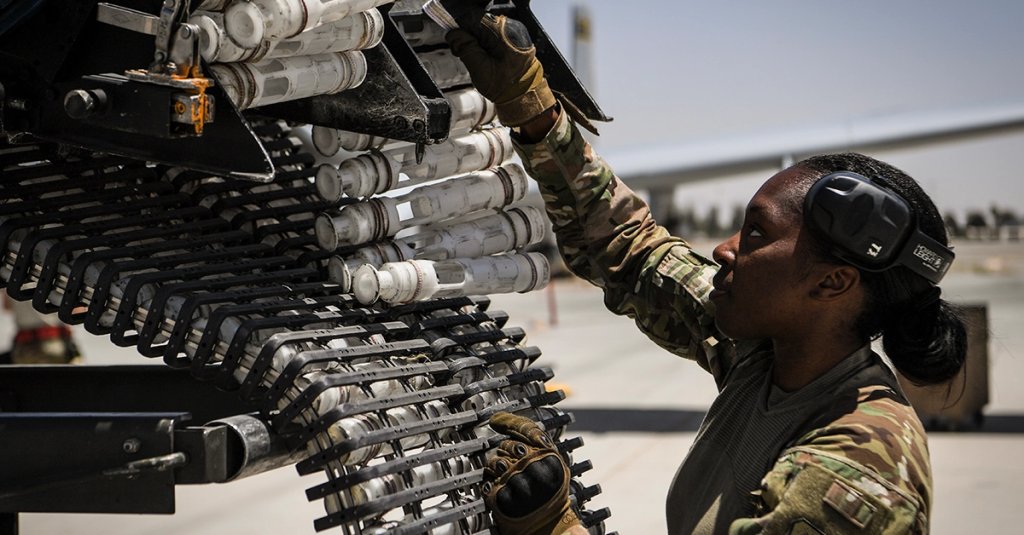
The bloodline branched, and some of the children grew up farm strong. The biggest is the GAU-8 Avenger, the 30mm seven-barrel cannon in the nose of the A-10 Thunderbolt II (the “Warthog”), source of the most beloved noise in close air support, the angry “BRRRRRT” that means somebody is contemplating the life choices that led up to that moment.
From it came the 25mm Equalizer on the Harrier and the AC-130, and from that the four-barrel GAU-22 inside the F-35, which carries the family’s most embarrassing chapter: the most expensive fighter ever built had a gun that could not shoot straight for years, firing rounds at about $131 apiece, roughly twenty-three grand to fill the magazine.
Then there is the cousin shaped like a hastily built R2D2. The Phalanx is an M61 bolted to its own radar and told to do its own thing, the last line against an incoming missile at sea and, as the land-based Centurion C-RAM, a gun that hurls 4,500 rounds a minute at rockets and mortars.
Why the M134 Doesn’t Jam
A normal gun runs on the violence of its own ammunition. The gas or recoil of each fired round works the action and chambers the next one, so a single bad round, a dud or a misfeed, can stop the whole machine cold. The rotary gun does not care, because it is driven from the outside. An electric motor spins the barrels and works the firing cycle, whether the ammunition cooperates or not.
Hand it a dud and the barrel rotates on, spits it out, and keeps going.
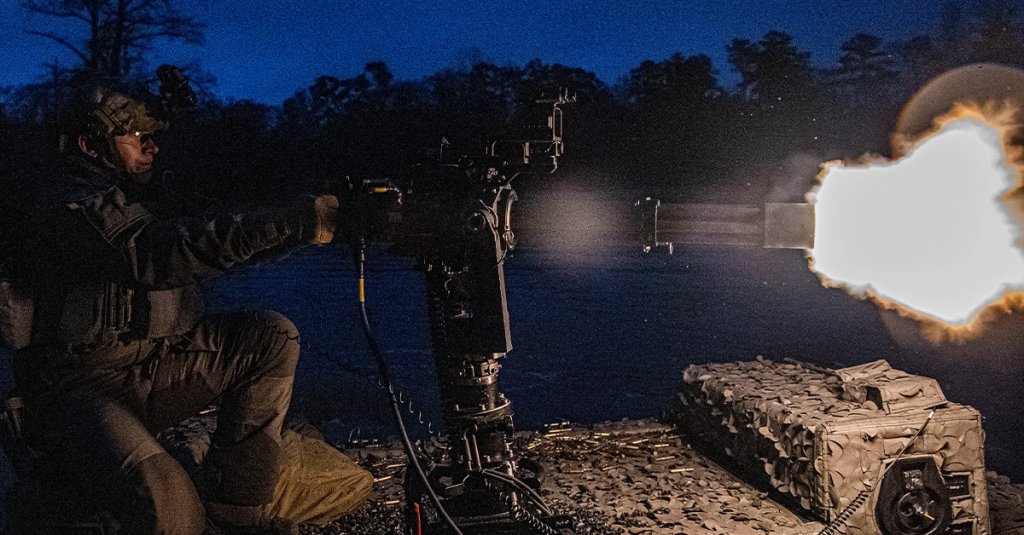
Six barrels also split the heat and the wear that would warp a single one. Now the honest part, because we are not in the myth business: it is not that these guns cannot fail. It is that they are gloriously indifferent to what can choke an ordinary weapon. Runaway guns and stoppages still happen.
None of this is free, of course. A gun firing 6,000 rounds a minute eats 100 every second, so trigger time on a fighter is measured not in magazines but in seconds. Hold it down, and a belt worth more than your car is gone before you finish the thought.
What’s Old Is New Again
For a while, the smart money wrote off the whole clan. Missiles took over air defense, the Army retired its M163 Vulcan air-defense vehicles, and the A-10 has been dodging the undertaker for a decade.
Then came the drones, and the math flipped. You cannot trade million-dollar interceptors against thousand-dollar drones forever, so a cheap wall of lead is the economical answer again.
Through 2025, American bases leaned on Phalanx and Land Phalanx Gatling guns to swat drones out of the sky, and the 2026 budget points toward $7.5 billion for counter-drones. Israel has looked at reviving its old M61 air-defense guns. Poland rolled out a four-barrel .50-caliber rotary gun running 3,600 rounds a minute after a Russian drone wandered into its airspace.
A Danish company is building, with a completely straight face, a Gatling-style rotary shotgun that throws 3,000 shells a minute at incoming drones. Richard Gatling would understand every bit of it. Throw enough barrels at the problem, and the problem goes away.
While the idea gets measured for a coffin about once a generation, and every time it walks back out of the funeral home. A hand crank in 1862. An electric motor in 1956. A radar and a brain in a trash can on a destroyer. A shotgun pointed at robots in 2026.
One stubborn idea to rule them all, one a doctor sketched while watching boys die of fever. Many barrels, one purpose, and a straight-up refusal to quit on you when the round in the chamber turns out to be junk. Other guns promise they will work. One day, the last of the Gatling family will fall silent; it will not be today, and probably not tomorrow.
Don’t Miss the Best of We Are The Mighty
• The grunt’s 250-year quest for a weapon that actually works
• American civilians donated personal weapons to the British during World War II
• Ukraine’s new drone weapon is basically a penis-shaped claymore



Loading comments…
Comments couldn’t be loaded. Please refresh the page.