
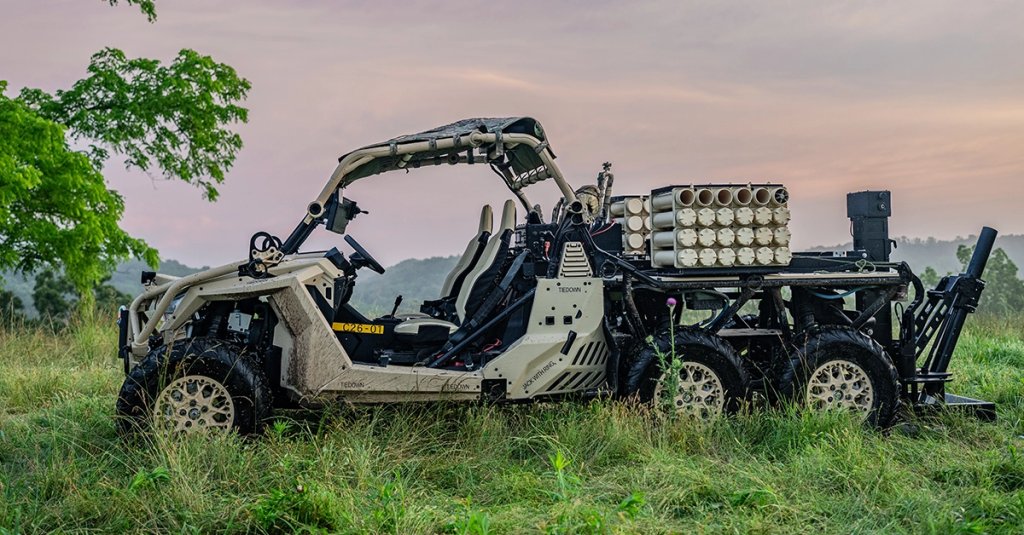
Nobody asked Polaris to build a six-wheeled tactical vehicle that fits inside a helicopter, carries more payload than a Humvee, and can launch loitering munitions before the enemy figures out it left the ground. Then again, nobody had to; however, maybe there were some clues.
Also Read: An ode to the Deuce-and-a-Half: the M35 Cargo Truck
Customers started showing up with problems their four-seater couldn’t solve, and Polaris answered the only way an engineering company knows how: Slap an extra axle on it.
The MRZR Alpha 6×6 is a pre-production prototype, technically speaking. Eight of them exist. They are currently in Norway, Australia, Quantico, and Tampa, which is not the distribution footprint of something anyone is planning to shelves.
Please, Sir, May I Have Some Payload?
Dave Skog, Business Development Manager with Polaris Government and Defense, was standing next to one of them at SOF Week in Tampa when he explained the whole thing in a single sentence.
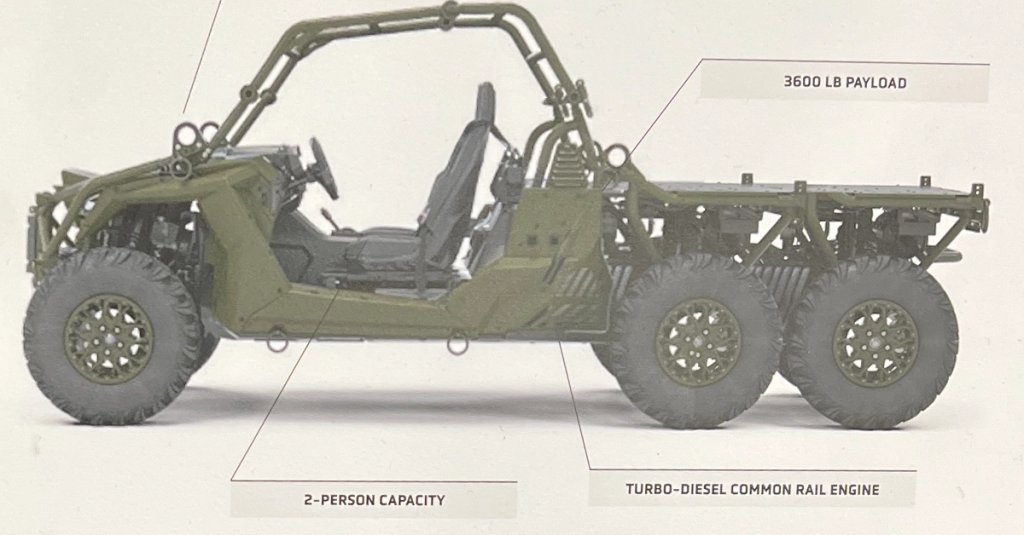
“The front half of the vehicle is all the same as our current SOCOM program of record vehicle, the Alpha 4×4. Basically, we have added an additional axle on the back.”
That is the entire gripping and cinematic origin story. The MRZR Alpha 4×4 is already a proven platform, used extensively by SOCOM. The Marines call theirs the Ultra-Light Tactical Vehicle. The Air Force ordered them as well. They have the parts, the logistics chain is in place, and the maintainers already know the vehicle.
Polaris kept more than 90% parts commonality between the 4×4 and the 6×6, which means the military is not being asked to learn a new vehicle. Only one new axle.
What that axle does to the payload numbers is the kind of thing that makes procurement officers sit up a tad straighter. The standard four-seat Alpha carries 2,000 pounds total, operators included. The 6×6 delivers what the military industrial complex craves: more room for stuff.
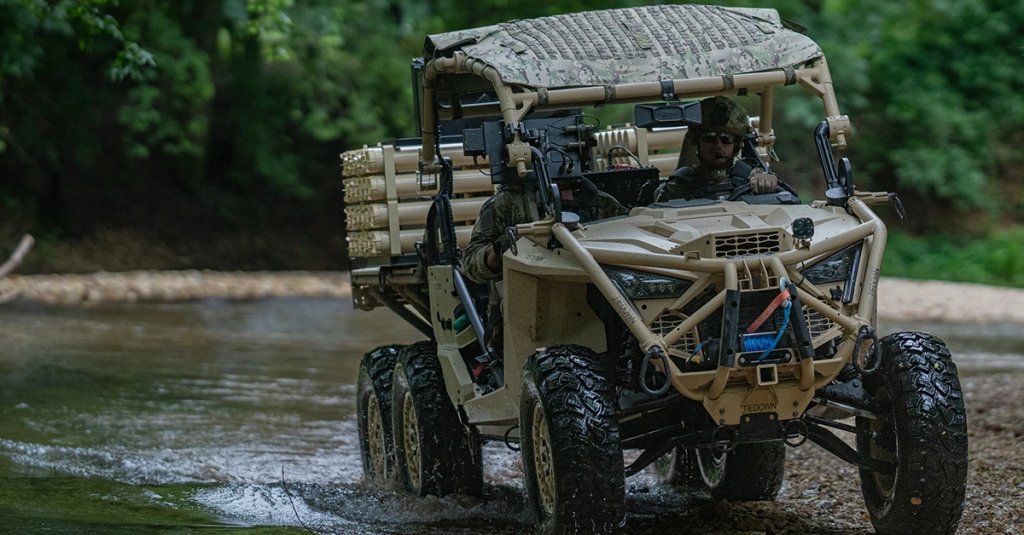
“The 6×6 is 3,000 pounds of capacity on the bed only, and then two 300-pound operators,” Skog said. “So it’s 3,600 pounds total on the vehicle.The cargo bed grows from 50 inches to 84 inches. The vehicle grows eleven inches in total length. That is the rub. Eleven inches for 3,000 pounds of bed payload, a 225-mile maximum range, and a gross vehicle weight that clears the standard M998 HMMWV, while the vehicle itself is a fraction of the size.
The third axle also distributes the vehicle’s weight across six contact points instead of four, dropping ground pressure per tire. Results are a six-wheeled vehicle that actually outperforms the four-wheeled version in soft soil, mud, and the kind of terrain that exists in, say, Norway, where two of the prototypes are currently being evaluated by people who know what Norwegian mud feels like in March.
It still fits inside an MV-22B Osprey. Roll-over protection system folded flat, loaded internally, same as the 4×4 always could. You fly it somewhere no road reaches, drive it off the ramp, and get to work.
All Over the World Already
Eight prototypes may sound like a small number until you consider where they are. Norway, Australia, the Marine Corps Warfighting Laboratory at Quantico. SOF Week in Tampa. USSOCOM’s Program Manager for the Family of Special Operations Vehicles received units earlier this year to begin informing future requirements. The MCWL has been actively experimenting with logistics and precision fires applications.
“They have gone out, and they’re actually all over the world now,” Skog said. “We’ve got a couple of them in Norway, and we’ve got one in Australia. So they’re with customers right now, basically going through that initial phase of trying them to see if they really like them.”
That is what pre-production momentum looks like. This is not a concept render on a trade show poster. The MRZR Alpha 6×6 is a Technology Readiness Level 8 prototype, which means the design is mature, it has been demonstrated in an operational environment, and it is one qualification step from full production. The people evaluating it are not doing so out of curiosity.
What’s in the Back
On the SOF Week floor, the vehicle on display was carrying a launcher, Northrop Grumman’s loitering munition system. Loitering munitions are exactly what they sound like. They go up, they circle, they light a cigarette, get chased by security, find what they are looking for, and then they stop being so patient about it. Skog confirmed the setup without much fanfare.
“That is actually a launcher. It’s called the Jackal. That is a launcher for loitering-type munitions, basically.”
A vehicle small enough for an Osprey, carrying a launcher for self-guided munitions. That is the display. But Skog was careful to keep the frame wide when the conversation turned to what the bed is actually for.
“It could be anything you wanna put on the deck, yeah. 3,000 pounds of whatever that is. So it could be fuel, water, munitions, supplies, you name it.”
That versatility is the whole ballgame. The weapons integration gets the attention at a show like SOF Week, but the logistics case is what keeps programs alive. Future fights will happen on islands, coastlines, and austere terrain where convoy trucks cannot go, and helicopters don’t have unimpeded freedom.
A vehicle that arrives by Osprey can sustain a small unit for days, and transforms into a weapons platform when the mission changes, scratching an itch the military has had for years.
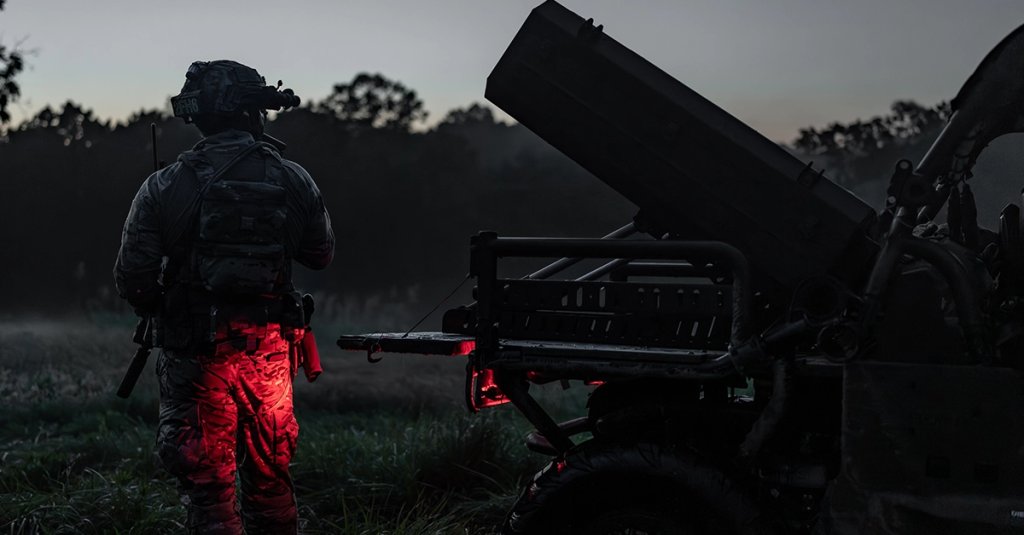
In February 2026, Global Military Products received a contract through the Naval Surface Technology and Innovation Consortium to integrate its Scorpion Light mobile mortar system onto the MRZR Alpha 6×6 for the Marine Corps.
The Scorpion Light deploys, shoots eight rounds, and scoots on out of there in under two minutes, a timeline demonstrated live at Quantico during the Marine Gunners Symposium. Polaris has since been awarded a contract for six additional prototypes specifically to test that integration. Live-fire evaluation by the Marine Corps follows delivery.
Like Peas and Carrots
The MRZR Alpha 6×6 sits between two vehicles that have never fully covered each other’s blind spots. The ultra-light tactical vehicle is fast and mobile, but burns through its payload capacity before the mission does. The Joint Light Tactical Vehicle is capable and protected, but too large to load onto the aircraft that gets small units to the places they actually need to be.
Neither one actually answers the requirement that the unit arrive by air, sustain itself, and generate fires without waiting on heavier assets.
“We have had customers coming to us asking, ‘Hey, I want to put more payload on, my payload is larger, what can you do?'” Skog said. “And this was our best solution to still keep the vehicle small.”
Small enough for the Osprey. Large enough to carry what the mission actually requires. That is the eye of the needle, and the 6×6 threads it cleanly.
No full production decision has been announced as of yet. The evaluations in Norway, Australia, Quantico, and elsewhere are still returning data. That is how this phase of a program works. The military drives something hard, breaks what can be broken, and decides whether the platform earned its place in the inventory.
Eight prototypes across Multiple allied nations with Mortar integration contracts sprinkled on top. But will the new size also come with new restrictions on what can transport it?
“This six-by-six can still go inside a V-22 helicopter,” Skog said, referencing the V-22 Osprey. “You can still fold the ROPS down, internally air transport it, all the same as the current four-seater, but it has the payload capacity and the cube capacity for the bed.”
Six wheels, one Osprey, and 3,000 pounds of whatever the mission dictates.
Don’t Miss the Best of We Are The Mighty
• An Army Infantry Squad Vehicle sells for $1 million to benefit the Medal of Honor Foundation
• The M113 armored personnel carrier was supposed to be obsolete
• Mike Vining on Vietnam, Delta Force, and the sardines he never ate



Loading comments…
Comments couldn’t be loaded. Please refresh the page.