
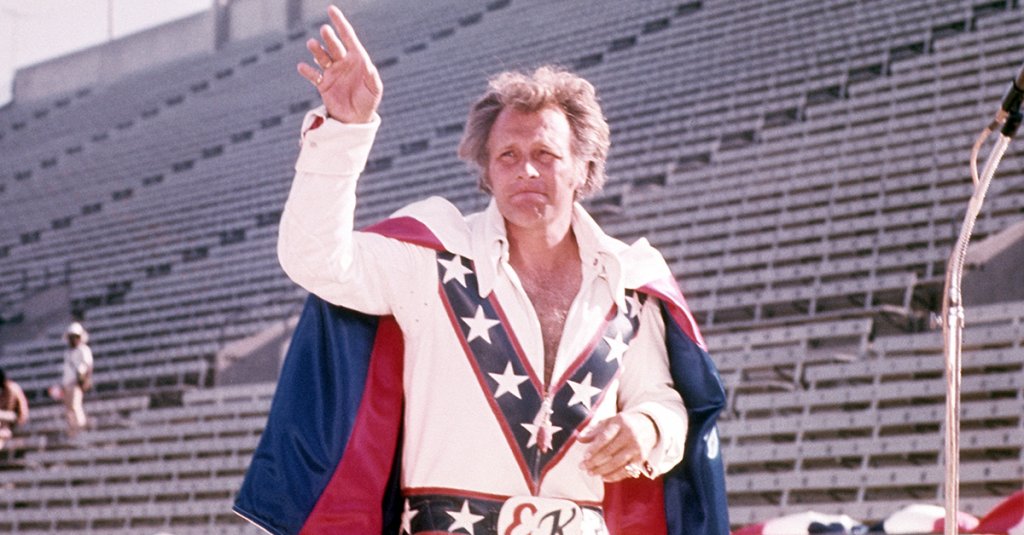
Robert Knievel was in his late teens, and he already faced a crossroads.
It was of his own making. Hell-bent on testing the limits of authority, Knievel ran afoul of the authorities in his native Montana several times. The judicial system finally tired of Knievel’s criminal antics and offered him a choice: Spend time in prison or enlist in the military.
Also Read: History Channel doc revisits boxing’s most politically charged rivalry
While Knievel was a troublemaker, he was not dumb. He joined the United States Army and became a paratrooper. When he got out, Knievel announced himself in a big way, becoming arguably the greatest daredevil America has ever produced.
Never Down for Long
Knievel’s career as a motorcycle jumper began in 1965 in Washington state when he leapt over a box of rattlesnakes and a couple of mountain lions. For the next decade-plus, Knievel developed a huge national following as his death-defying jumps became more outrageous.
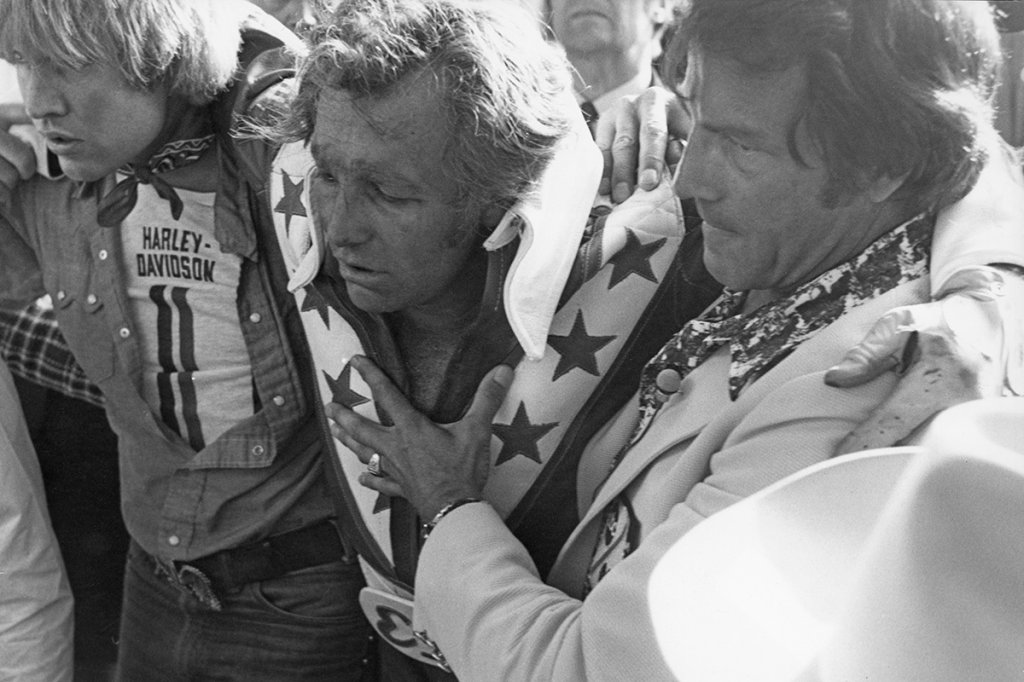
By one account, Knievel attempted 175 jumps during his career, and a good number of them resulted in significant bodily harm. Knievel wouldn’t (or couldn’t) quit. When Knievel crashed while trying to soar above 13 single-decker buses at Wembley Stadium in London in 1975, he sustained severe pelvis and back injuries. Still, a determined Knievel walked away without the use of a stretcher.
“I never thought I was a failure unless I didn’t try to get up after a crash,” Knievel told Maxim magazine in an interview in 2007. “Kids come up to me all the time and say, ‘Once I was going through a really bad time and I saw you crash and get up, and it inspired me.’”
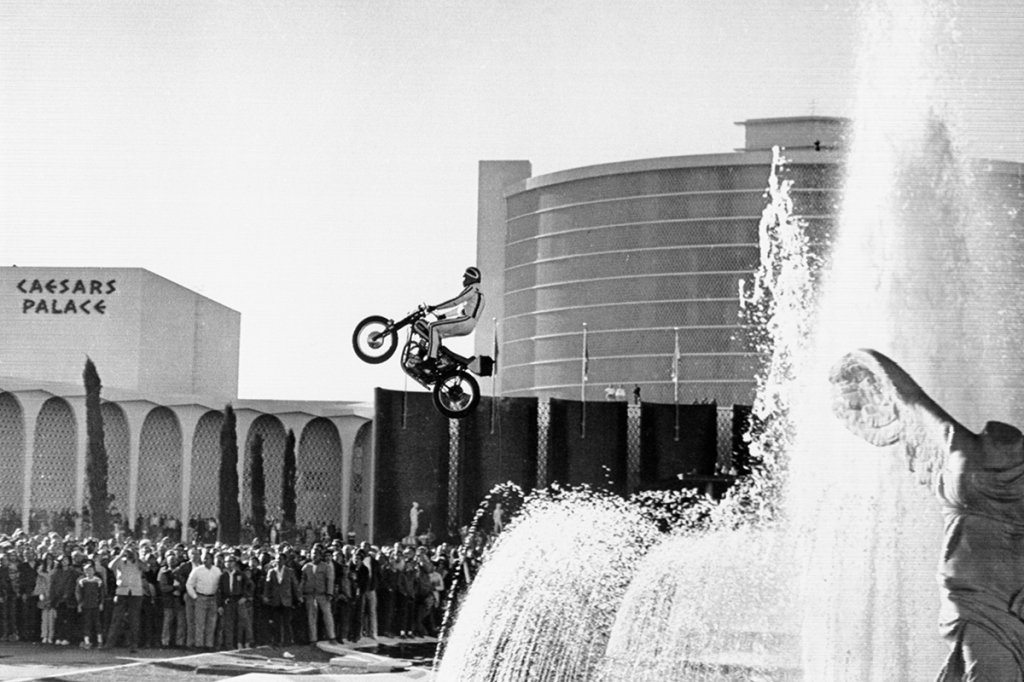
Some crashes are so bad, however, that it is impossible to get up. Knievel stayed down after one of his most well-known stunts. Doctors told the daredevil his career was likely over after a jump at Caesars Palace in Las Vegas on December 31, 1967, went horribly wrong. The crash’s impact crushed Knievel’s pelvis and upper leg (among other injuries) and left him with a concussion so severe that he was in a coma for a month.
After Knievel regained consciousness, it wasn’t long before he couldn’t wait to fly through the air again.
A Body Battered and Beaten
A website devoted to Knievel’s career includes a chart depicting all of the injuries he incurred. Beside a picture of Knievel’s body, a quote is attributed to the ultimate thrill seeker in which he says he broke 35 bones and underwent 14 surgeries during his career.
“I forget all of the things that have broke,” Knievel said.
Along his way to becoming infinitely familiar with the inside of emergency rooms, Knievel created some indelible memories for his fans. There was seemingly no object over which Knievel—given the right circumstances and payday—would not jump. Knievel’s motorcycle carried him over not only fountains, but also cars, delivery trucks, and buses. The Harley-Davidson XR-750 that propelled Knievel above 50-plus stacked cars in Los Angeles in 1973 actually resides in the Smithsonian Institution.
Knievel became a frequent presence on television, and his willingness to push boundaries made him believe anything was possible.
Even jumping the Grand Canyon.
The Snake River Canyon Jump

Evel Knievel's Jump at Snake River | Pure Evel: American Legend
For years, Knievel longed to jump in the Grand Canyon, one of the United States’ most recognizable national landmarks. He even hired a high-priced lawyer to advocate his case.
In the end, though, the U.S. government refused to approve Knievel for the jump. Responding to the rejection, he pivoted quickly to an alternate location: the Snake River Canyon. Knievel spared little expense. He paid $35,000 to lease 300 acres in Idaho and hired an aeronautical engineer to develop a steam-powered rocket.
Knievel attempted to fly over a 1,600-foot gap in the canyon on September 8, 1974, but his parachute deployed prematurely. The mishap caused him to land on the same side of the canyon from which he launched. It was a disappointing outcome for such a highly publicized event.
A few more jumps followed, leading to a planned attempt in January 1977 that put the phrase “jumping the shark” into our pop culture lexicon. Inspired by the movie “Jaws,” Knievel intended to soar over a tank holding 13 sharks in Chicago. The attempt was called off after a practice crash in which Knievel broke both arms after striking a cameraman. The cameraman lost an eye.
Legal Troubles
That incident ended Knievel’s career.
Knievel achieved a level of adulation he couldn’t have imagined in his younger years. The man whose exploits helped sell millions of toys during the 1970s remained an enigma for much of his life.
Knievel courted trouble sometimes as much as he did danger. Early in his daredevil career, the FBI suspected him in several beatings although it never charged him. Then, less than a year after his retirement, a judge sentenced Knievel to six months in jail and three years of probation after he attacked his former press agent with a bat.
After Knievel died in 2007, at the age of 69, that same press agent sued his estate for more than $64 million.
Knievel—who also ran afoul of the IRS— lived his life a certain way and, right or wrong, made no apologies.
“You can’t ask a guy like me why,” Knievel told Maxim in 2007. “I wanted to fly through the air. I was a daredevil, a performer. I loved the thrill, the money, the whole macho thing. All those things made me Evel Knievel. Sure, I was scared. You got to be an ass not to be scared, but I beat the hell out of death.”
Don’t Miss the Best of We Are The Mighty
• Army staff sergeant makes NFL history during draft
• When the Secret Service shot at an Army helicopter at the White House
• Ola Mize became ‘the Audie Murphy of the Korean War’ by fighting off a Chinese division
Featured


Loading comments…
Comments couldn’t be loaded. Please refresh the page.